

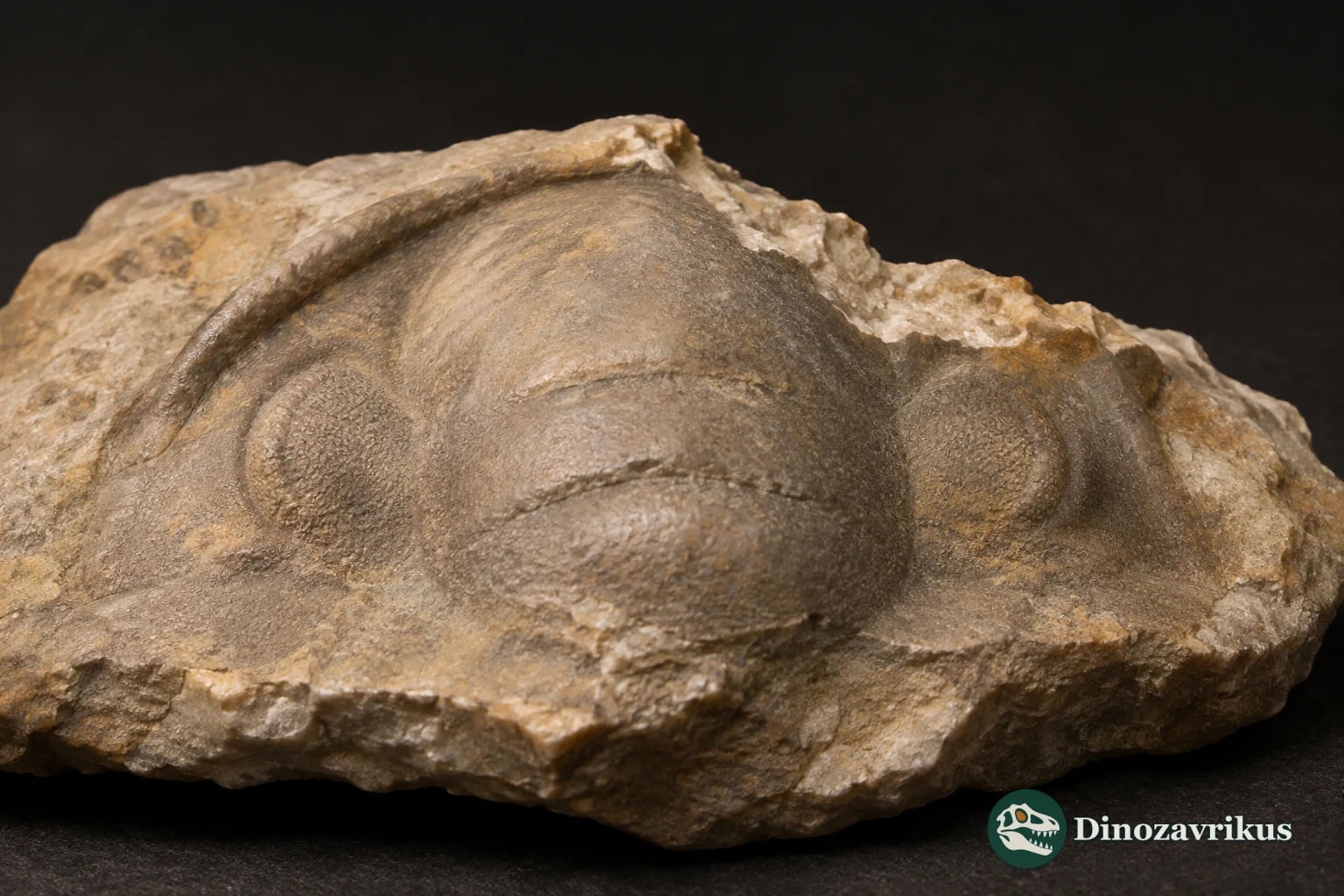
A broken front margin makes the type species of Burnetiella hard to compare with other members of the genus. The fragment from Texas preserves much of the central head shield. In more complete specimens from Oklahoma, the length of the rim is one of the clearest ways to tell similar forms apart.
Quick facts
| Group | Trilobites |
|---|---|
| Age | Late Cambrian, Furongian |
| Region | North America (United States) |
| Diet | Unknown |
| Type species | Burnetiella urania |
| Type specimen | Cranidium USNM 23861a, Texas |
What can the fossils tell us?
The Texas cranidium of B. urania preserves part of its anterior border. The missing edge prevents a reliable comparison of its full length with Oklahoma specimens.
In the measured sample, the front border is 57–66% as long as the glabella. The proportion compares parts of a cranidium and gives no direct measurement of body length.
Pygidia assigned to the genus show a relatively narrow axis with five rings and a concave border. The holotype of B. urania contains no tail shield.
From Ptychoparia to Burnetiella
Charles Doolittle Walcott described the Texas species as Ptychoparia? urania in 1890 and later placed it in Burnetia. Christina Lochman established Burnetiella in 1958 with this species as its type.
The holotype, USNM 23861a, is a cranidium from the Morgan Creek Member of the Wilberns Formation. Stephen Westrop and colleagues found the anterior part incomplete when they restudied the specimen in 2010. They restricted the name B. urania to the holotype. Wilbernia is another trilobite recorded from the Wilberns Formation, which spans several fossil-bearing horizons.
A measurable difference in Oklahoma
In Burnetiella exilis, the front border is long and tongue-shaped. Its average length is about 61% that of the glabella, the raised central part of the head shield. The border slopes forward near the furrow, then flattens towards the edge. A second form tentatively assigned to Burnetiella has a shorter border, about 47% of glabellar length. Both were recovered from the Honey Creek Formation.
The revision transferred the holotype formerly called Burnetia ectypa to Burnetiella exilis. It also found that the cranidium originally designated as a paratype of B. pennsylvanica belonged to a different, unidentified species of the genus. Those reassessments show the value of examining individual pieces rather than relying on old identifications.
The evidence from the tail shield
An unusually narrow axis with five rings and a concave border distinguish pygidia assigned to this genus. Head shields share several features with related dokimocephalids, including a very short area between the glabella and the front border furrow. The shape of the front sutures and the details of the pygidium help distinguish the genera.
An isolated tail shield or cranidium preserves valuable anatomy. The material described for these comparisons offers no reliable whole-body length or direct indication of diet.
Frequently asked questions
What is the type species of Burnetiella?
It is Burnetiella urania. Walcott named the species in 1890, and Lochman made it the type of Burnetiella in 1958.
Why is the Texas type difficult to compare?
Its front margin is incomplete. The curvature and full length of that margin are among the features used to distinguish closely similar forms.
What identifies the Oklahoma species B. exilis?
Its long, rounded front border measures 57–66% of the total glabellar length in the sample used for comparison.
Which features distinguish the pygidium?
It has a comparatively narrow central axis with five rings and a concave border.