

Caiuajara dobruskii was described from a rich pterosaur bonebed in Paraná, Brazil. Fossils of different sizes offer an unusual view of skull crest changes during growth. The bones accumulated in an interdunal lake setting. A 2024 revision identified another pterosaur genus in the same assemblage, so the entire original sample cannot simply be counted as Caiuajara.
Quick facts
| Scientific name | Caiuajara dobruskii, Manzig and colleagues, 2014 |
|---|---|
| Locality | Cruzeiro do Oeste, Paraná, Brazil |
| Burial setting | Interdunal lake in an ancient desert |
| Holotype | CP.V 1449, partial skeleton including skull |
| Group | Tapejarid, a toothless crested pterosaur |
| Original sample | At least 47 individuals under the 2014 assignments; subsequently revised |
| Age | Cretaceous; more precise dating debated |
What can the fossils tell us?
The 2014 description counted dozens of pterosaurs of different sizes. Shared burial is observed; social behaviour in life is inferred.
Smaller skulls had lower crests than larger ones. Growth comparisons need the identities of specimens checked after revision.
The 2024 study named Torukjara from the bonebed and reassigned some earlier specimens. CP.V 1449 remains the Caiuajara holotype.
Young and large individuals occur together, but the deposit does not itself document nests, eggs or the exact age of first flight.
Discovery at Cruzeiro do Oeste
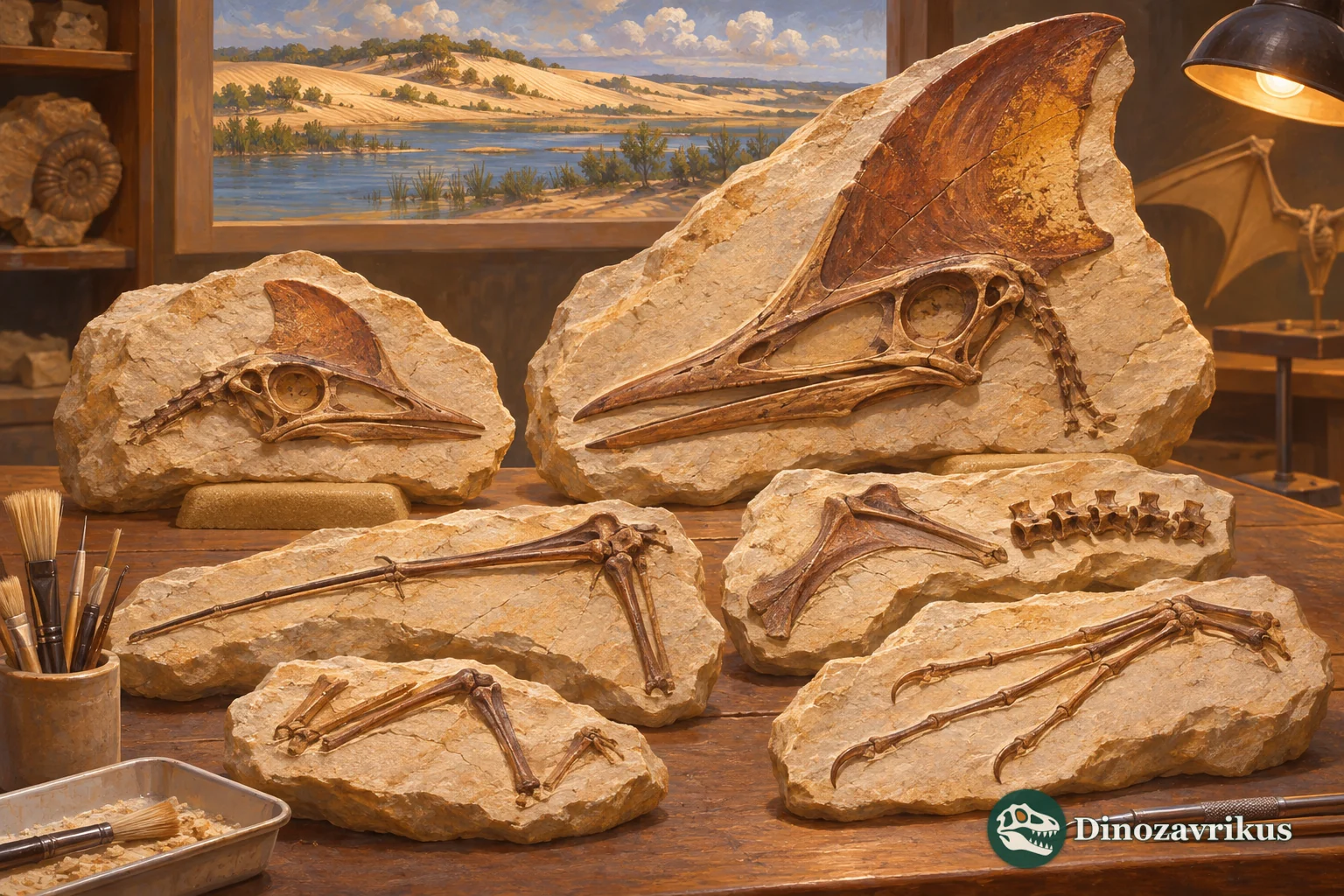
Alexandre Dobruski and his son João discovered the fossil-rich site near Cruzeiro do Oeste in 1971. Paulo Manzig and colleagues named Caiuajara dobruskii in 2014, honouring Alexandre Dobruski. The type specimen CP.V 1449 includes a skull, lower jaw and other skeletal elements.
The deposit formed around water among desert dunes. The original paper assigned it to the Goio-Erê Formation and proposed a Late Cretaceous age by regional correlation. Later studies questioned the formation assignment and narrower date. A Cretaceous age is safer than a fixed stage for this locality.
Skull crest and growth
Caiuajara was a toothless tapejarid with a conspicuous cranial crest. In the originally assigned sample, smaller skulls bear lower and differently angled crests than larger skulls. This series provided evidence for growth-related change. The 2014 paper estimated wingspans of about 0.65 to 2.35 metres across sampled individuals, rather than a single adult size.
Sinopterus offers a tapejarid comparison, but its fossils do not replace the Caiuajara growth series. Pterodaustro is another South American pterosaur from a different lineage, with unlike jaws.
The 2024 reassessment
The original count of at least 47 individuals included all bones then identified as Caiuajara. A 2024 revision recognised Torukjara in the same bonebed and reconsidered several assignments. It reassigned the well-preserved skull CP.V 8175, described in 2022 under Caiuajara, to Torukjara. The name Caiuajara dobruskii remains anchored to CP.V 1449.
Because the assemblage contains more than one taxon, its original total is not a revised census of Caiuajara alone. Growth studies and behavioural proposals should take the identity of each specimen into account.
What a bonebed can show
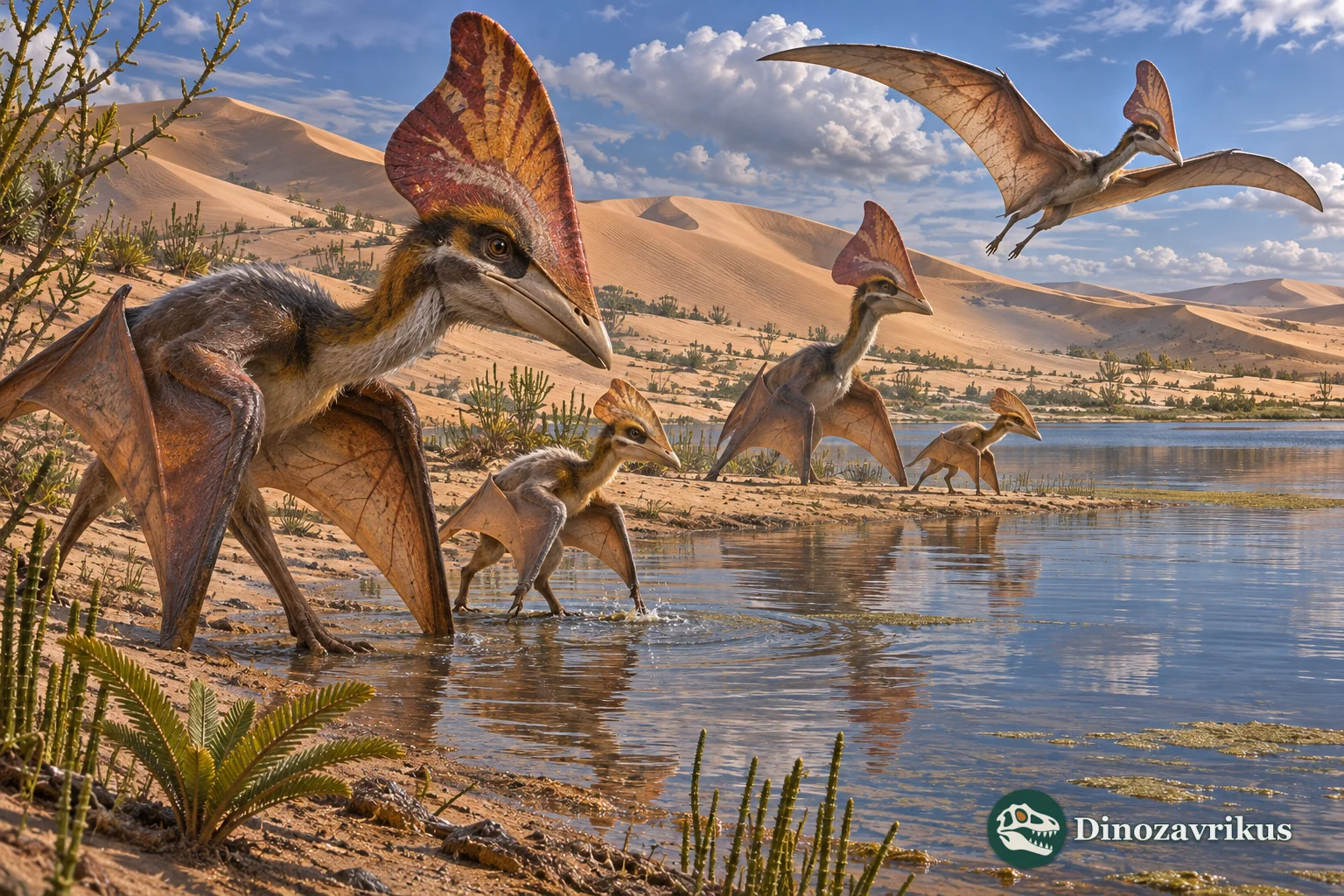
The first description proposed that individuals of different ages might have lived in groups or colonies. Their shared burial is real evidence, yet transport and repeated accumulation could affect the deposit. No nest or egg of Caiuajara has been demonstrated there. The onset of flight and exact social behaviour cannot be read directly from the bones.
A plant-based diet is sometimes proposed by comparison with other tapejarids, but direct gut contents have not established it for this species. A scene of a group at a lake remains a reconstruction of plausible setting, not observed behaviour.
Frequently asked questions
Why is the number 47 qualified?
It was the original count for material then assigned to Caiuajara. A 2024 revision attributed some fossils to another genus or left them uncertain.
How did the crest change with growth?
Smaller skulls in the original series had lower crests; larger ones had taller crests. Each specimen's identity must be checked after revision.
Are Caiuajara nests known?
No. Mixed ages prompted a colony hypothesis, but the bonebed has not yielded documented eggs or nests of this species.
When did Caiuajara live?
The fossils are Cretaceous. Their narrower geological age remains disputed because the local rock-unit assignment is debated.