

Calvinella was a Late Cambrian trilobite. Its type species has a slender occipital spine rising from the back of the head shield. The central lobe of the head is elongated and the area directly in front of it lacks a distinct transverse division. Researchers compare these features across fossil sites. Other trilobites carried similar spines, so the rest of the shell matters in an identification.
Quick facts
| Group | Trilobites, placed in Dikelocephalidae by some authors |
|---|---|
| Age | Late Cambrian, Furongian |
| Region | North America and Asia |
| Diet | Unknown |
| Type species | Calvinella spiniger |
| Material | Cranidia, free cheeks and tail shields |
What can the fossils tell us?
The type head shield preserves a long midline spine just in front of the joint between the head and trunk.
The frontal area, spine, free cheeks and grooves on the tail shield can be compared with those of the type species.
Individual traits of Calvinella occur in other genera. The relationships of all the species placed in Calvinella remain open to revision.
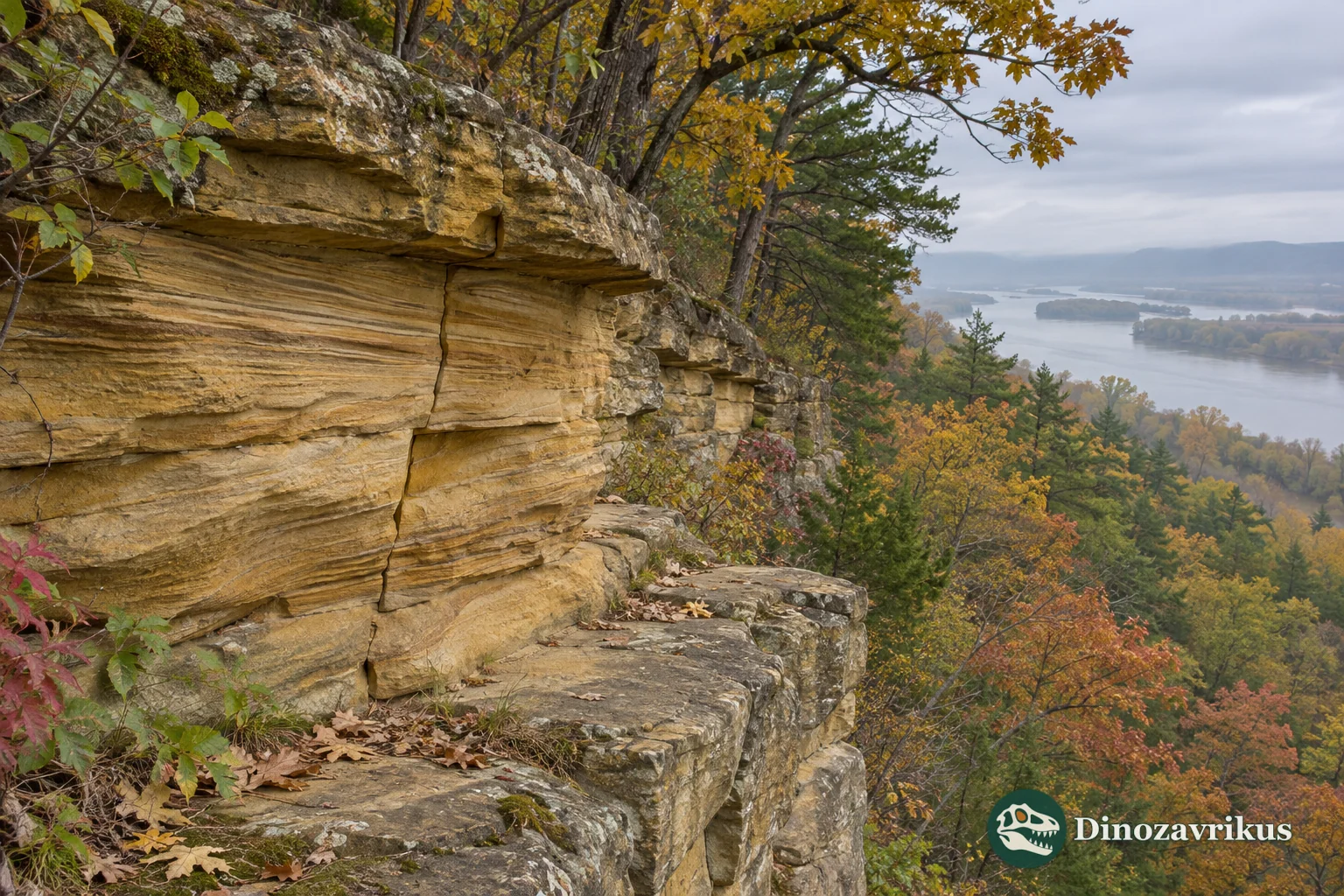
Type material from Wisconsin
James Hall described the species in 1863 under the name Dikelocephalus spiniger. Charles Walcott established Calvinella in 1914. The type material came from Late Cambrian sandstones around Trempealeau, Wisconsin. The lectotype, AMNH 341A, is a cranidium. The original tail shield, AMNH 341B, is preserved as a separate piece.
Additional fossils came from the base of the Jordan Sandstone near Arcadia. The cranidia and tail shields were compared with C. wisconsinensis. The material supported a comparison with that species and was assigned to it tentatively.
What the occipital spine shows
The spine extends from the rear ring of the glabella, above the junction of head and trunk. In the Arcadia material it is slender and slopes upwards. The slightly convex area in front of the glabella lacks a pronounced transverse division into a brim and border.
The lateral portions of the tail shield are divided into bands of unequal width. Comparable features help palaeontologists sort isolated shields in other Late Cambrian genera such as Briscoia. Stephen Westrop's comparisons of Calvinella considered the cranidium, free cheeks and tail shield together.
Records from North America and Asia
Beyond the United States, Calvinella has been described from Cambrian rocks in Alberta, Canada. Northern Vietnam has yielded material identified as C. walcotti, and the genus also gave its name to part of a Late Cambrian fossil zone in northern China. These are separate occurrences, and any comparison with the Wisconsin type species depends on which features are preserved.
Frequently asked questions
Where was the type species found?
It was collected in Late Cambrian sandstones near Trempealeau, Wisconsin, United States.
Where was the occipital spine?
It projected from the back of the head shield, along the midline. Cheek spines, where present, sit to either side.
What is specimen AMNH 341A?
It is the cranidium selected as the lectotype of Calvinella spiniger.
Can a spine by itself identify Calvinella?
Other trilobites also carried occipital spines. Identification uses details of the head, cheeks and tail in combination.