

Cameroceras is an Ordovician endocerid, a cephalopod with a long, straight shell. It is often pictured as a multi-metre marine predator, but the fossil record is stronger for shell construction and the internal siphuncle than for total length or behaviour.
Timothy Abbott Conrad named the genus in 1842; its type species is Cameroceras trentonense. Because large shells are fragmentary, many length claims extend an incomplete cone. The Ordovician Period guide sets these cephalopods in their geological context.
Quick facts
| Scientific name | Cameroceras Conrad, 1842 |
|---|---|
| Type species | Cameroceras trentonense Conrad, 1842 |
| Group | Cephalopoda, order Endocerida |
| Age | Mainly Middle to Late Ordovician |
| Fossil evidence | Fragmentary straight shells and large siphuncles |
| Maximum length | Extrapolated estimates are not measurements of a complete shell |
| Ecology | Marine cephalopod; exact swimming and prey are unknown |
| Limit | No accessible specimen confirms the often repeated 10 m claim |
What can the fossils tell us?
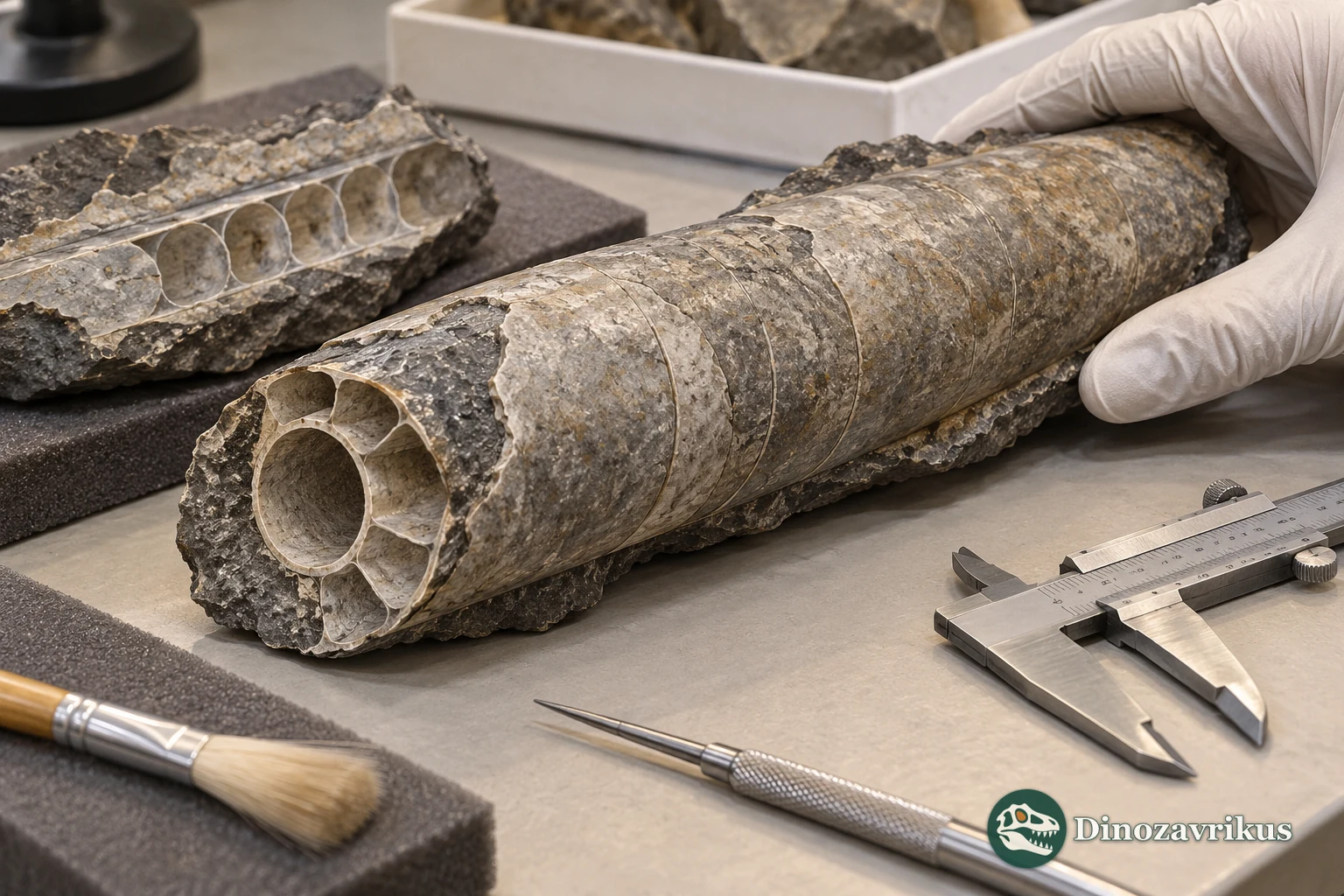
Fossils show a long, straight shell divided by transverse septa. Most specimens are fragments, so total length is commonly extrapolated rather than measured on a complete individual.
The siphuncle could occupy a large share of the shell diameter and lay near its margin. Endocones and other siphuncular deposits provide systematic characters, although internal details are not known for every named species.
A recent review notes a roughly 3 m endocerid shell fragment in a museum collection and an extrapolated total length of about 5.7 m for that specimen under an assumed body-chamber proportion. A 10 m report lacks an available specimen or photograph.
The chambered shell and siphuncle support identification as a cephalopod. Buoyancy, orientation, diet and behaviour are inferred from comparative anatomy and context; soft parts of Cameroceras do not directly establish them.
Name and limits of the genus
Conrad described Cameroceras from material associated with the Trenton Limestone of North America. Later authors applied the name broadly to large straight-shelled endocerids that shared a general outline. Revisions distinguish forms through the position of the siphuncle, septa, endocones and other internal characters. Historical records and especially record-size claims therefore need to be tied to a specimen and a taxonomic concept.
Cameroceras is usually placed in Endocerida and Endoceratidae, although classifications differ at higher ranks among nautiloid cephalopods. The robust observation is the large internal tube characteristic of endocerids.
Chambered shell and siphuncle
The straight conch was divided by transverse septa into chambers. The animal occupied the outer body chamber at the broad end, while older chambers remained behind. The siphuncle crossed the septa and could be very broad in mature parts of the shell. Endocones – nested cone-shaped deposits inside the siphuncle – help distinguish endocerids.
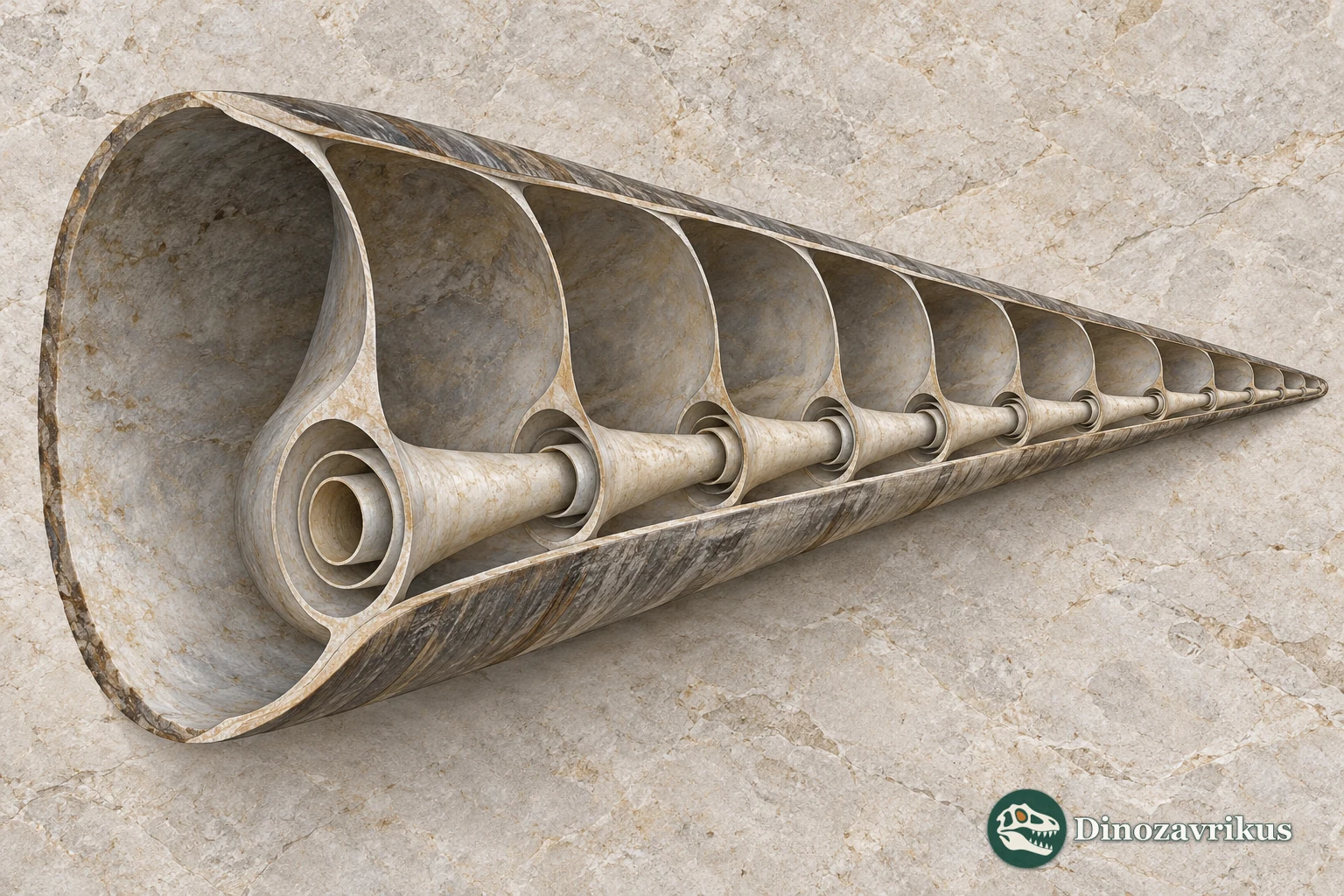
Not every fragment preserves this architecture. Some fossils retain the outer shell, while others are internal casts of a siphuncle or the base of an endocone. These remains require care: an internal tube can resemble the entire shell of a smaller genus.
Ordovician age and fossil localities
Well-supported records of Cameroceras are concentrated in the Middle and Late Ordovician of North America. The genus is known from the Trenton Group of New York and nearby regions, as well as younger Ordovician strata in the Cincinnati region and the upper Mississippi valley. Putative early representatives have been described from the Middle Ordovician of Utah. Isolated later reports do not by themselves demonstrate a long, continuous range.
Fossils occur in marine limestones and shales. Limestone may preserve the shell’s shape, whereas shale can flatten it. The bed position and associated fossils constrain the age and environment of a particular specimen; the shell alone does not reveal exact depth or current strength.
What can be said about length?
Large endocerid shells rank among the largest known cephalopod shells. A measured fossil fragment and a reconstructed total length are different quantities. A recent review identifies a fragment about 3 m long in a museum collection; an estimated total length of about 5.7 m for that individual assumes a particular proportion for the body chamber. That is an extrapolation, not a measurement of a complete animal.
Popular claims of a 10 m Cameroceras trace to an unverified report: the specimen was not preserved, published or photographed. Without it, neither the identification nor the measurements and reconstruction can be checked. It is more accurate to describe the shells as gigantic but mostly incomplete and to separate preserved dimensions from calculated ones.
Life and reconstruction
The chambered shell and siphuncle invite comparison with other cephalopods. The animal may have adjusted its position in the water using its chambers and soft siphuncular tissues, while a funnel probably powered jet propulsion. However, the genus has not yielded enough soft parts to establish body orientation, speed, prey or hunting method.
The shell outline is based on fossils. Arms, eyes, colour and posture are comparative reconstruction rather than direct evidence. Cameroceras appears in the Early Palaeozoic marine fossil catalogue, alongside taxa from different groups and Ordovician settings.
Frequently asked questions
When did Cameroceras live?
Well-supported records are mainly Middle and Late Ordovician. Isolated later mentions need to be checked against their source material.
Was Cameroceras 10 metres long?
A 10 m length is not confirmed by an available specimen. A recent estimate near 5.7 m extrapolates from a roughly 3 m shell fragment and depends on assumed proportions.
How was Cameroceras different from Endoceras?
Both names refer to large endocerids. Their distinction depends on shell and siphuncle characters, not simply on a straight outline or size.
Do we know what it hunted?
No direct evidence identifies specific prey. Shells and marine strata do not preserve stomach contents, hunting traces or an exact diet.