

Carolinites is an Ordovician trilobite genus in Telephinidae. Large eye surfaces and elongated palpebral lobes give some species a distinctive head outline. Its best-known species, C. genacinaca, has been reported from every Ordovician paleocontinent. That distribution helped inspire a hypothesis of life and dispersal in the upper water column, but geography alone cannot show exactly how the animal moved.
The Tasmanian type species and the geographically widespread C. genacinaca have different taxonomic histories. The genus is included in the ancient arthropod catalogue and lived during the Ordovician.
Quick facts
| Scientific name | Carolinites Kobayashi, 1940 |
|---|---|
| Type species | C. bulbosus; later synonymized with C. tasmaniensis in a 1985 revision |
| Group | Trilobita; Telephinidae |
| Age | Ordovician; C. genacinaca is Lower Ordovician |
| Type region | Caroline Creek, Tasmania |
| Best-known species | C. genacinaca, reported from all Ordovician paleocontinents |
| Life setting | Upper-water-column hypothesis; not directly observed |
What can the fossils tell us?
The type species is C. bulbosus from Caroline Creek, Tasmania. Jell and Stait’s 1985 revision treated C. tasmaniensis as a senior synonym of C. bulbosus and C. genacinaca nevadensis. This does not erase the separate history of Ross’s C. genacinaca.
McCormick and Fortey found similar morphometric samples from Alberta, Spitsbergen and Australia when compared with western US material. A small number from Siberia and central China differed; preservation, photography or real disparity remained possible explanations.
An epipelagic life has been proposed from functional morphology, analogy with modern pelagic crustaceans and geological occurrence. These lines support an interpretation, not a direct observation of swimming depth or behaviour.
In a studied succession, measured characters varied, shifted abruptly and sometimes reversed. The authors found no sustained directional trend in their tests; the conclusion is limited by sampling and stratigraphic resolution.
From Tasmania to a species from Utah
Kobayashi established Carolinites in 1940 using trilobites from Caroline Creek, Tasmania. The early material carried several names. Jell and Stait’s 1985 revision compared those specimens and treated Carolinites tasmaniensis as a senior synonym of the type species C. bulbosus and of C. genacinaca nevadensis. Nomenclatural revisions matter because old species lists can count multiple names for one diagnosed form.
Ross described C. genacinaca in 1951 from the Garden City Formation of northeastern Utah. Later reports from distant regions made this species central to discussion of trilobite dispersal. Not every remote fragment is an unquestioned match: some old identifications remain tentative, and Siberian and Chinese material deserves further sampling.
Large eyes and a possible life above the seafloor
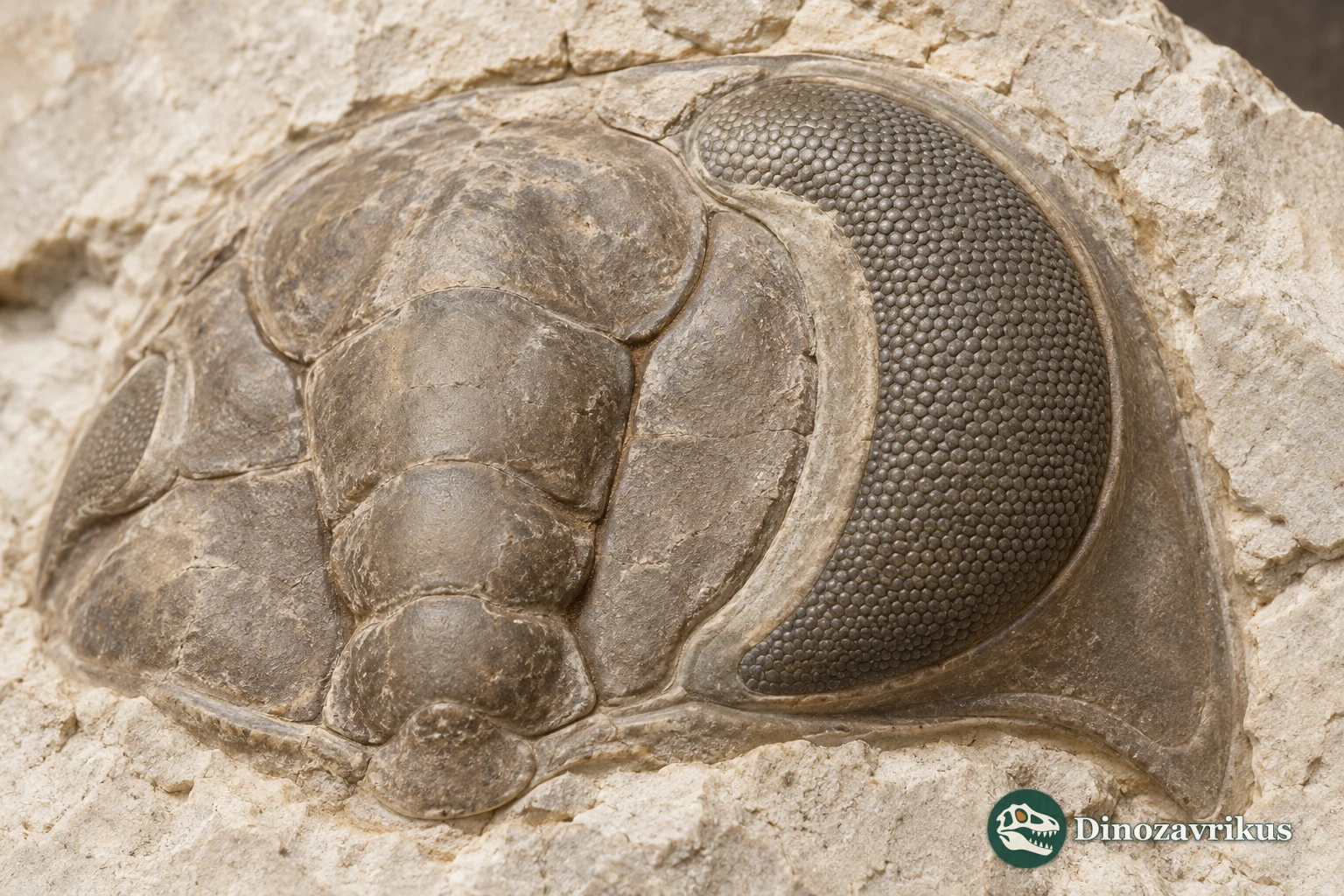
The eye surfaces cover a large part of the free cheeks in some species. Their shape and position contributed to the proposal that Carolinites genacinaca spent at least part of its life in the water column rather than living only on the seabed. The epipelagic interpretation combines functional morphology, analogy with modern swimming crustaceans and the geological distribution of the fossils.
This is a multi-part argument, but it remains an ecological reconstruction. Eye geometry cannot directly reveal swimming speed, precise depth or feeding behaviour. No fossil records the trilobite swimming. It is more accurate to describe an epipelagic hypothesis than a demonstrated way of life.
One species across a widely separated world
McCormick and Fortey compared head-shield proportions of C. genacinaca from the western United States with samples from Alberta, Spitsbergen and Australia. The material was morphometrically similar in the comparisons they made, including specimens from distant parts of the known range. This supported the hypothesis that one species had dispersed broadly.
The pattern was not uniform. A small number of specimens from Siberia and central China differed in cranidial proportions. The authors could not tell whether preservation and photographic technique caused the differences or whether the animals were genuinely more variable. With more material, those alternatives could be tested. Distant dots on a map therefore do not automatically establish every specimen as C. genacinaca.
Testing change through a Utah sequence
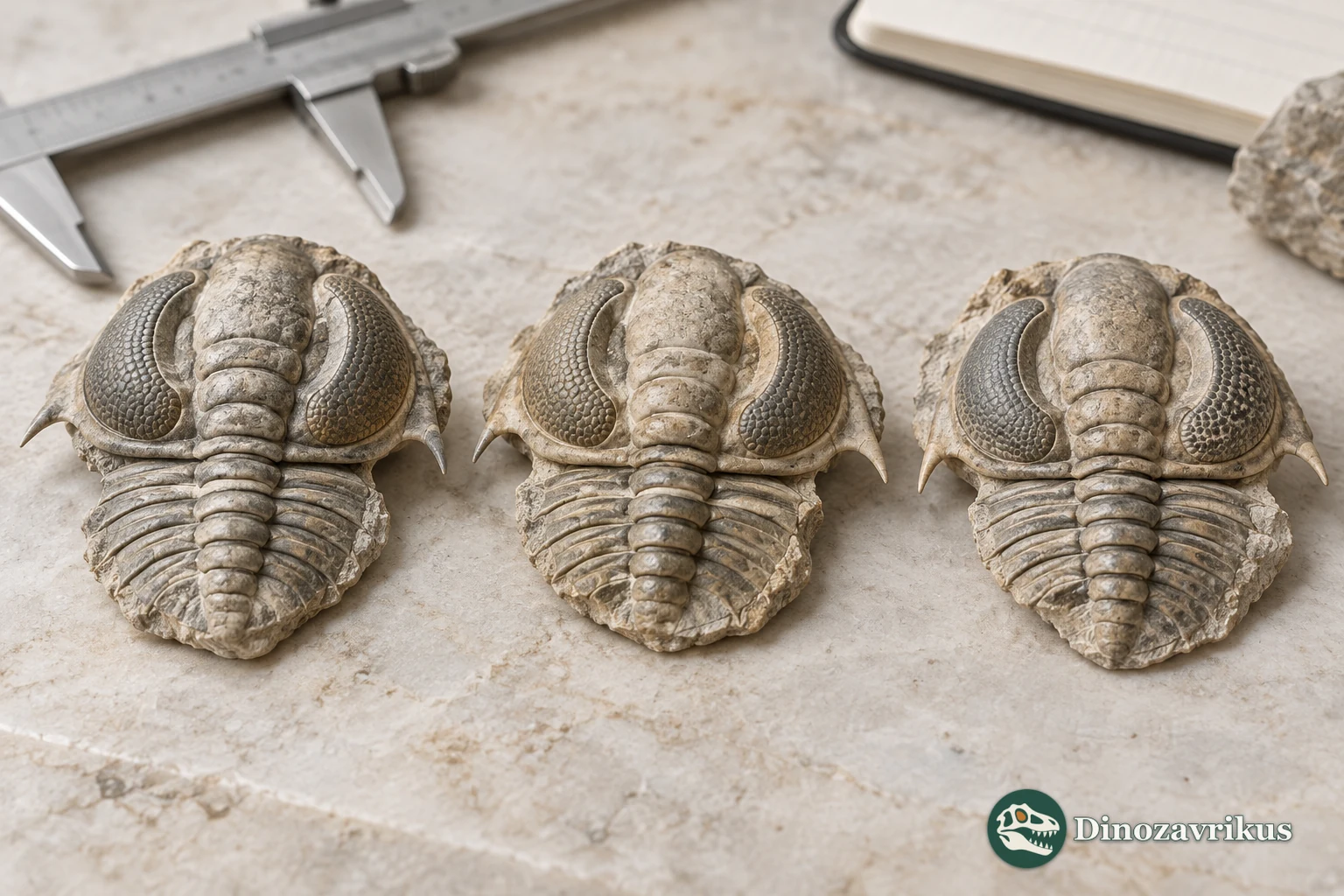
In a separate study, McCormick and Fortey used C. genacinaca through a Utah succession as a test case for microevolution in a fossil lineage. They measured several head-shield characters rather than treating one dimension as the full history of the animal.
The measured traits did not change in lockstep. Some fluctuated, shifted abruptly or returned toward earlier states. The authors found no sustained directional trend among the characters in their tests. That result applies to the sampled interval and its stratigraphic resolution; it does not mean the genus never evolved or that every population was identical.
What fossils cannot yet settle
Fossils securely preserve the mineralized shields, including the eye-bearing regions, and allow quantitative comparisons among localities and layers. They do not preserve the exact colours, soft tissues, feeding choices or daily behaviour discussed in reconstructions. Even the proposed life in the upper water column rests on indirect evidence rather than a single decisive feature.
The cover is an imagined marine scene, not a photograph of a museum specimen. Colour, posture and soft-body details are illustrative. The eye close-up and measurement scene also explain research questions; they do not document actual fossils.
Frequently asked questions
When did Carolinites live?
The genus is known from Ordovician rocks. The particularly wide-ranging C. genacinaca is Lower Ordovician, while other species have their own occurrence intervals.
Was Carolinites found on every ancient continent?
C. genacinaca has been reported from all Ordovician paleocontinents. Some distant specimens differ in shape or are tentative, so the claim concerns the documented species record and remains open to refinement.
Did Carolinites swim in the water column?
An epipelagic lifestyle has been proposed from morphology, analogy and fossil distribution. It is a supported hypothesis, not direct evidence of a precise swimming depth or behaviour.
How did researchers test changes in its shape?
McCormick and Fortey compared measured characters through a Utah succession. They found fluctuations and shifts but no sustained directional trend among the traits tested in that sampled sequence.