

Castillomys was a small extinct murid rodent known mostly from cheek teeth. Its record spans the Pliocene and early Pleistocene. Species comparisons use millimeter-scale tooth size alongside the connections between cusps on the chewing surface. The cover is an artistic reconstruction; a tooth series does not preserve fur or complete body proportions.
At Spanish sites, its fossils occur near those of other small mammals, including Mimomys and Allophaiomys. Co-occurrence in a sediment layer does not make them close relatives or reveal their exact diets.
Quick facts
| Family | Muridae |
|---|---|
| Type species | Castillomys crusafonti Michaux, 1969 |
| Type locality | Layna, Spain |
| Age | Pliocene to early Pleistocene |
| Main fossils | Tiny molars and some jaw fragments |
| Barranco de los Conejos | C. rivas teeth from a horizon around 1.8 million years old |
What can the fossils tell us?
Researchers compare tooth size and longitudinal crests. One isolated molar may lack the full combination needed for a secure species name.
A revision proposed the sequence gracilis–crusafonti–rivas based on population changes. It is an evolutionary inference, not a recovered parent-child chain.
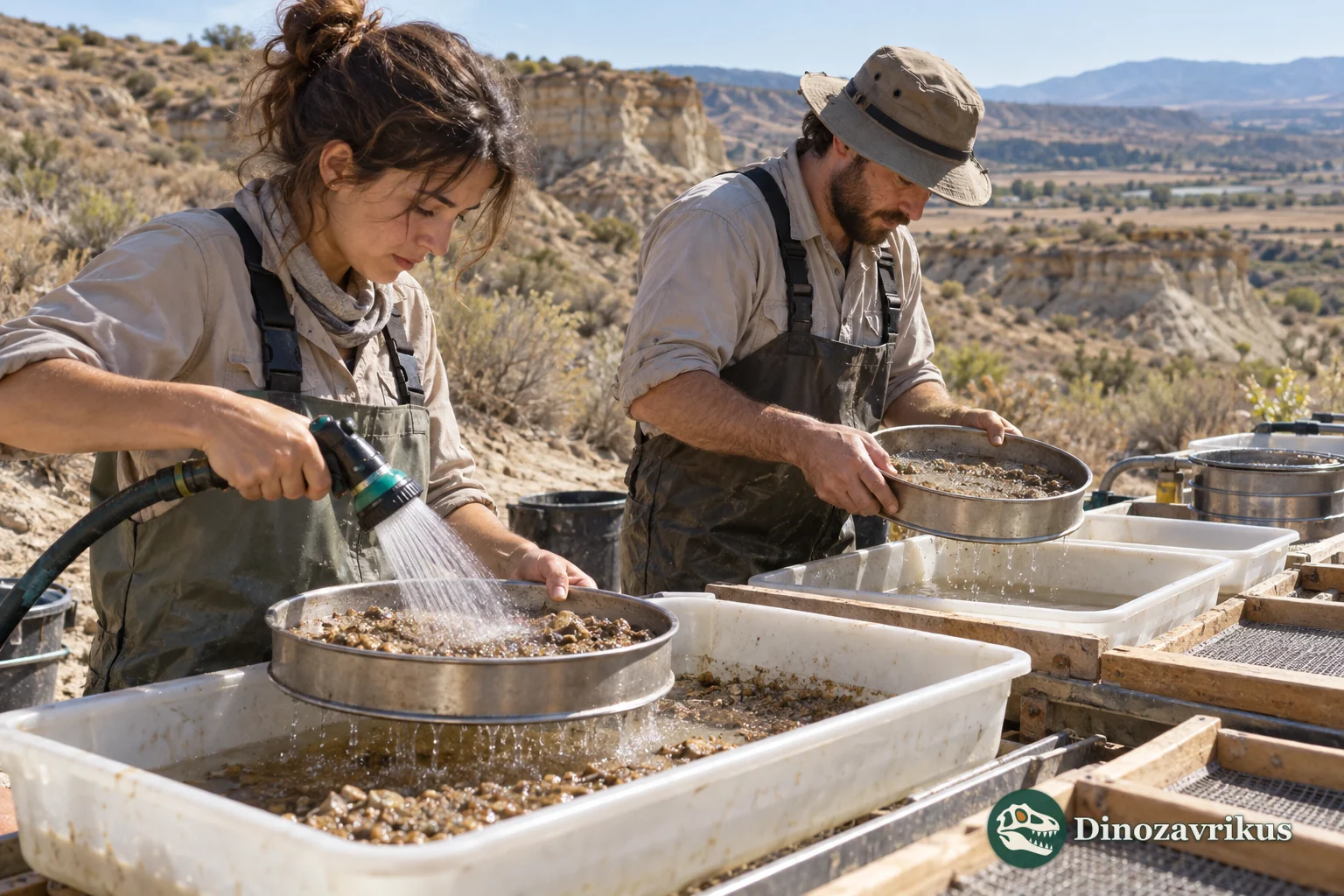
Barranco de los Conejos sediment was water-screened. The resulting count of teeth is not a count of complete animals.
The Layna type and a revised genus
Jacques Michaux established Castillomys in 1969 with C. crusafonti as its type species from Layna, Spain. At first the genus contained one species. In a 1991 revision, Emilia Martín Suárez and Pierre Mein compared dental samples from multiple localities, raised some older subspecies to species and named C. rivas. They also transferred certain Italian and Turkish populations formerly placed in Castillomys to other genera.
The authors proposed a sequence from C. gracilis through C. crusafonti to C. rivas, with larger teeth and stronger longitudinal cusp connections. This is a hypothesis about successive populations, not a direct genealogy of recovered individuals. Each species boundary and geological occurrence needs separate evaluation.
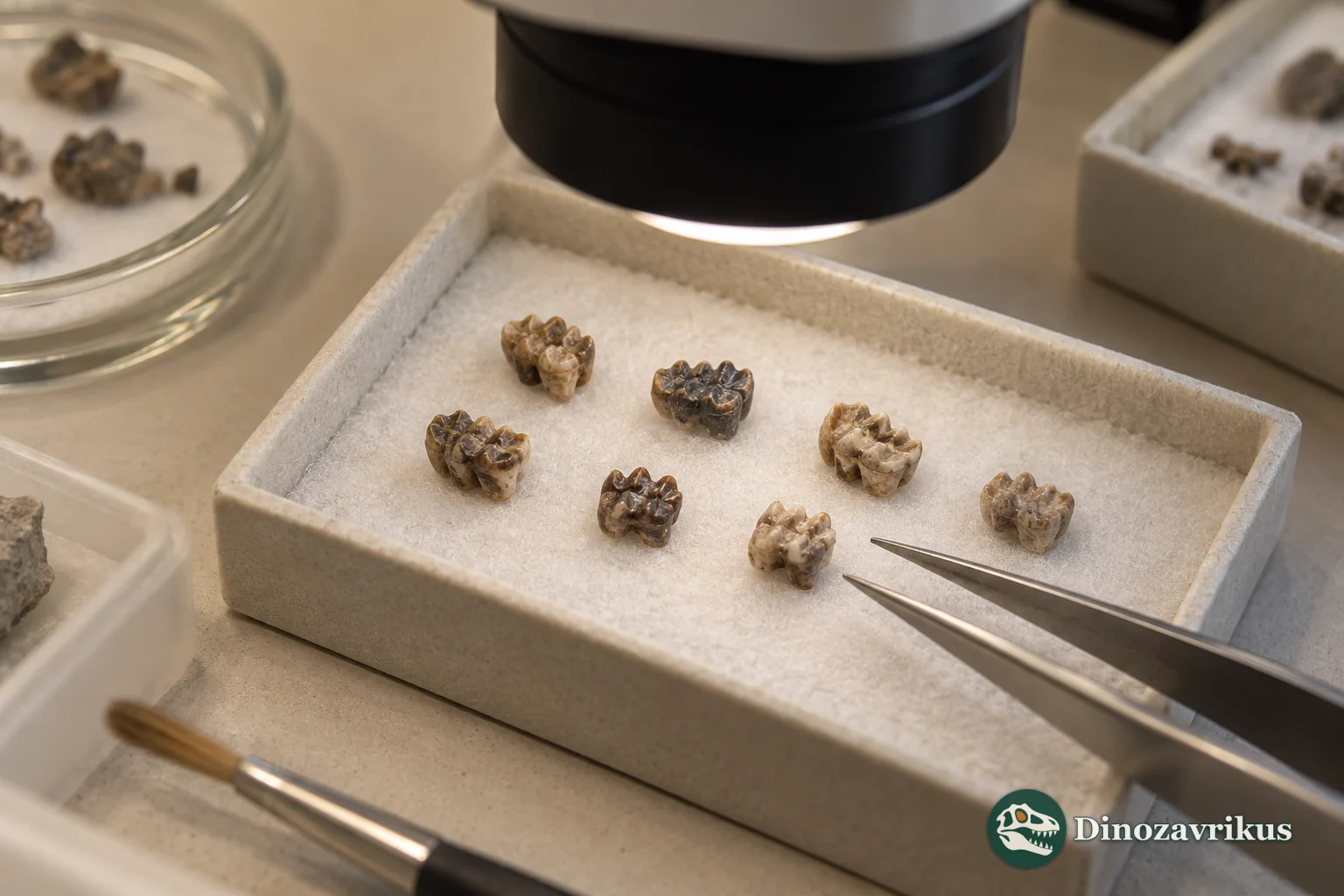
Seventeen teeth from Barranco de los Conejos
At the early Pleistocene Barranco de los Conejos site in Spain's Guadix-Baza Basin, sediments were washed through sieves down to 0.5 mm mesh. The Castillomys rivas sample contains eight first upper molars, one second and one third upper molar, three first and four second lower molars. Seventeen teeth do not mean seventeen complete skeletons.
Measured first upper molars from this sample are 1.67 to 1.98 mm long. Their well-developed longitudinal crests, together with size and other cusp characters, distinguish them from compared C. gracilis and C. crusafonti samples. These numbers describe teeth from one locality; they cannot be converted into total body length or mass.
Age and reconstruction limits
Barranco de los Conejos is estimated at about 1.8 million years old from its stratigraphic position and associated fauna. That date constrains a C. rivas population, not the first Castillomys. Older members occur in Pliocene sites. Some older Spanish cave lists use cautious names such as C. crusafonti ssp. because isolated teeth do not always allow secure species assignment.
Molars reveal chewing anatomy but cannot identify the exact seeds or other foods eaten by Castillomys. The small mammal Prolagus appears in some comparable faunas, illustrating coexistence without close kinship. The microscope and sediment-screening images are educational scenes, not documentation of the named fossils or excavation.
Frequently asked questions
Was Castillomys only a Pleistocene animal?
No. The genus also has a Pliocene record, while some species occur in early Pleistocene deposits.
Why is it identified from individual teeth?
Tiny molars survive and can be recovered by sediment screening. Their cusp patterns and size can diagnose a genus and sometimes a species.
How many animals were found at Barranco de los Conejos?
The published C. rivas sample contains seventeen separate teeth, which does not equal a count of individuals.
Is C. rivas proven to be a direct descendant of C. crusafonti?
No. A revision proposed a sequence based on changing dental features in populations, not a documented genealogy.