

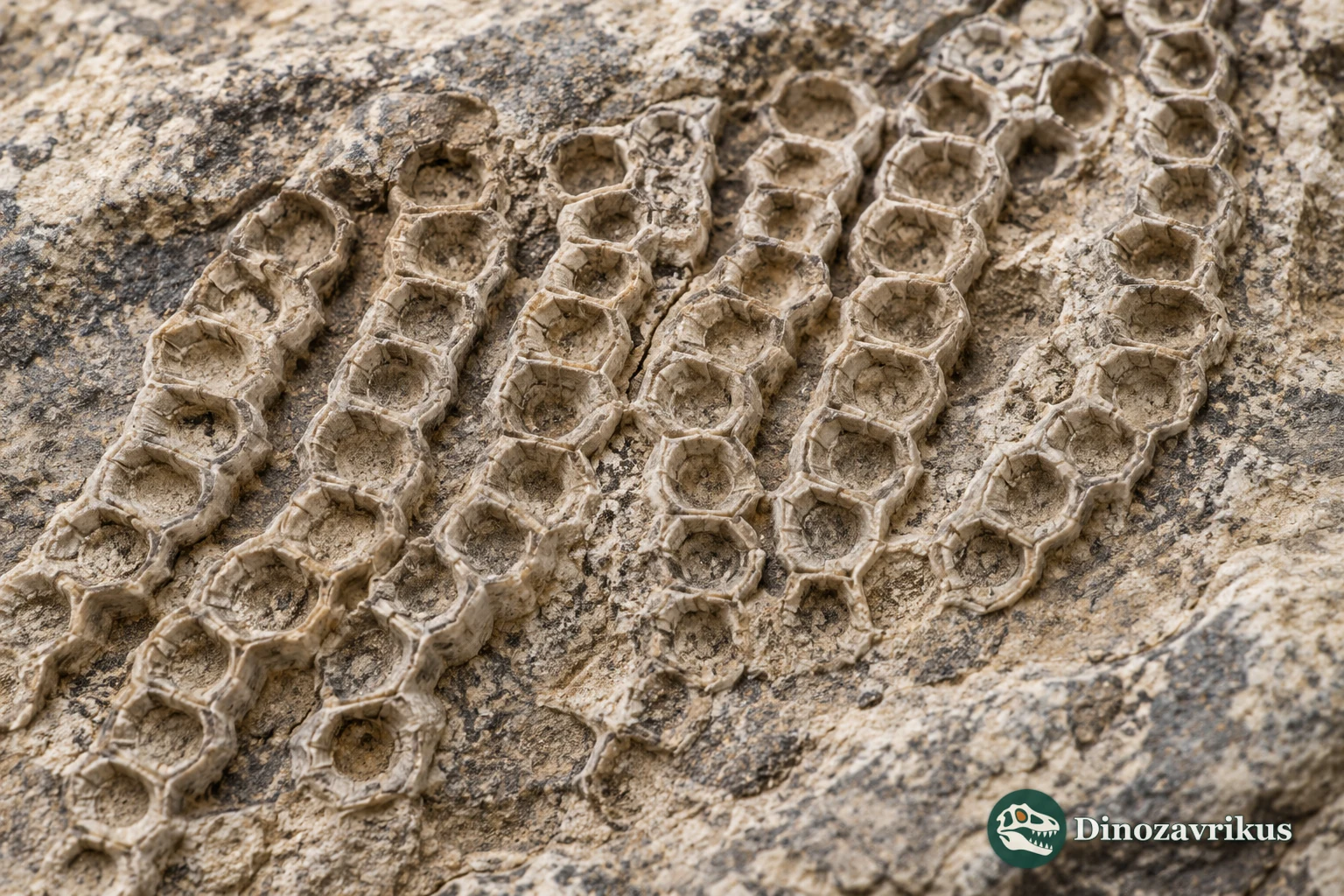
Catenipora is an extinct genus of colonial tabulate corals. Its corallites, the calcareous tubes built by individual polyps, meet in characteristic chains. Fossil surfaces reveal the chain pattern, while transverse and longitudinal sections show walls and internal tabulae. The genus is known from Late Ordovician and Silurian rocks, though individual records belong to different species and localities.
The genus name was introduced by Jean-Baptiste Lamarck in 1816. The type species is Catenipora escharoides, associated with Silurian material from Gotland. The early animal catalogue includes this later Palaeozoic coral alongside other marine fossils while keeping its actual geological age explicit.
Quick facts
| Scientific name | Catenipora Lamarck, 1816 |
|---|---|
| Type species | Catenipora escharoides |
| Group | Tabulate coral, Halysitidae |
| Range | Confirmed records from the Late Ordovician into the Silurian |
| Material | Calcareous colonies and transverse or longitudinal sections |
| Colony | Touching tubular corallites arranged in chains |
| Ecology | Attached colony; suspension feeding inferred from coral biology |
| Limit | The skeleton does not preserve polyps, colour or exact currents |
What can the fossils tell us?
Surfaces and sections show touching tubes in parallel rows. Thin sections expose tabulae and shared walls, but one cut cannot show the complete colony or its soft polyps.
Catenipora tongchuanensis was described from the middle Jinghe Formation of Sandbian age. This is an early confirmed halysitid occurrence, not a precise date for every lineage.
Researchers compare tabularium area, wall thickness and corallite proportions. Character combinations separate morphospecies, while facies and stratigraphic position can also affect measurements.
Some Xiazhen Formation colonies remain intact in growth position in limestone, while shale material is more often crushed or fragmented. This is a local preservation pattern.
How the chain colony grew
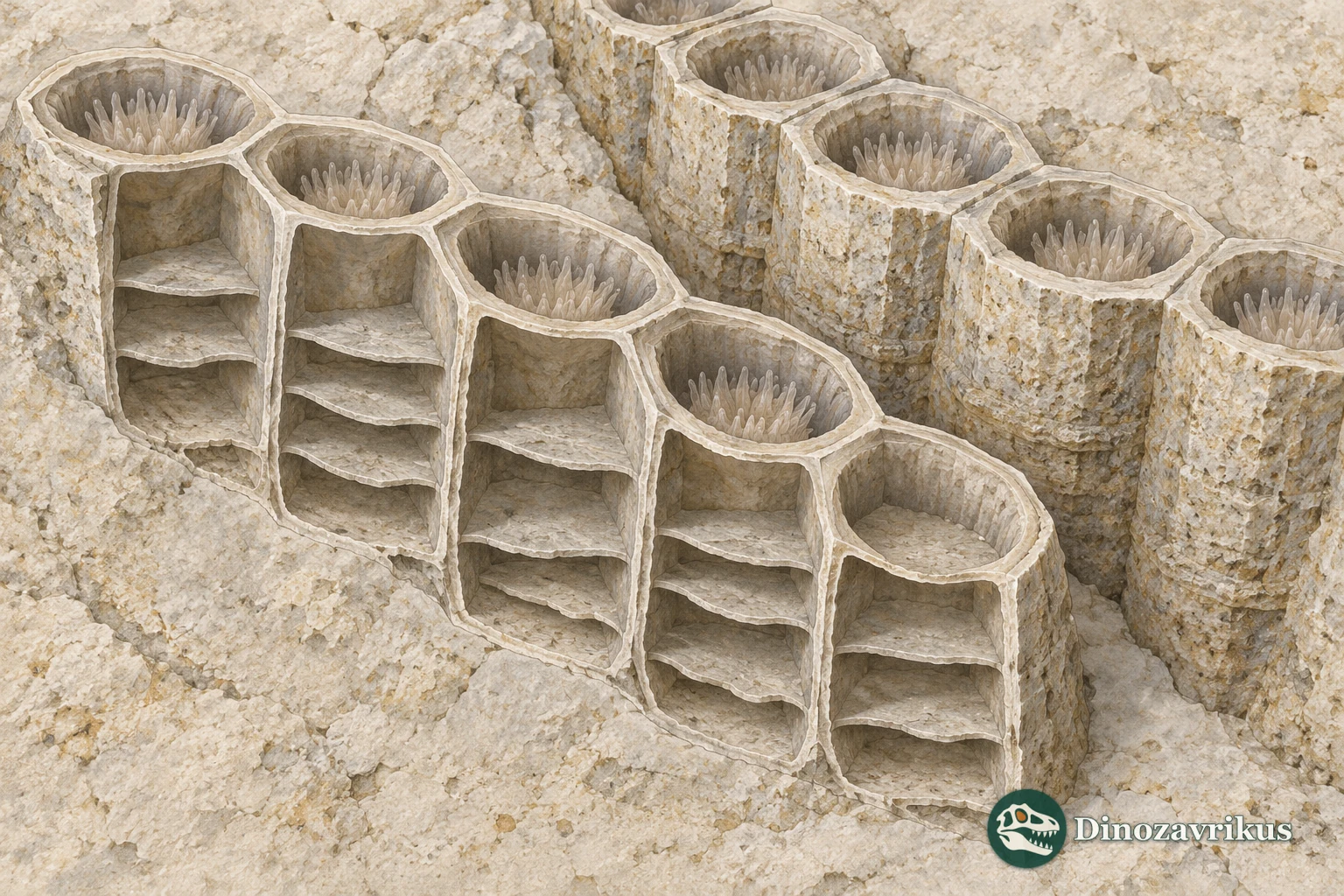
Each corallite housed a coral polyp in life. In Catenipora, the tubes touched in rows that form chain-like patterns on the colony surface. A longitudinal section may show tabulae, the transverse mineral partitions deposited as a corallite grew. In cross-section, researchers compare tube outlines, wall thickness and spacing. Those details are more useful for classification than the colony's general honeycomb appearance.
Anna Stasińska's study described an individual chain as unbranched, with new corallites added at its growing end. Several chains could aggregate into a larger mass. The contacts between skeletal rows are directly visible; a history involving multiple larval settlements is an interpretation of how such aggregates formed.
Names, species and classification
Current classifications place Catenipora among anthozoan tabulates in Halysitidae. Some revisions treat names including Quepora and Holocatenipora as synonyms. Such synonymy is a taxonomic decision based on diagnoses and type comparisons; it does not automatically relabel every historic museum specimen.
A morphometric study of Upper Ordovician colonies from central China recognised five morphospecies, three newly described. The authors compared corallite dimensions and type material, and raised the possibility that the broad traditional genus could include more than one lineage. That is a hypothesis requiring further testing, not an established split of Catenipora.
Age, measurements and environments
Catenipora tongchuanensis comes from the middle Jinghe Formation of Sandbian age in central China. Its holotype is NIGPAS 159394, with paratypes NIGPAS 159395–159397. The authors described it as the earliest confirmed halysitid tabulate known at the time. Measurements of corallites in the studied Jinghe and Beiguoshan formations range roughly from 0.6 to 2 mm in length and 0.4 to 1.4 mm in width. These are sample-level values, not a fixed range for every species.
Colonies from the Upper Ordovician Xiazhen Formation show how lithology affects preservation: some limestone specimens remain in growth position, while shale examples are more often compressed. Lower Silurian material from Jamtland has been interpreted as living in a muddy, silty setting between fair-weather and storm wave base within the photic zone. That environmental model applies to that locality, not to the whole genus.
Feeding and what remains unknown
A fixed coral colony probably captured suspended particles with its soft polyps. This feeding mode follows coral biology, not preserved gut contents from Catenipora. The skeleton records colony architecture and growth, but it does not preserve tentacles, water flow, a specific diet or colour. Growth studies of C. rubra have also modelled how vertical extension responded to sediment influx in one Late Ordovician setting; this cannot be generalised to all species.
Evidence, inference and reconstruction
The fossil record establishes calcareous chain colonies and their internal partitions. Attachment and suspension feeding are reasonable biological inferences. The exact current regime, colour, soft anatomy and independent history of every chain remain outside the direct evidence.
Frequently asked questions
When did Catenipora live?
Secure reports range from the Late Ordovician into the Silurian. The earliest confirmed halysitid material cited here is Sandbian in age.
Why is it called a chain coral?
Its corallites touch in parallel rows that resemble links. Several chains could aggregate, although a studied individual chain did not branch.
What are tabulae?
They are transverse mineral partitions inside a corallite. Sections reveal their position and help describe colony architecture.
Can fossils show its colour or exact diet?
No. Suspension feeding is inferred from coral biology, while colour and a specific menu are not preserved.