

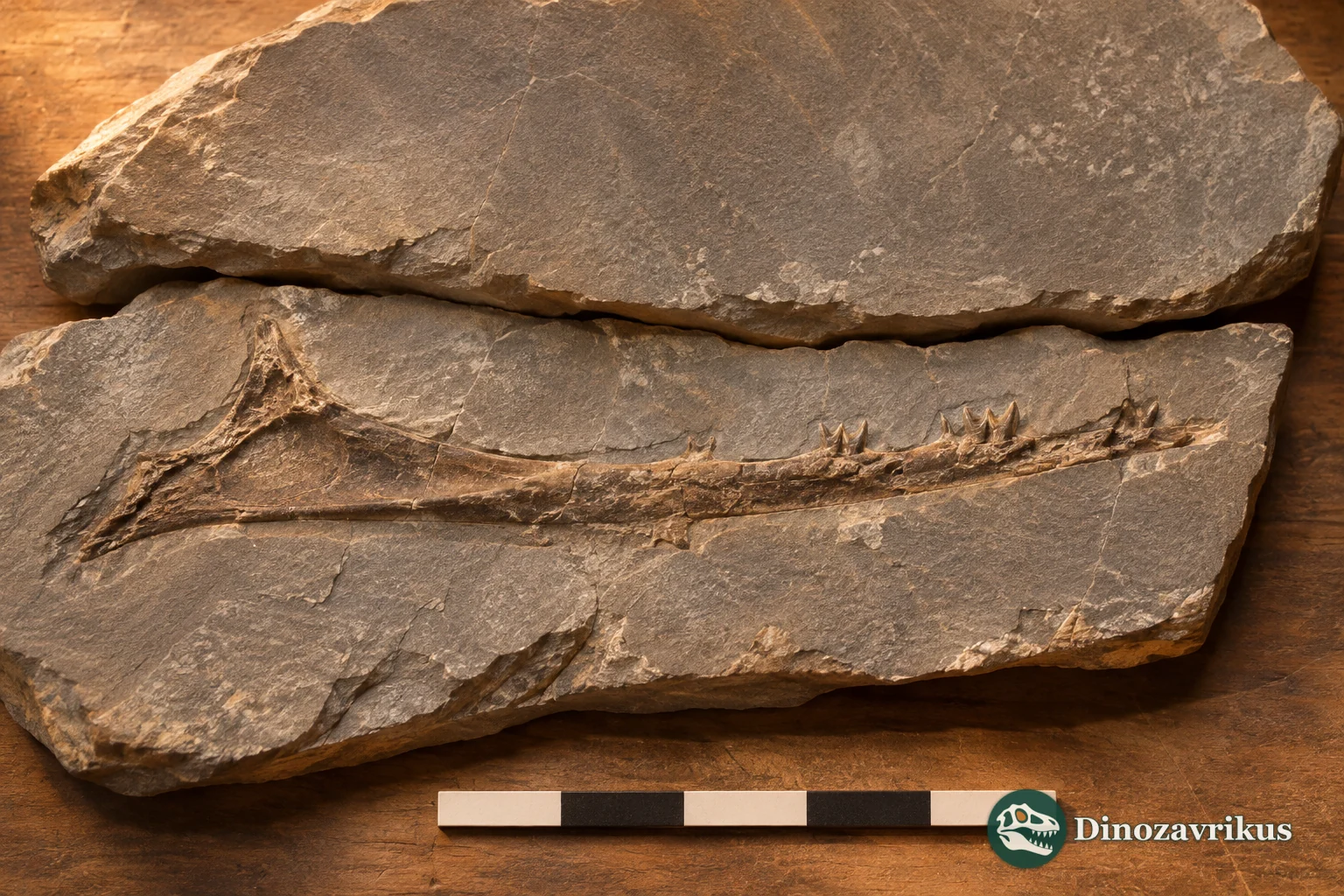
Caviramus schesaplanensis is based on a fragment of a right lower jaw from Late Triassic strata in Switzerland. The preserved teeth have multiple cusps, while parts of the jaw show cavities and a notch. No skull or wing belongs to the type specimen, so a complete head shape and wingspan cannot be read from this fossil.
Quick facts
| Scientific name | Caviramus schesaplanensis, Fröbisch and Fröbisch, 2006 |
|---|---|
| Holotype | PIMUZ A/III 1225, partial right lower jaw |
| Locality | Schesaplana, Switzerland |
| Rock unit | Alplihorn Member, Kössen Formation |
| Age | Late Norian to early Rhaetian, Late Triassic |
| Preserved jaw length | About 52 mm, partly preserved as an impression |
| Wingspan | Not established from the type specimen |
What can the fossils tell us?
PIMUZ A/III 1225 preserves roughly 52 mm of a right lower jaw. It is not associated with a skull or wing bones.
Two multicusped teeth remain in position, and at least twelve tooth positions are discernible. Missing teeth cannot be counted directly.
A ventral notch and cavities are part of the preserved anatomy. A keratinous covering at the front is an interpretation, not preserved tissue.
Similarity to the separately described Raeticodactylus has led to a proposed same-genus interpretation, but the specimens remain distinct and the assignment is debated.
A jaw from Schesaplana
Nadia and Jörg Fröbisch named Caviramus schesaplanensis in 2006 from specimen PIMUZ A/III 1225. The fossil comes from the Alplihorn Member of the Kössen Formation on the western side of Schesaplana. These rocks span the late Norian to early Rhaetian stages near the end of the Triassic. The generic name refers to a cavity and a jaw ramus, whereas the species name recalls the mountain.
The surviving right jaw segment measures about 52 mm. Bone and impressions together trace its outline. Two multicusped teeth remain in place, and the authors identified at least twelve positions. A higher estimate for the full tooth row assumes that spacing continued into the missing portion; those extra teeth were not found. Austriadactylus illustrates the diversity of Triassic pterosaurs, but its anatomy cannot fill the missing parts of this Swiss jaw.
What the jaw reveals
The teeth carry several points rather than simple single tips. A notch marks the lower edge of the jaw, and cavities and depressions occur in the bone. The describing authors suggested that the front of the jaw may have carried a keratinous covering. No such soft tissue survives in the slab.
Tooth shape invites questions about food handling, but no gut contents identify a particular prey. A species-specific head crest, complete body outline or flight style cannot be established from this fragment alone.
The Raeticodactylus question
The Swiss pterosaur Raeticodactylus filisurensis was named from a different, more complete specimen. Similarities between its jaw and that of Caviramus prompted a proposal to place them in the same genus. Fabio Dalla Vecchia's later review considered this plausible while treating their species separately and stressing the need for more material. The original Raeticodactylus description had retained separate genera.
The other specimen's crest and wing measurements therefore should not be presented as direct observations of the Caviramus holotype. Campylognathoides is a later Jurassic pterosaur with another documented anatomy, not a substitute skeleton for Caviramus.
The limits of a life reconstruction
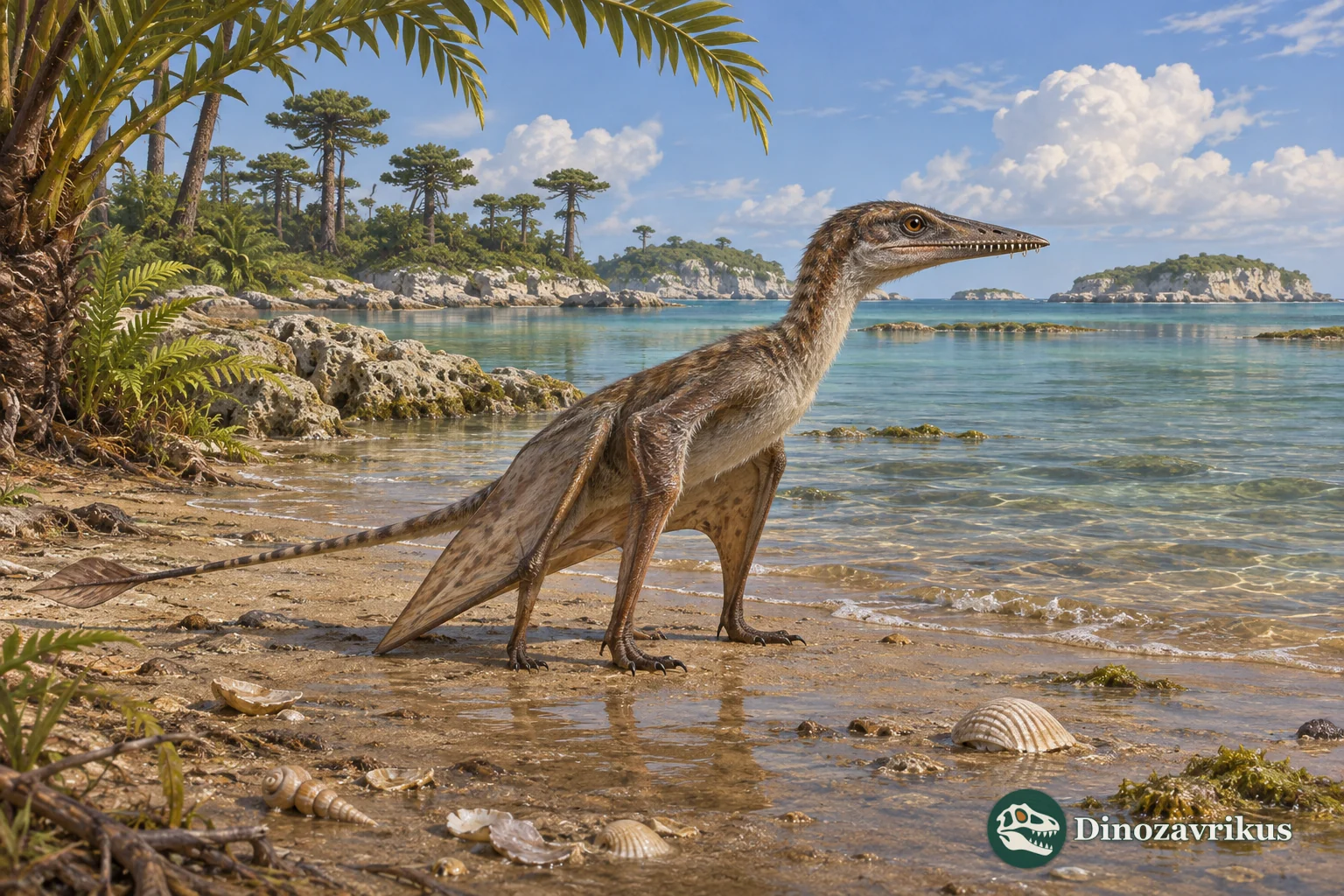
Coastal terrain is consistent with the sedimentary setting, yet the animal's colours, exact wing proportions and behaviour are unknown. Fossil images in this article are educational artwork; the specimen itself is a small, incomplete jaw, not a complete skull or skeleton.
Frequently asked questions
Where was Caviramus discovered?
Its type jaw comes from the Alplihorn Member of the Kössen Formation on Schesaplana in Switzerland.
How many teeth were actually found?
Two multicusped teeth remain in place. At least twelve tooth positions were identified; a longer complete row is an estimate.
Is its wingspan known?
No. The type specimen contains a partial jaw and no wing bones.
Is Raeticodactylus the same animal?
The names were based on different specimens. Similarities have led to a proposed same-genus assignment, but the taxonomic interpretation remains open to revision.