

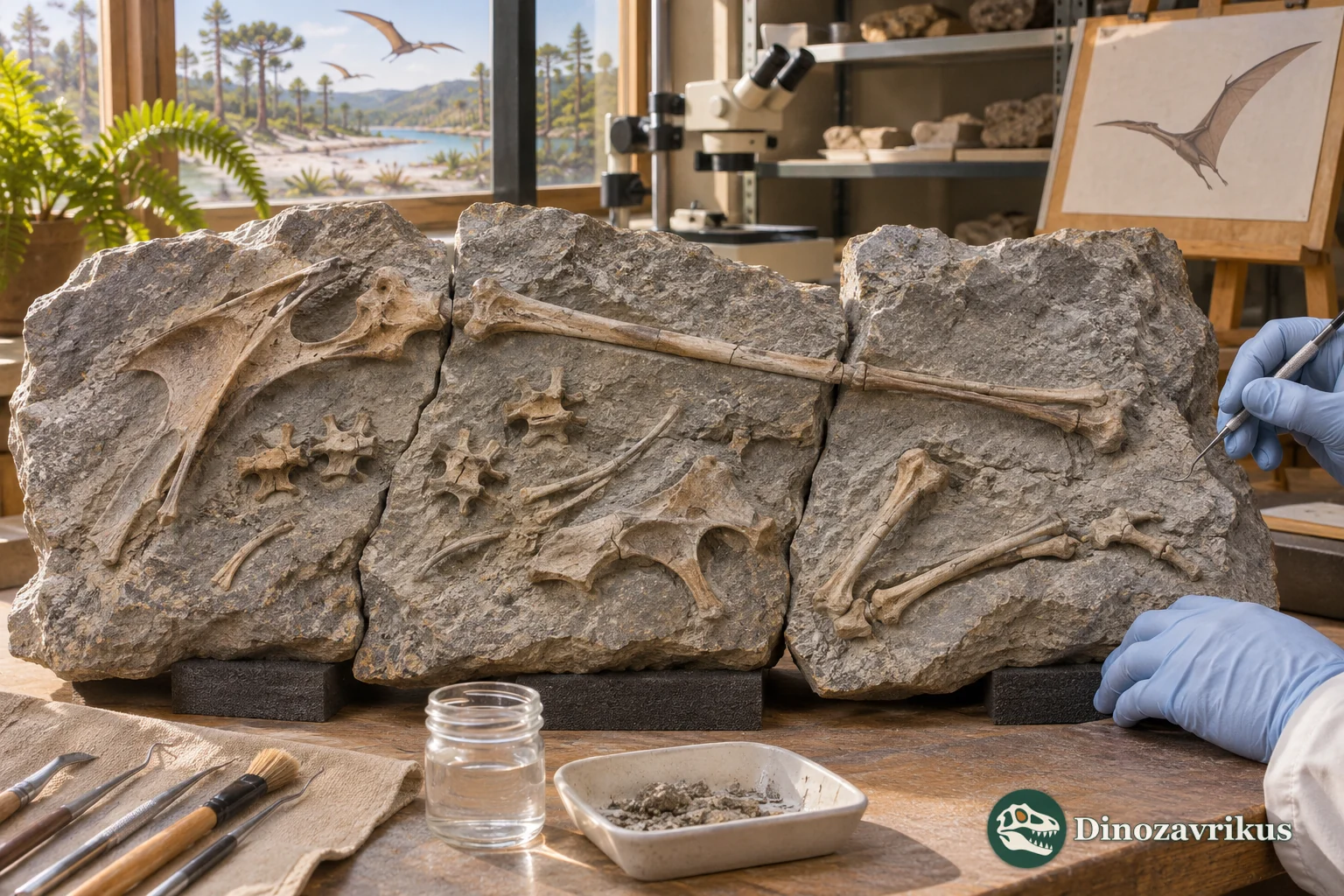
Ceoptera evansae is a Middle Jurassic pterosaur from Scotland's Isle of Skye. Its holotype is an associated but incomplete postcranial skeleton distributed across three rock blocks. Micro-CT scanning helped reveal bones within the matrix. Because the skull is missing, the head and feeding anatomy shown in any life image remain conjectural.
Quick facts
| Scientific name | Ceoptera evansae, Martin-Silverstone and colleagues, 2024 |
|---|---|
| Holotype | NHMUK PV R37110, associated partial skeleton without skull |
| Locality | Near Elgol, Isle of Skye, Scotland |
| Rock unit | Kilmaluag Formation |
| Age | Bathonian, Middle Jurassic |
| Wingspan | About 1.6 m, estimated from wing metacarpal |
| Research method | Micro-computed tomography of rock blocks |
What can the fossils tell us?
Vertebrae, shoulder, wing, pelvis and hind limb elements are preserved, but the skull and jaws are absent.
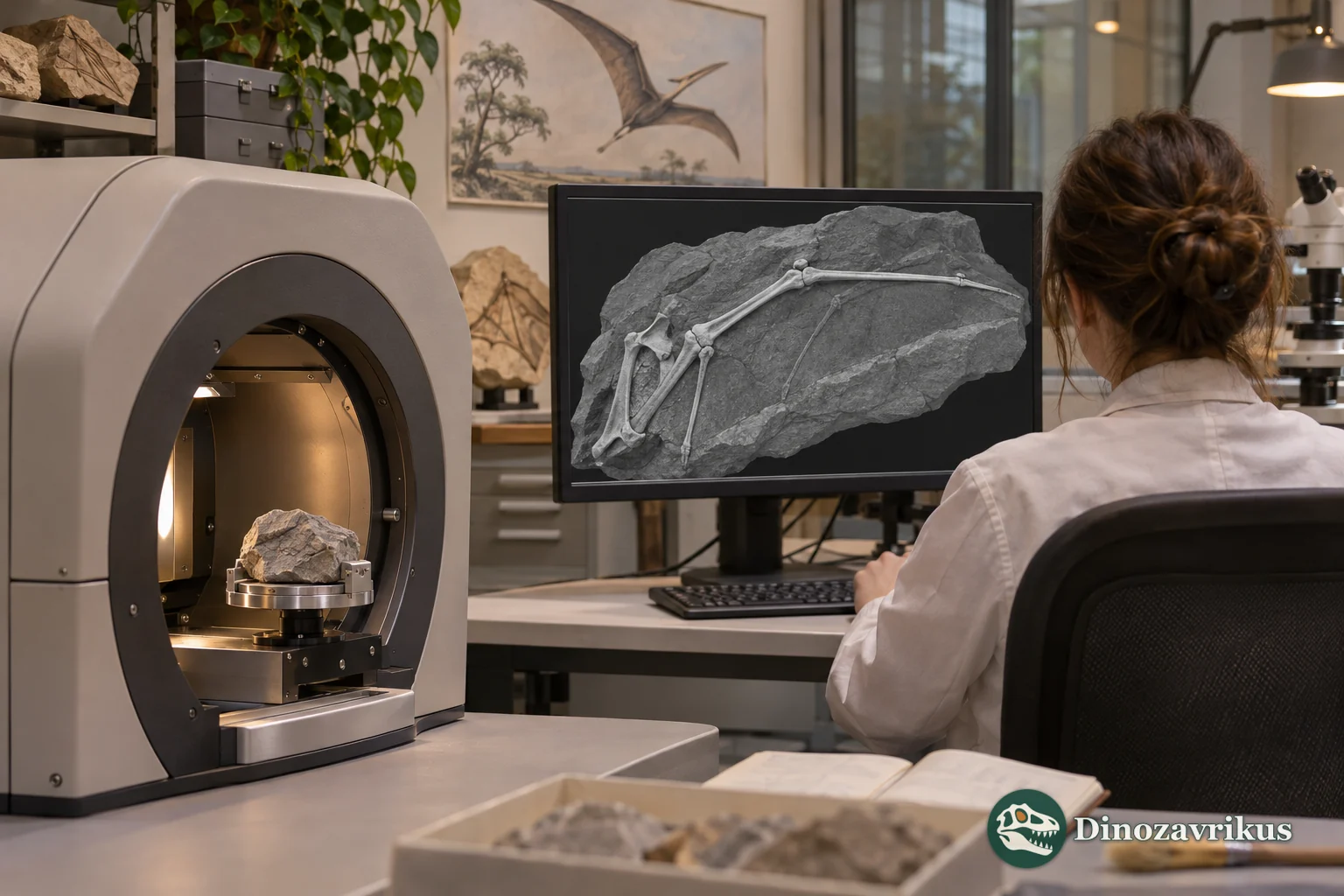
Micro-CT made some matrix-embedded bones visible without completely removing the surrounding rock.
The published value of about 1.6 m follows a regression based on the wing metacarpal; no complete wing was measured.
The fossil cannot determine the snout, teeth or diet. These features in artwork are comparative reconstructions.
A coastal discovery on Skye
NHMUK PV R37110 was found in 2006 near Cladach a’Ghlinne, north of Elgol on the Isle of Skye. The bones lay in a fallen coastal boulder from the Kilmaluag Formation, which is Bathonian in age. The boulder identifies the rock unit but does not pin down the animal's exact original position within the outcrop.
In 2024 Martin-Silverstone and colleagues named Ceoptera evansae. The genus combines Scottish Gaelic ceò, meaning mist, with a term for wing; the species honours palaeontologist Susan E. Evans. Dearc is another pterosaur from Skye, but it is a separate taxon and fossil occurrence.
The bones that were actually found
Three neighbouring blocks preserve associated vertebrae, parts of the sternum and pelvis, a complete scapulocoracoid and wing metacarpal, wrist bones and hind limb elements. No skull, jaws or teeth belong to the holotype. The condition of the bones does not support an exact facial reconstruction.
Micro-computed tomography revealed features still embedded in rock. A flange on the coracoid and a depression on the ilium were among the anatomical characters described in the diagnosis. The scan provides evidence about bone shape, not soft tissue colour or diet.
Wingspan and growth
The describing team estimated a wingspan of roughly 1.6 m from the complete wing metacarpal, using a relationship calibrated against other pterosaurs. This is a comparative calculation rather than a direct measurement of two complete wings. Fusion of some bones suggests advanced growth, yet other elements remain unfused; maturity is therefore not a simple yes-or-no determination.
Their phylogenetic analysis placed Ceoptera among darwinopterans, while some precise branches remain weakly resolved. Campylognathoides offers a different Jurassic pterosaur anatomy; its skull cannot be assigned to Ceoptera.
What the images cannot establish
A misty Jurassic wetland makes a plausible setting for the artwork, but the particular scene is illustrative. The type specimen cannot tell us the snout length, whether this animal had teeth, its exact prey, colour or everyday flight behaviour. Those questions require additional fossils rather than more detailed painting.
Frequently asked questions
Where was Ceoptera found?
Its holotype was found in a coastal boulder near Elgol on the Isle of Skye, from the Bathonian Kilmaluag Formation.
Is the skull known?
No. The type material includes postcranial bones but no skull or jaws.
How was the 1.6 m wingspan obtained?
It was estimated from the length of the wing metacarpal using comparisons with other pterosaurs, not measured from a complete wing.
Why did researchers use micro-CT?
Some bones remained concealed in the rock, and scanning helped reveal their shapes without fully extracting them.