

Cervalces, often called the stag-moose, was an extinct deer related to the moose line. Its antlers and skull were distinctive, but comparisons among fossil cervids are complicated by variation and incomplete specimens. The well-documented partial skeleton of C. scotti from Ohio links its anatomy to a direct date and a local wetland setting.
It belongs in the ice-age animal catalogue. The stag-moose should not be confused with the giant deer Megaloceros; their large antlers alone do not make them the same animal.
Quick facts
| Group | Deer, Cervidae |
|---|---|
| North American species | Cervalces scotti |
| Time | Late Pleistocene |
| Ohio find | 44 bones and fragments of one male |
| Direct Ohio date | 11,695 ± 35 radiocarbon years BP |
| Individual's estimated age | About 4.5–5.5 years |
What can the fossils tell us?
Forty-four bones and fragments recovered near Chippewa Lake belong to one male Cervalces scotti. The partial skeleton anchors anatomical study much better than an isolated antler.
A bone yielded 11,695 ± 35 radiocarbon years BP. This is a radiocarbon age for the Ohio individual, not an exact calendar date for the entire genus.
Spiral fractures and gnawing marks indicate carcass processing by scavengers. They do not establish what killed the animal.
Names and moose relationships
North American Cervalces scotti was a member of the deer family. Its broad antlers suggest a moose-like animal, yet the branching arrangement differs from that of a living moose. Published classifications have disagreed about the boundaries between Cervalces and Alces, and about how European fossil species such as C. gallicus and C. latifrons fit into the lineage.
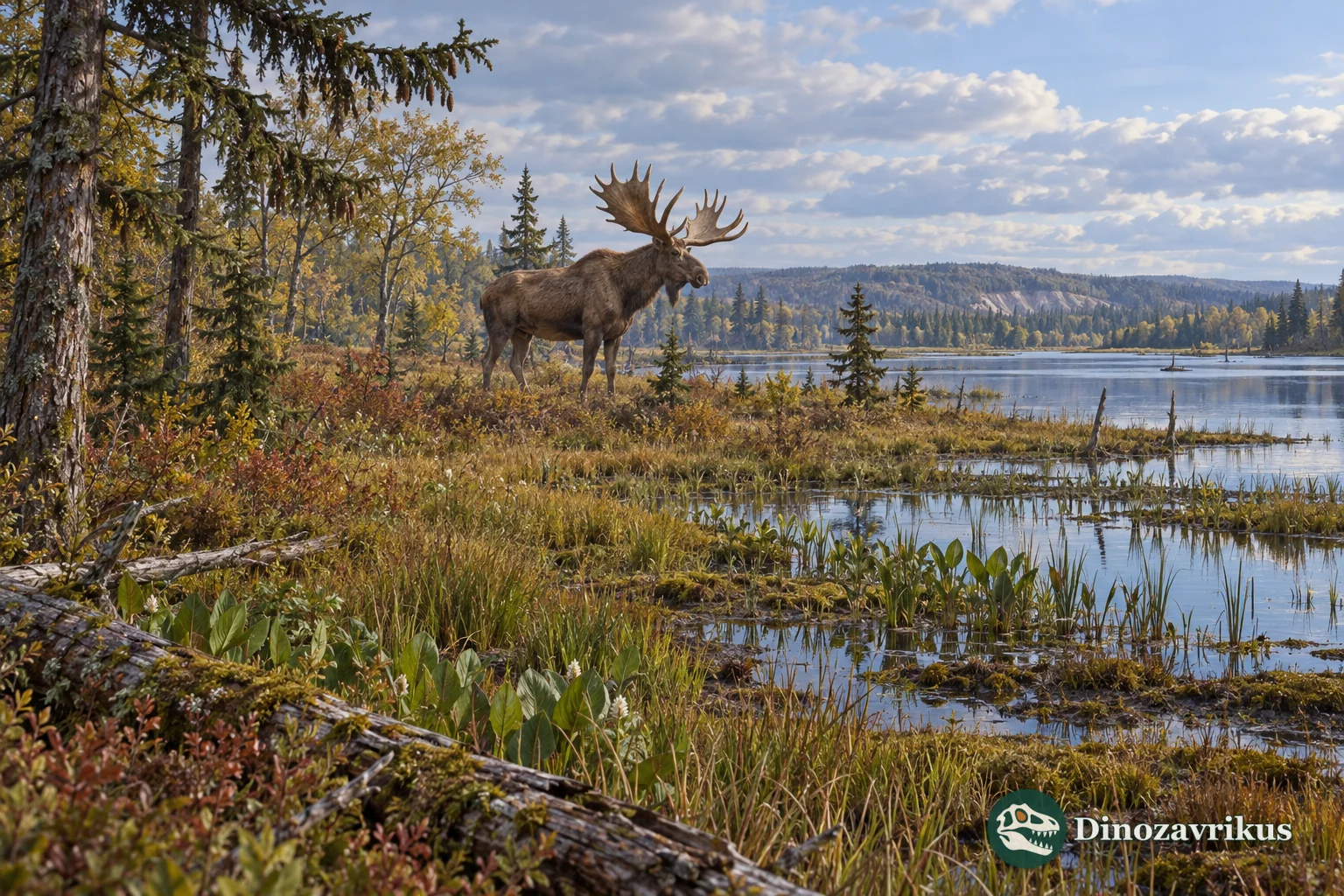
An antler is useful but should be read with skull and other skeletal characters. The reconstruction on this page illustrates a plausible animal; it does not resolve all taxonomic disagreements or document coat color.
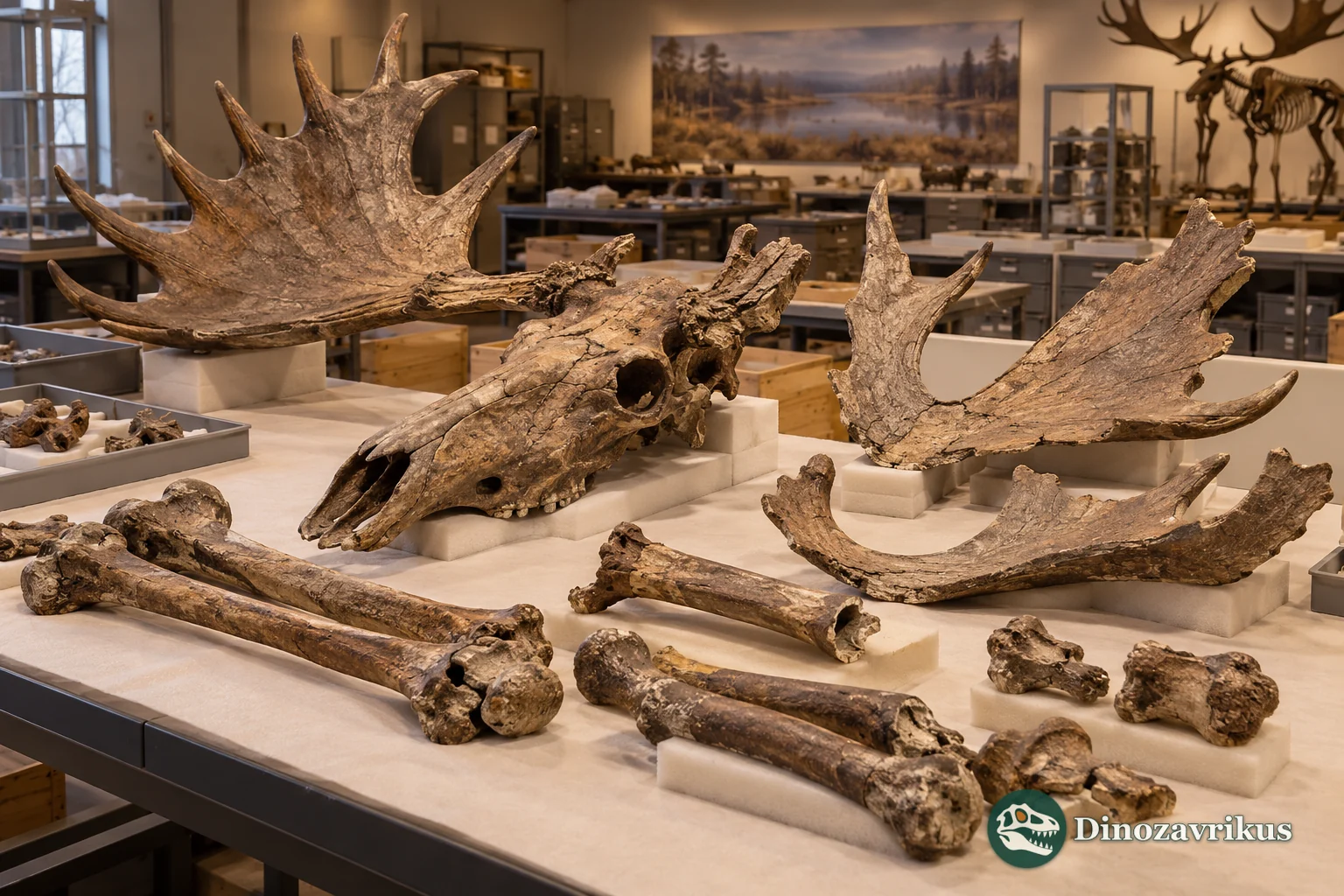
A male skeleton near Chippewa Lake
Excavation near Chippewa Lake in Ohio recovered 44 bones and fragments attributed to one male C. scotti. The remains lay roughly five metres below the modern surface in a wetland sequence. Tooth and antler evidence led researchers to estimate an age of about 4.5 to 5.5 years for this individual.
A bone was dated directly to 11,695 ± 35 radiocarbon years before present. Radiocarbon years are not identical to calendar years. Peat, mollusks, pollen and seeds around the find helped reconstruct its local environment, but the direct bone date is the most specific chronological evidence for this animal.
What damaged bones can and cannot tell us
Some Ohio bones have spiral fractures and gnaw marks. They show that scavengers accessed the carcass while portions were still fresh. Such marks cannot by themselves prove predation or identify the cause of death. Burial, later disturbance and excavation history also need consideration.
The partial skeleton contains more anatomical information than a single antler, but much of the animal remains missing. Estimates of overall height or mass for the species require comparisons with other specimens and living deer rather than measurements from this one incomplete skeleton alone.
An Illinois wetland near the end of the Ice Age
Fossils from Lang Farm in northern Illinois provide a separate late Pleistocene record of C. scotti. A published radiocarbon determination is about 11,405 ± 50 radiocarbon years BP. Plant evidence points to a wet landscape with changing spruce and ash forest. The Illinois date and the Ohio date refer to separate localities and should not be collapsed into one event.
Moose-like dentition and the plant community make browsing a reasonable ecological inference. No preserved stomach contents identify what either individual ate on its last day. A wide-antlered animal in an illustrated lake margin is a reconstruction of the setting, not a photograph of the fossil site.
Frequently asked questions
Was Cervalces the same as the giant deer Megaloceros?
No. Both were deer, but they belonged to different lineages and their antler forms and fossil histories differ.
What was dated in the Ohio discovery?
A bone from the Chippewa Lake Cervalces scotti skeleton was directly dated to 11,695 ± 35 radiocarbon years BP.
Do tooth marks prove that a predator killed it?
No. The marks show scavenging of the carcass; the cause of death remains unknown.
Was Cervalces a modern moose?
No. It was an extinct relative in the moose lineage, and the exact genus boundary with Alces has been debated.