

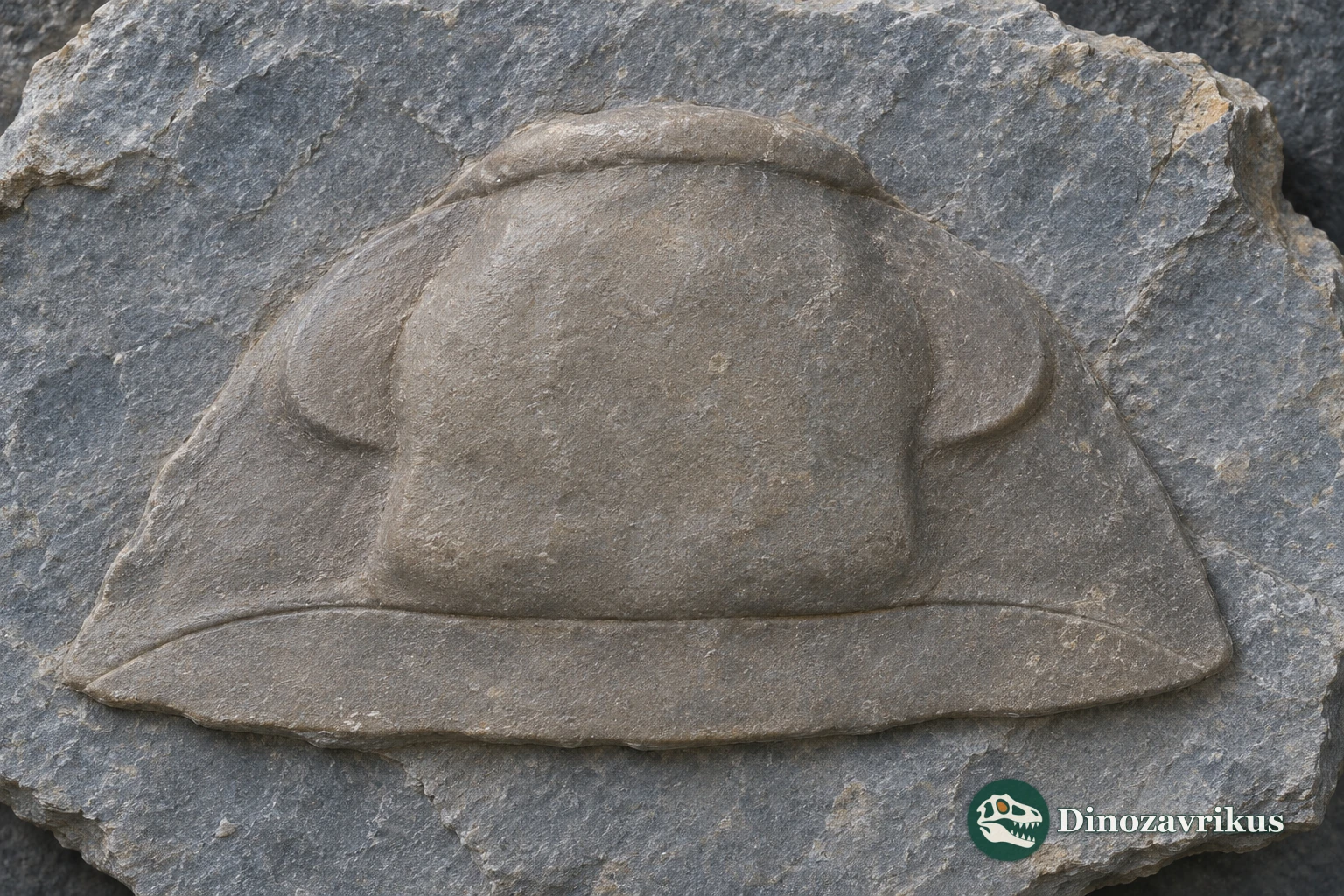
Chapmanopyge was an Early Ordovician trilobite in the family Bathyuridae. Its type species from Oklahoma has a broad tail shield, nearly twice as wide as it is long in some specimens. The genus received a replacement name several years after the fossils were described.
Quick facts
| Group | Bathyurid trilobites |
|---|---|
| Age of the type material | Early Ordovician |
| Replacement name | R. Fortey and D. Bruton, 2013 |
| Type species | Chapmanopyge oklahomensis |
| Holotype of the type species | Cranidium UMC 16857 |
| Type formation | Kindblade, Oklahoma |
What can the fossils tell us?
The type species has a shield 1.7–1.8 times as wide as it is long. Most of the relief lies close to the axis.
It can account for about a third of cranidial length in some specimens of the type species.
The original genus name was already in use for another organism.
The fossils and the two genus names
James Loch described the genus Chapmania in 2007. He designated C. oklahomensis from the Kindblade Formation as the type species and assigned 39 cranidia, 56 tail shields and 29 free cheeks to it. The holotype UMC 16857 is a cranidium from the Kindblade Ranch section.
The name Chapmania was already occupied. Richard Fortey and David Bruton introduced Chapmanopyge as its replacement in 2013. Their study of Spitsbergen also discusses Early Ordovician assemblages that include the genus.

An angular glabella and a fan-shaped tail
The raised centre of the head, or glabella, is angular at the front in the type species. A sloping field separates it from the outer edge. The flat front border can reach 30 per cent of cranidial length in large specimens.
The tail shield has a broad fan-like outline. Individual shields in the described material are up to 15 mm long. The first pair of furrows beside the axis is distinct and the next pairs are weaker. A change in surface slope helps identify the wide marginal zone.
Which species could belong to Chapmanopyge?
After revisiting the type material of Licnocephala, Jonathan Adrain suggested that two species previously placed there, L. cavigladius and L. ovata, probably belong to Chapmanopyge. That placement remains provisional. A fan-shaped tail occurs in several related genera, so the comparison also draws on characters of the head.
Frequently asked questions
Why did Chapmanopyge receive a new name?
The name Chapmania, introduced in 2007, was already occupied. Chapmanopyge replaced it in 2013.
Where was the type species found?
In the Kindblade Formation of southern Oklahoma.
What are the proportions of the tail shield?
In the type species it is 1.7–1.8 times as wide as it is long.
Which former Licnocephala species have been compared with Chapmanopyge?
L. cavigladius and L. ovata are probable members of the genus.