

Chomatobatrachus halei was an Early Triassic temnospondyl from Tasmania. Its fossil record includes a nearly complete skull, fragments of other skulls and lower jaws, and a few postcranial bones from several southeastern Tasmanian localities.
The species belongs in the ancient amphibian catalogue. Comparisons between the adult holotype and smaller palatal specimens reveal growth-related anatomical differences, while the missing articulated skeleton limits what can be said about the animal’s body and way of life.
Quick facts
| Species | Chomatobatrachus halei |
|---|---|
| Group | Temnospondyl; usually placed in Lydekkerinidae |
| Age | Early Triassic, mainly Induan |
| Region | Southeastern Tasmania, Australia |
| Formation | Knocklofty Formation |
| Holotype | UTGD 80738, a nearly complete isolated skull |
| Body size | No reliable total length is established |
What can the fossils tell us?
The skull preserves the roof, palate and occipital region well enough for anatomical comparisons. It is not an articulated skeleton and cannot determine body proportions or exact length.
The juvenile-palate reconstruction is based on UTGD 87791 and UTGD 87792. Denticles and the vomerine tooth row differ from the adult holotype in reported ways, supporting ontogenetic change without providing a complete growth series.
Comparisons generally group Chomatobatrachus with Lydekkerina in Lydekkerinidae. The result depends on anatomical character coding and is a phylogenetic relationship, not evidence of direct ancestry.
Palynological and vertebrate correlations point mainly to the Induan, with broader estimates extending toward the lower Olenekian. This is a stratigraphic correlation, not a direct date on the skull.
A skull from the Knocklofty Formation
John W. Cosgriff named Chomatobatrachus halei in 1974 in his study of Tasmanian Lower Triassic temnospondyls. The holotype, UTGD 80738, is a nearly complete isolated skull from near Meadowbank Dam northwest of Hobart. It anchors the species name and remains the clearest specimen for describing the skull roof, palate and occipital region.
Other material includes skull and jaw fragments from several localities in southeastern Tasmania, plus an incomplete clavicle. These finds broaden the known record, but they do not form one complete skeleton. Differences among isolated bones must be evaluated specimen by specimen.
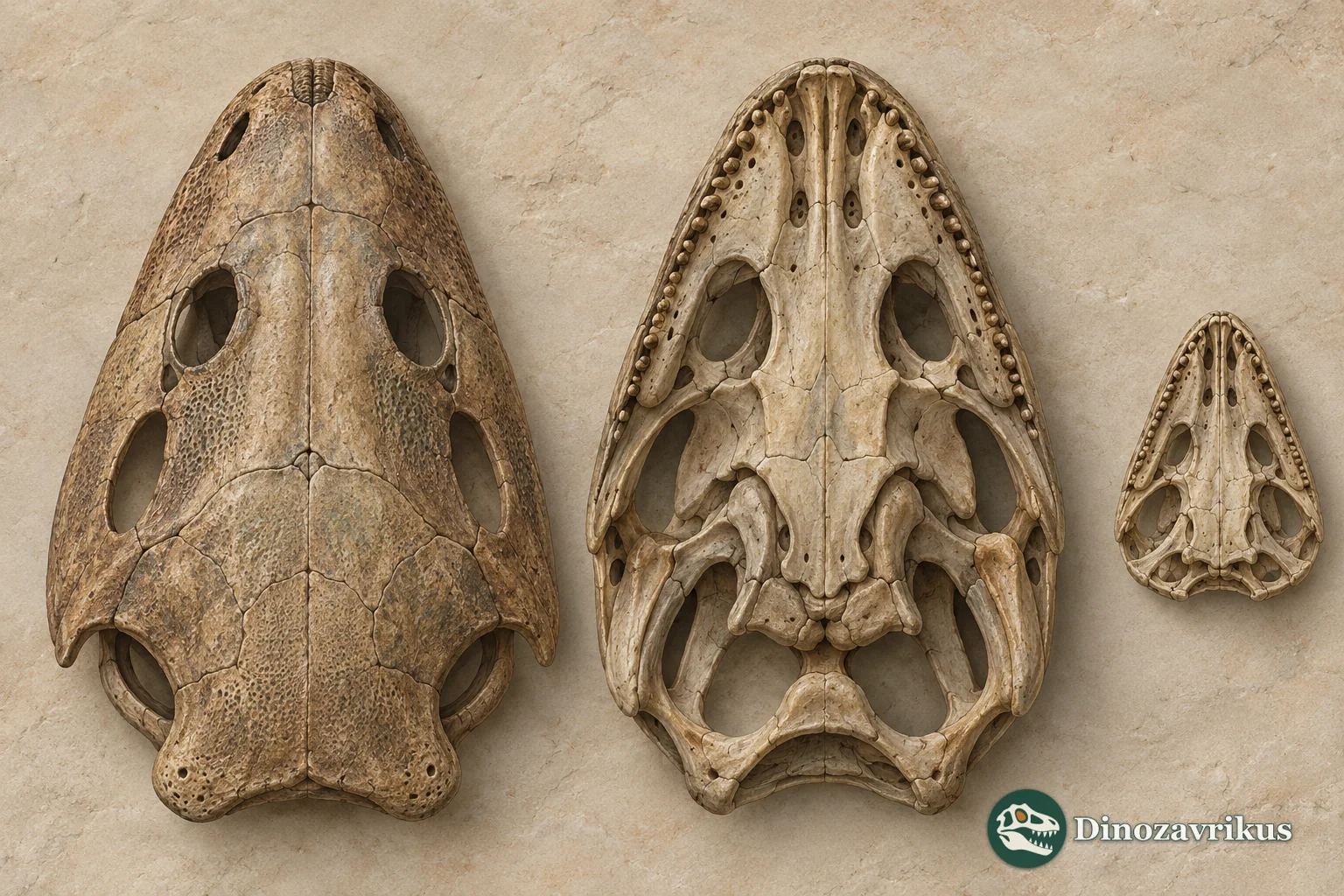
What the juvenile palate adds
A composite reconstruction of a smaller palate is based on UTGD 87791 and UTGD 87792. These specimens show denticles on the palatine and ectopterygoid and a transverse vomerine tooth row along the back edge of the anterior palatal opening. The adult holotype does not show the same arrangement in the same way.
This contrast supports an ontogenetic interpretation: some palatal details changed as the animal matured. It does not provide a full sequence from larva to adult, a growth rate or the exact age of each specimen. The record is informative about skull development while remaining incomplete.
Lydekkerinid affinities and taxonomic questions
Later comparisons distinguish Chomatobatrachus from the South African Lydekkerina huxleyi. Current Australian checklists consistently place it with lydekkerinids, a group of early stereospondyl temnospondyls. The placement rests on combinations of skull and palatal characters; individual traits have been assessed differently in past classifications.
Its relationship with Lydekkerina is a position on a branching evolutionary tree, not proof that one genus directly gave rise to the other. Broader phylogenetic studies may revise the boundaries of these early temnospondyl groups as additional specimens and character scores are tested.
Early Triassic Tasmania
The fossils are associated with the Knocklofty Formation, whose age has traditionally been correlated with the Induan and in some treatments extends into the lower Olenekian. Palynomorphs and vertebrate comparisons provide the age framework; the holotype skull itself has not been directly radiometrically dated.
The formation preserves a continental vertebrate assemblage. That context supports a freshwater or near-water setting as a plausible part of the animal’s ecology, but it does not identify the exact water depth, prey or behaviour of an individual Chomatobatrachus.
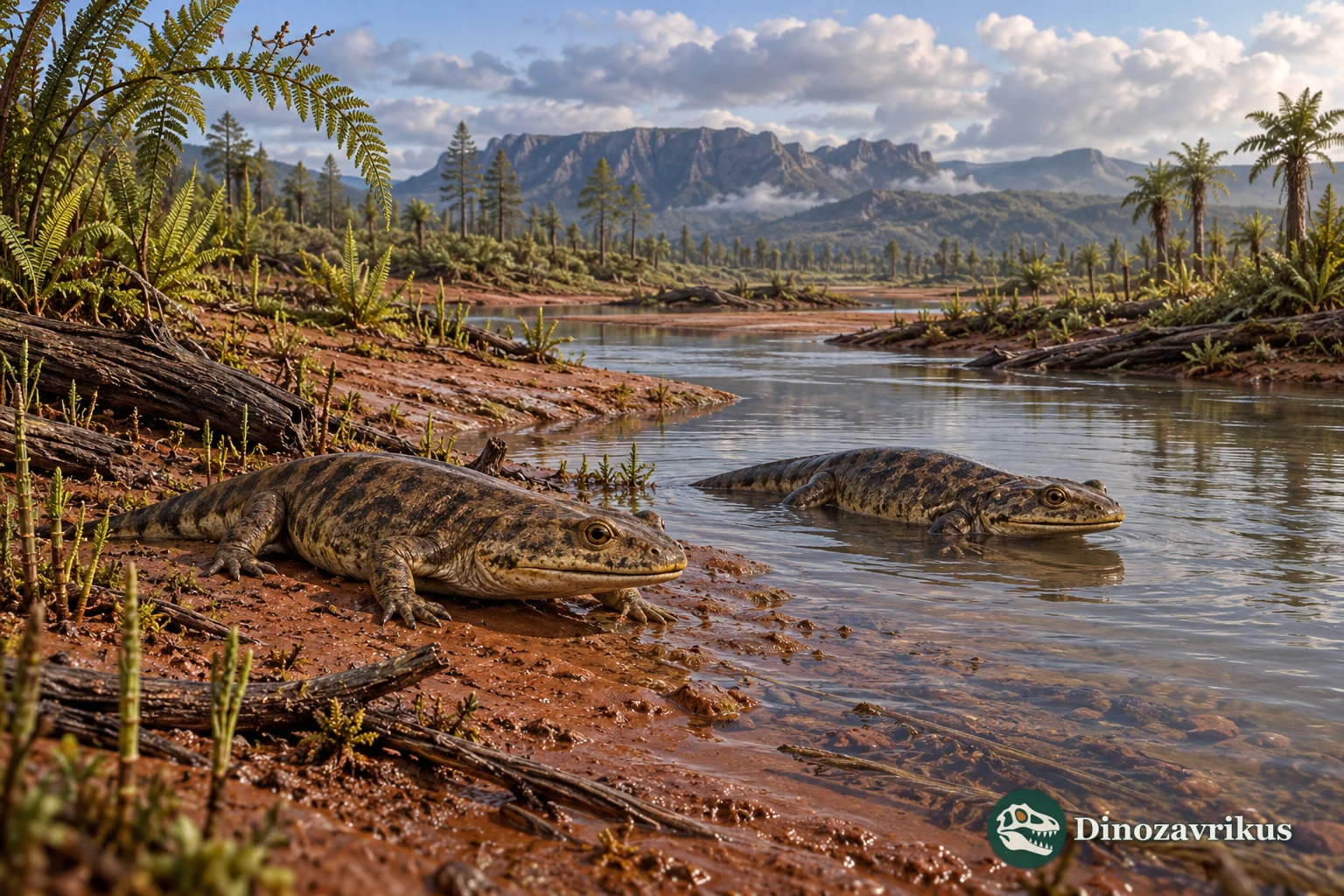
What the fossils do not preserve
The skull establishes the shape of the head and details of the palate. No complete articulated skeleton provides a dependable body length or mass, and the fossils do not preserve colour, calls, reproduction or a specific feeding event. A low-bodied aquatic form is a cautious visual interpretation, not a measured reconstruction of the holotype.
Frequently asked questions
When did Chomatobatrachus live?
It lived in the Early Triassic, mainly correlated with the Induan; some broader stratigraphic estimates extend into the lower Olenekian.
What is the holotype?
UTGD 80738 is a nearly complete isolated skull from the Meadowbank area of Tasmania, not a complete skeleton.
What do the smaller palate specimens show?
UTGD 87791 and UTGD 87792 preserve palatal details that differ from the adult holotype, supporting growth-related change.
Was it related to Lydekkerina?
Current checklists place both genera in Lydekkerinidae based on anatomical comparisons, but this does not establish direct ancestor-descendant status.