

Clamorosaurus was a temnospondyl amphibian from near the end of the Early Permian. Skulls of two species come from the Pechora Basin. Together with bones of the shoulder girdle, they document the survival of eryopids in northeastern European Russia into the late Kungurian.
Quick facts
| Group | Temnospondyls, eryopids |
|---|---|
| Age | Early Permian, late Kungurian |
| Region | Europe, Russia (Komi Republic) |
| Type species | Clamorosaurus nocturnus |
| Scientific name | Clamorosaurus |
| Diet | Exact prey is unknown |
What can the fossils tell us?
Several skulls and shoulder bones are known for the type species. The second species was named from one skull with a palate and several associated cranial bones.
Small eye sockets, dense skull ornament and a well-ossified jaw joint support adult status. The revision places the genus among the later branches of the eryopid family.
Most of the measurements come from skulls. The known bones cannot establish total body length or which prey these animals ate.
Two species from the Komi Republic
Yuri Gubin named the genus in 1983. The holotype of Clamorosaurus nocturnus, PIN 1582/1, comes from the Sheshminskian Horizon along the Pechora River. The holotype of C. borealis, identified in the 2024 revision as PIN 3950/1, came from coal mine No. 9 near Inta in the Inta Formation. Both sets of beds are assigned to the late Kungurian, near the end of the Early Permian.
What was preserved with the skulls
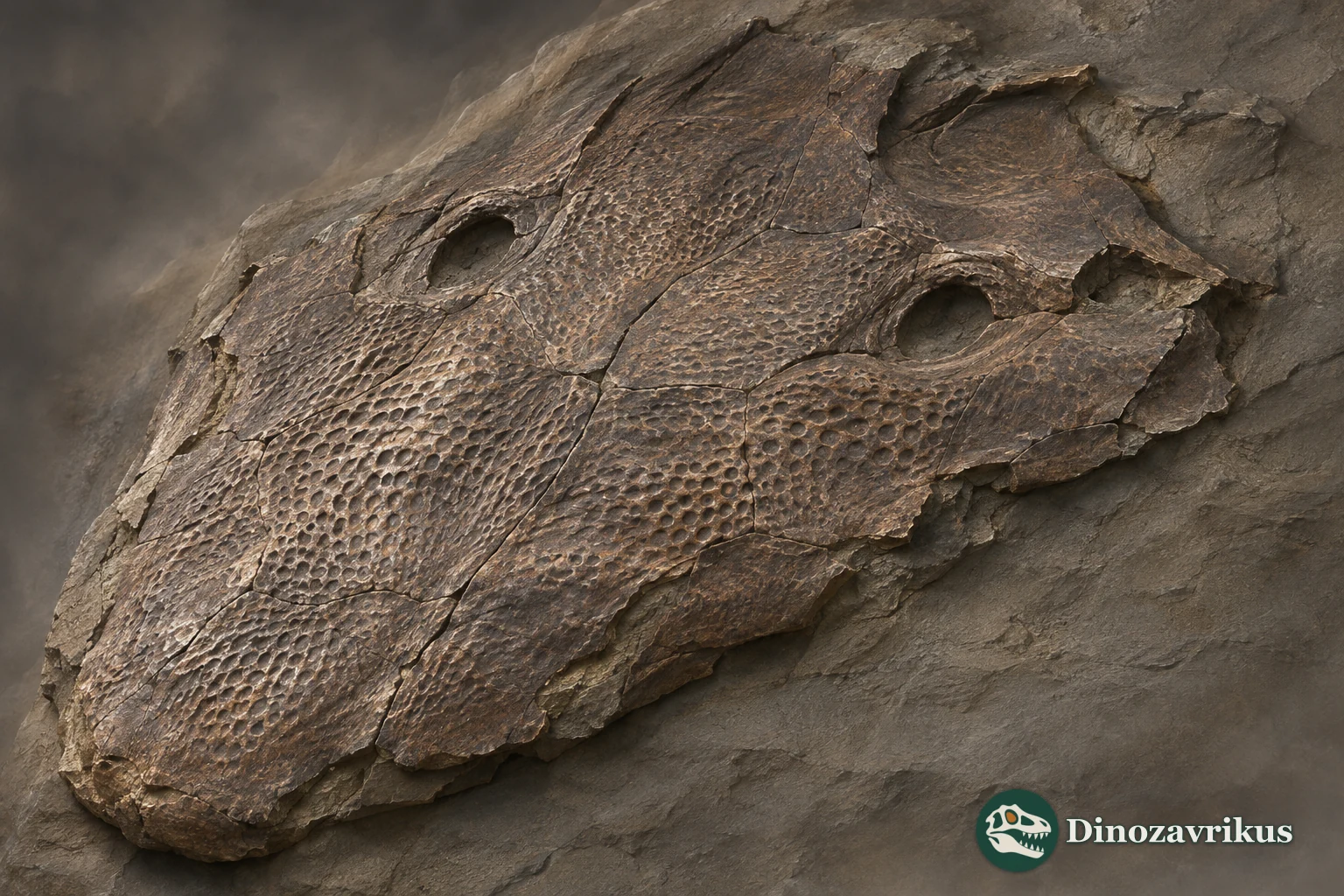
Several partial skulls and some trunk material are known for the type species. Shoulder bones and ventral scales were found with the type skull. Additional specimens retain a scapulocoracoid, a clavicle and ribs. The only specimen of C. borealis preserves a skull with its palate, lower jaws and associated bones, including a pair of stapes from the middle ear region.
How maturity was assessed
In the redescription the type skull of C. nocturnus measures 18.2 cm long and that of C. borealis 15.3 cm. A dense network of small pits and ridges covers the surface. Small orbits and ossification around the jaw joint point to adult animals. Parts of the braincase remained incompletely ossified, which led the authors to interpret the specimens as early adults.
Relationships and way of life
The 2024 revision confirmed that Clamorosaurus belongs to Eryopidae and placed it close to the North American Eryops. Its exact position in the tree depends on how the anatomical characters are weighted. Clamorosaurus occurs in lake limestones, and the researchers interpreted these eryopids as semiaquatic. The fossils give little indication of how much time the animal actually spent on land.
Frequently asked questions
Where was Clamorosaurus found?
The two species come from the Pechora River and a mine near Inta, both in Russia’s Komi Republic.
When did Clamorosaurus live?
It lived during the late Kungurian, near the end of the Early Permian.
How long were its skulls?
The 2024 revision reports a length of 18.2 cm for the skull of the type species and 15.3 cm for that of the second species.
Was Clamorosaurus fully aquatic?
The redescription favours a semiaquatic lifestyle. The available bones leave the animal’s degree of dependence on water uncertain.