

Crassiproetus had a strongly raised central head lobe and a long, convex tail shield. In the type species the front margin turns upward, and small, lens-shaped eyes sit to either side. Fossils from Michigan preserve those parts in several different views.
Quick facts
| Group | Trilobita, Proetidae |
|---|---|
| Age of type material | Middle Devonian |
| Type species | Crassiproetus traversensis |
| Name established | Erwin Stumm, 1953 |
| Type area | Michigan, USA |
| Holotype | Gravel Point Formation specimen |
What can the fossils tell us?
The front margin turns up, and the surviving cheeks preserve the ocular platforms.
The count is approximate because the grooves between many rings are shallow.
In C. arietinus two cranidia from the type series show diagnostic head features more clearly than the holotype.
A name based on Michigan fossils
Erwin Stumm proposed Crassiproetus in 1953 as a subgenus of Proetus. Its type species was the newly named Proetus (Crassiproetus) traversensis. Later work treated Crassiproetus as a genus. Holotype USNM 117876 from the Gravel Point Formation preserves the head and part of the thorax.
The type species occurs in the Middle Devonian Traverse Group. Material was also described from the Four Mile Dam Limestone. Detached head shields, cheeks and tails give different views of the same animal’s shell.
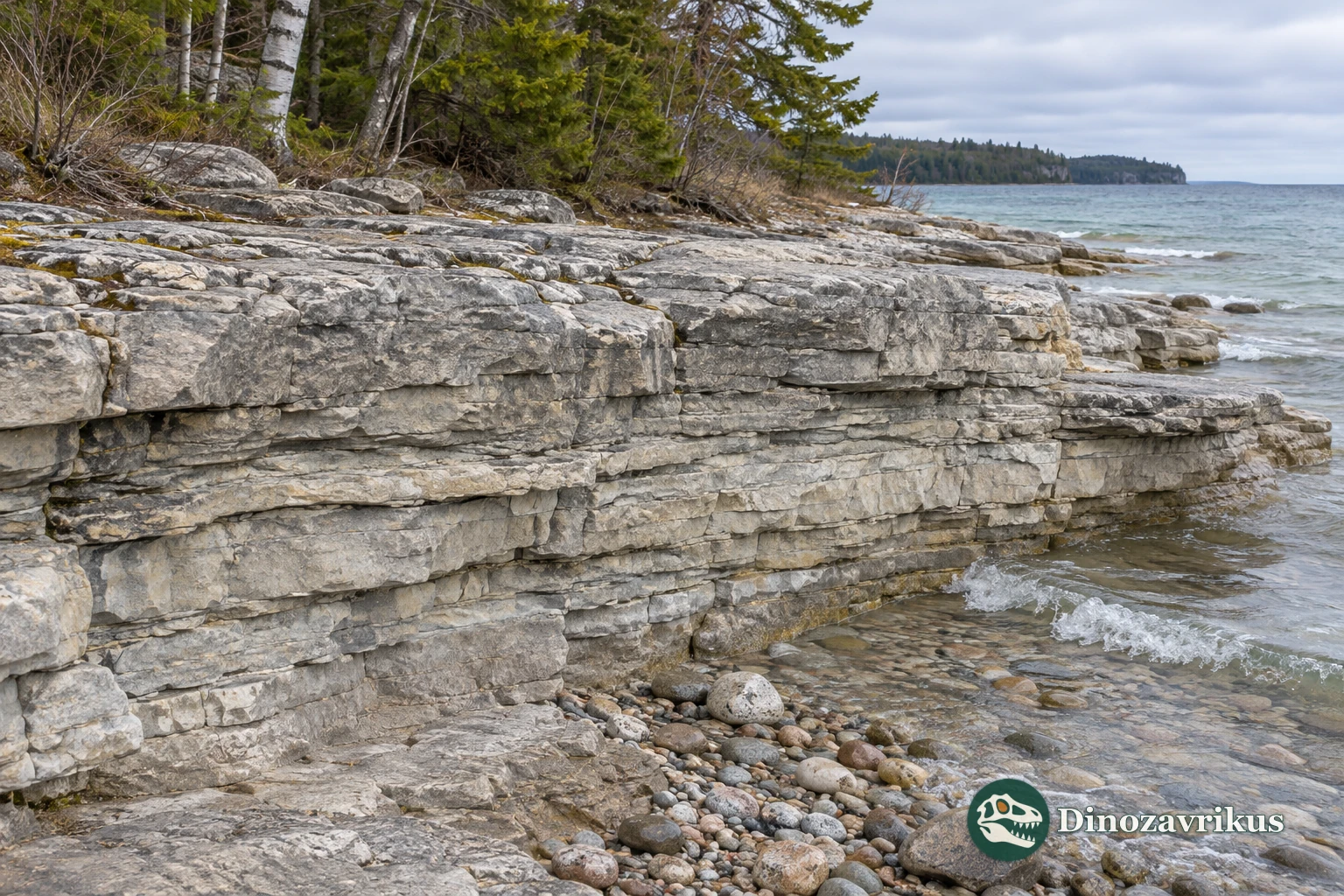
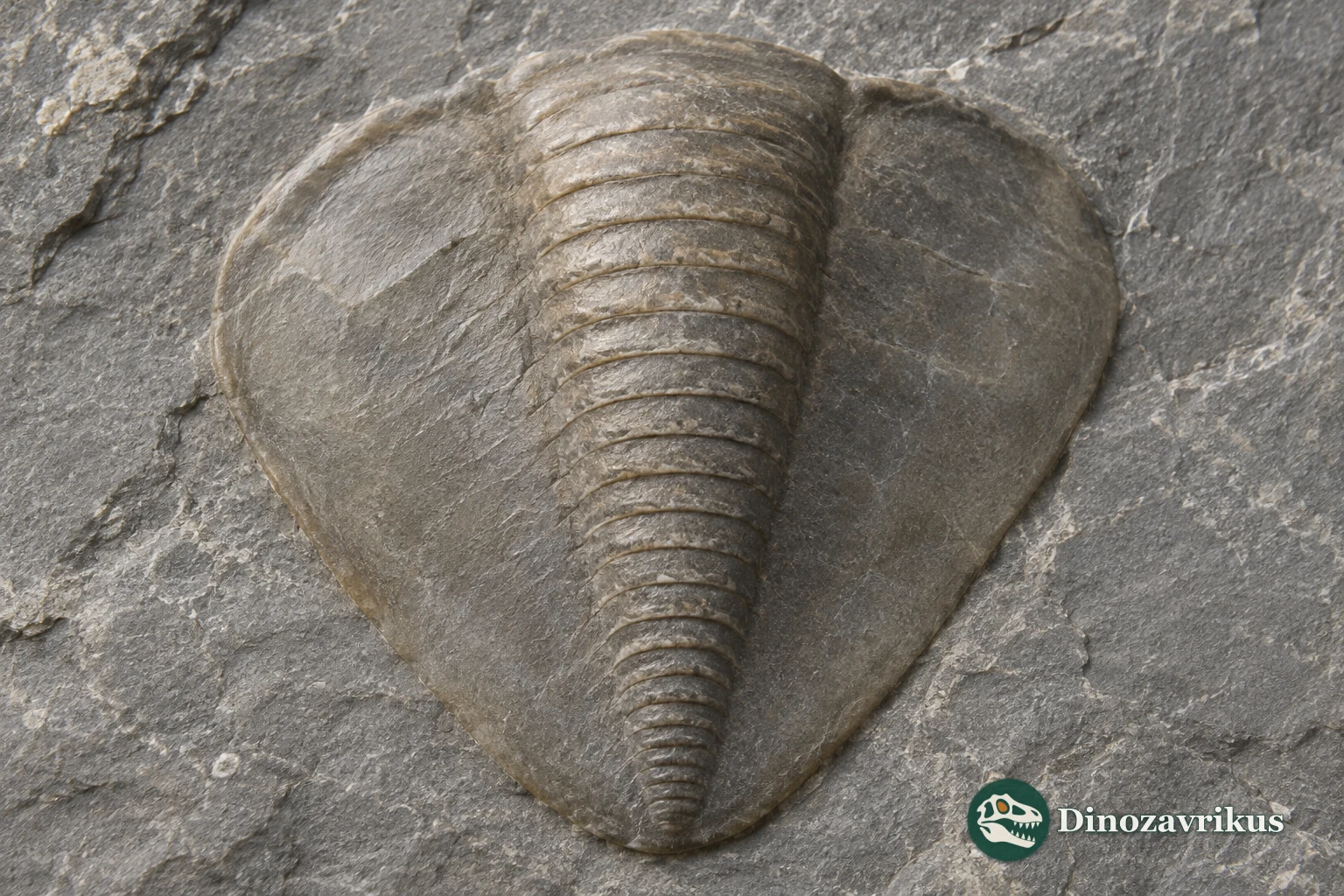
The raised head and the shallow tail rings
The glabella of the type species is almost as wide as it is long, with a rounded front and faint or absent grooves. Fine lines run along the thick, upturned anterior rim. The outer cheeks have rounded rear angles, and the eyes are about twice as long as they are high.
The tail axis tapers towards the rear. Stumm counted about 14–16 low axial rings and 9–11 less conspicuous lateral divisions, fading towards the back. Fine punctures on the shell are visible only in favourably preserved specimens.
Preservation and setting in Iowa and Ontario
The holotype of C. arietinus from the Cedar Valley Formation in Iowa, SUI 9122, is complete but heavily weathered. Cranidia SUI 9123 and SUI 9124 show the diagnostic relief more clearly. Locally the species is abundant in the Solon Member trilobite assemblage.
Crassiproetus is also one of the dominant proetid genera in the older, Emsian reef fauna of the Formosa Limestone in southern Ontario. This documents the genus in a reef assemblage. The fossils do not identify a particular diet.
Frequently asked questions
When was Crassiproetus named?
Erwin Stumm proposed the name for a subgenus of Proetus in 1953.
Which is the type species?
Crassiproetus traversensis from Michigan’s Middle Devonian Traverse Group.
How many rings were counted on the type species’ tail axis?
The published estimate is about 14 to 16. The ring furrows are shallow.
Where was it found in reef deposits?
In the Emsian Formosa Limestone of southern Ontario.