

Cryptopsar was an extinct starling from Mauritius. Some of the bones that revealed its identity had spent more than a century in a museum collection. A strong bill and short, sturdy legs set it apart from other extinct Mascarene starlings, but its plumage and the exact time of its disappearance remain unknown.
Quick facts
| Group | Starlings |
|---|---|
| Locality | Mauritius |
| Age | Holocene |
| Body length | About 26 cm, comparative estimate |
| Named by | Julian Hume, 2014 |
What can the fossils tell us?
A complete mandible collected by Étienne Thirioux was selected as the holotype. This physical specimen anchors the application of the species name.
Cranial fragments and wing and leg bones have also been assigned to the bird. They reveal proportions, but preserve no plumage colours.
Jaw structure and the robust tarsometatarsus are consistent with ground feeding. Particular prey and the causes of extinction remain hypotheses.
A starling hidden in a museum drawer
Julian Hume named Cryptopsar ischyrhynchus in 2014 during a revision of the Mascarene starlings. The genus combines Greek words for hidden and starling: the distinctive bird had remained unrecognised among museum bones. Its species name refers to the strong bill.
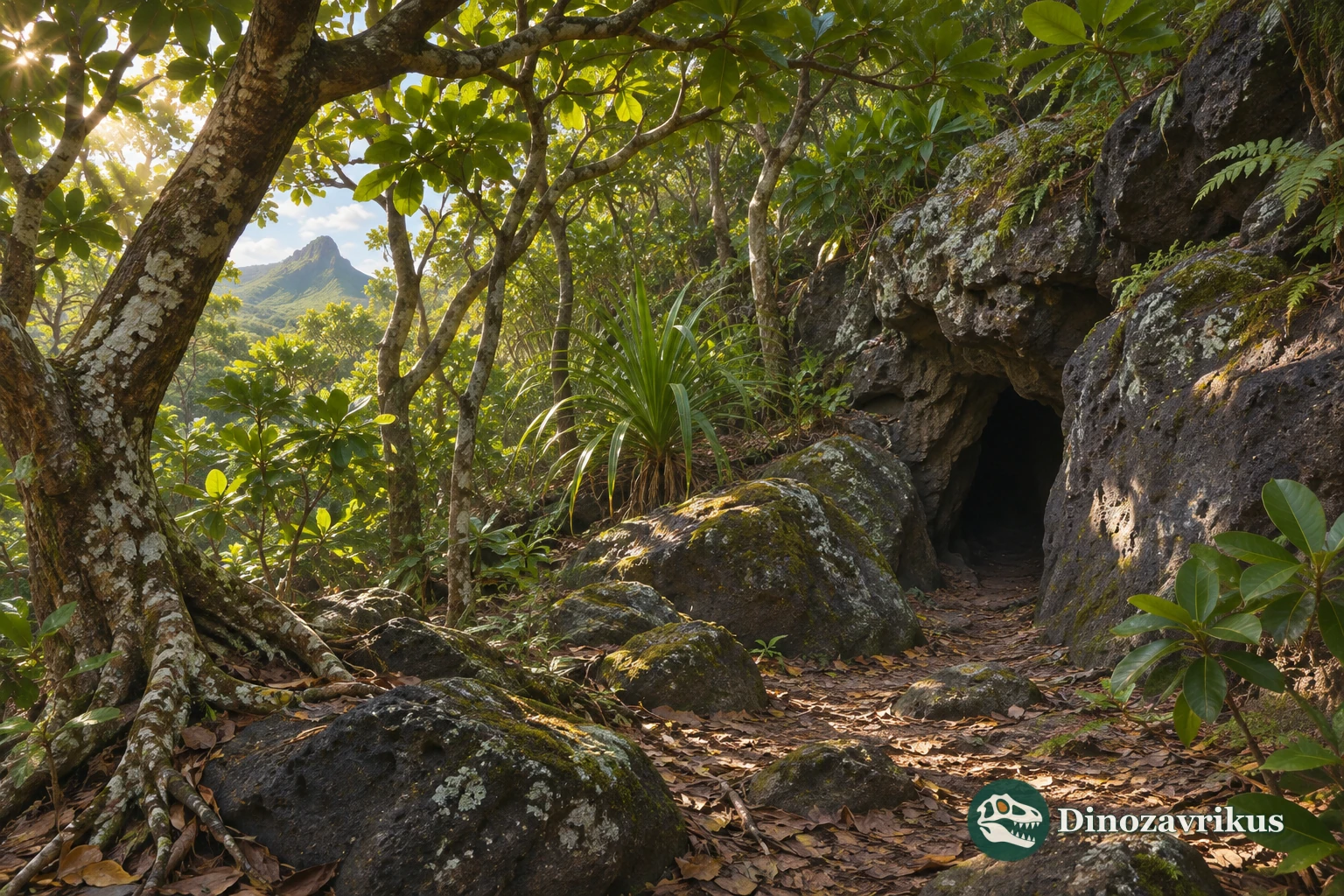
The holotype is a complete mandible, MNHN MAD6931, collected by naturalist Étienne Thirioux around 1904 in the Vallée des Prêtres area of Mauritius. Its precise origin in a cave or among boulders could not be recovered. The specimen is held by the Muséum national d’Histoire naturelle in Paris.
What survives of the bird
The material includes more than mandibles: parts of the cranium and upper bill, shoulder-girdle elements, wing bones and hindlimb bones have been identified. They come from several localities and must not be presented as a single complete skeleton. An additional upper-bill fragment was collected in a cave at Vieux Grand Port in southeastern Mauritius.
A total length of approximately 26 cm was estimated by comparison with other starlings. The tarsometatarsus was relatively short and robust, whereas the humerus was more slender. Cryptopsar was smaller than the other known extinct starlings of the Mascarene Islands.
A strong bill in an island forest
The bill had a pointed, slightly downcurved tip. A prominent process behind the jaw joint provided a lever for muscles opening the bill. This arrangement is consistent with forceful gaping: opening the bill within a substrate to expose concealed food.
Strong legs suggest frequent feeding on the ground. Invertebrates and small vertebrates have been proposed as possible prey, but no stomach contents establish the diet. Comparison with the related Necropsar helps explain the diversity of island starlings without borrowing that bird’s plumage for Cryptopsar.
The distribution of remains suggests an association with semi-dry evergreen forest. Cave sediments preserved the bones of dead birds; finding their remains there does not, by itself, demonstrate nesting inside caves.
Why its extinction cannot be dated precisely
Early accounts of Mauritius contain no reliable observation of a living Cryptopsar. It may have disappeared before regular European observations began, or simply escaped notice. Hume discussed introduced rats as a possible threat, especially to a bird spending substantial time on the ground. Neither an exact extinction year nor a single cause has been established.
Frequently asked questions
Is Cryptopsar known only from one jaw?
No. A mandible is the holotype, but other cranial remains and wing and leg bones have also been attributed to the species. These are separate finds, not a complete preserved bird.
How large was Cryptopsar?
It was estimated to be about 26 cm long. This is a comparison based on bones and the proportions of other starlings, not a measurement of a preserved skin or complete skeleton.
Can its feather colours be reconstructed?
Not securely. No preserved plumage or reliable description of the living bird is known. The colours in the artistic reconstruction are conjectural.
Was Cryptopsar hunted to extinction?
There is no direct evidence of hunting. Introduced animals may have contributed to its disappearance, but the shortage of dated records prevents a firm conclusion about the cause.