

The spines on the front segments of Cyphaspides point outwards. Towards the tail they become longer and turn backwards. Articulated shells from southeastern Morocco preserve the transition and show why thoracic segments can be hard to count even when the head and tail are in place.
Quick facts
| Family | Aulacopleuridae |
|---|---|
| Age | Devonian, Pragian to Givetian |
| Named by | Ottomar Novák, 1890 |
| Type species | Cyphaspides scuticauda |
| Complete shells | Near Erfoud, Morocco |
| Thorax | 13 segments in two Moroccan species |
What can the fossils tell us?
Head, thorax and tail are articulated. The front lateral spines are shorter than those nearer the tail.
The front segments can be covered by the head shield. The visible count may be incomplete.
Small shields have less pronounced relief and fewer distinct ribs. Growth and preservation affect counts.
From a German tail shield to Moroccan shells
Ottomar Novák established Cyphaspides in 1890. In 1925 Anthony Vogdes designated C. scuticauda as the type species. Its type is an isolated tail shield from the Eifelian Greifenstein Limestone of Hesse, Germany. Other occurrences are known from Europe, Uzbekistan, South China and Morocco.
Brian Chatterton, Stacey Gibb and Ryan McKellar described three species from articulated specimens in Eifelian beds of the Bou Tchrafine Group near Erfoud. The holotype of C. ammari, UA14313, came from Talawarite. The holotypes of C. nicoleae, UA14317, and C. pankowskiorum, UA14316, came from the Jorf area. The three fossils are held by the University of Alberta. C. ammari honours the Moroccan fossil preparator Ammar Ait H’Ssaine.

Small eyes and rows of spines
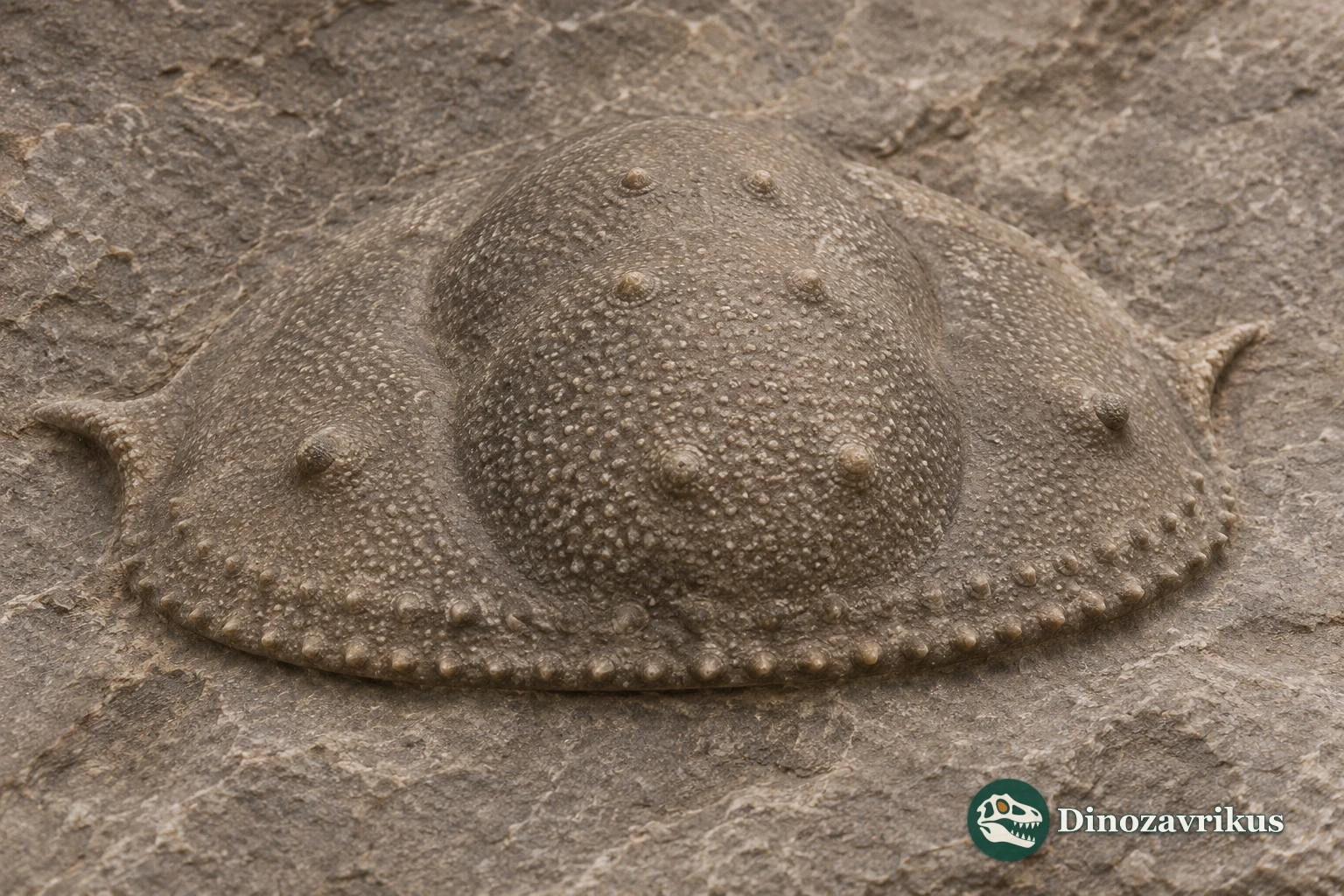
The eyes of C. ammari are small, raised on short stalks and widely spaced. Larger tubercles form irregular pairs on the domed glabella. Rows of pointed tubercles stand along the rim of the head. The facial sutures are fused in mature specimens. Their condition in the earliest larvae remains unknown.
Cyphaspis is a distinct trilobite genus with a similar name. In C. ammari, the cheek spines are relatively short, and lateral spines are present on each of the thirteen thoracic segments. In front they point down and outwards. Farther back they become longer and increasingly point backwards.
Tail ribs at different sizes
The tail axis of C. ammari preserves at least twelve rings and a terminal piece. Four or five main pairs of marginal spines extend from the tips of the tail ribs, along with smaller spines. The German type species has six such well-defined pairs of ribs.
Small silicified tail shields from Morocco have more subdued grooves and fewer distinct ribs. The authors suggested that the number of conspicuous ribs may increase as an individual grows. Comparisons between differently sized tail shields must therefore allow for growth.
Why counts can differ
Thirteen segments are established in C. ammari and C. pankowskiorum. Eleven are visible in the holotype of C. nicoleae. Its two foremost segments could be hidden under the head, so the visible count leaves open whether the species actually differ in segment number.
The last pair of thoracic spines in C. pankowskiorum project well past the tail shield. In C. ammari the same spines usually stop just short of its rear edge. This difference is visible on the articulated shells.
Frequently asked questions
Where was the type specimen of the genus found?
The type tail shield comes from the Devonian Greifenstein Limestone of Hesse, Germany.
How many thoracic segments did the Moroccan species have?
Thirteen are visible in C. ammari and C. pankowskiorum. The holotype of C. nicoleae exposes eleven, with two possibly hidden under the head.
Why is C. ammari named ammari?
It honours Ammar Ait H’Ssaine, a Moroccan trilobite fossil preparator.
Where were the eyes on the head?
In C. ammari the small eyes are set on short stalks near the lateral margins of the head.