

Cyriacotherium was a small-bodied mammal from the Paleocene of western North America. It is known chiefly from teeth, jaws and fragments of the snout. Some dental features resemble those of pantodonts, while others have been compared with dermopterans, the group that includes living colugos. This combination made its relationships unusually difficult to assess.
The genus belongs in the ancient mammal catalogue. Its fossils add to a diverse early placental record, but the sparse material cannot support a detailed account of its full body or behaviour.
Quick facts
| Scientific name | Cyriacotherium Rose & Krause, 1982 |
|---|---|
| Known species | C. argyreum and C. psamminum |
| Group | Cyriacotheriidae; its placental relationships have been debated |
| Age | Paleocene of North America |
| Best-known locality | Brice Canyon, Bighorn Basin, Wyoming |
| Holotype of C. argyreum | YPM-PU 18821, a crushed snout with teeth |
| Main limitation | Evidence consists chiefly of teeth and jaw or skull fragments |
What can the fossils tell us?
YPM-PU 18821 preserves part of the snout and tooth row. It allows anatomical comparisons, but is not a complete skull or skeleton.
Some dental features were compared with pantodonts and others with dermopterans. Tooth shape is directly observed; its meaning for ancestry is inferred from comparative analyses.
Craig Scott's phylogenetic analysis placed Cyriacotheriidae within Pantodonta. That result depends on the taxa and characters included and does not erase earlier alternatives.
Discovery and the type specimen
Kenneth Rose and David Krause established Cyriacotheriidae and the genus Cyriacotherium in 1982. They named two species, C. argyreum and C. psamminum. The holotype of the first, YPM-PU 18821, came from the Brice Canyon locality in the northern Bighorn Basin of Wyoming and is held by the Yale Peabody Museum.
The specimen is a crushed snout with parts of the upper tooth row and sockets for missing teeth. Stephen Secord's study of the Tiffanian land-mammal age listed the preserved elements and locality. This fragment anchors the name, but it does not show the proportions of a complete skull or body. Other referred material is also fragmentary, and isolated teeth are not always securely assignable to a species.
Unusual teeth
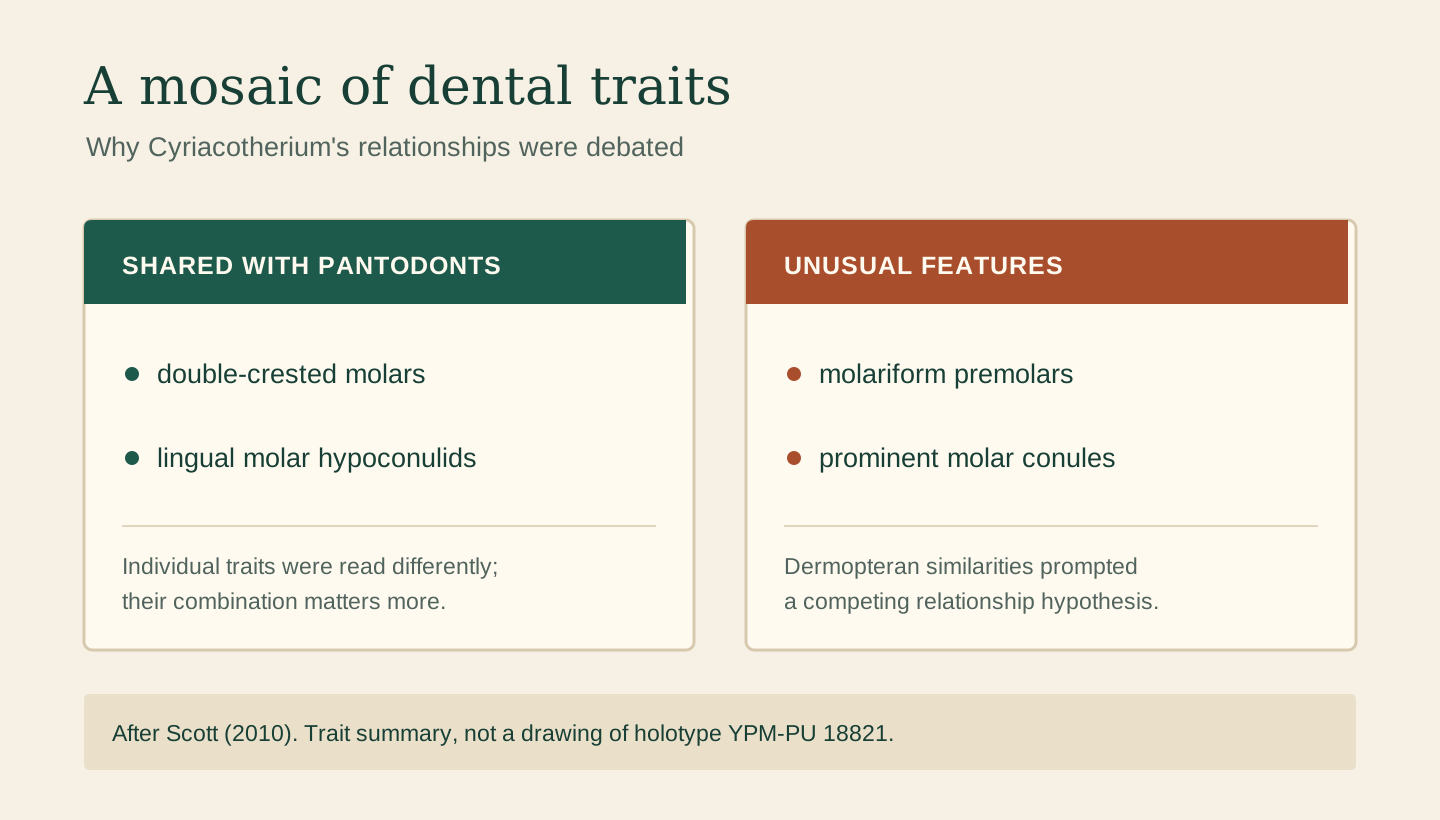
The first authors placed the family among pantodonts, an extinct group of placental mammals. The teeth share some traits with pantodonts, yet the upper premolars and molars have features that are unusual in that group. Comparisons with dermopterans drew attention to particular ridges, cusps and the position of structures on the crown.
A tooth crown records shape, wear and the arrangement of enamel ridges. It does not preserve food itself. Similar structures can evolve in separate lineages, so one matching feature cannot demonstrate close ancestry or an identical diet. A useful comparison considers many characters across a broad sample of related and unrelated mammals.
A debated evolutionary position
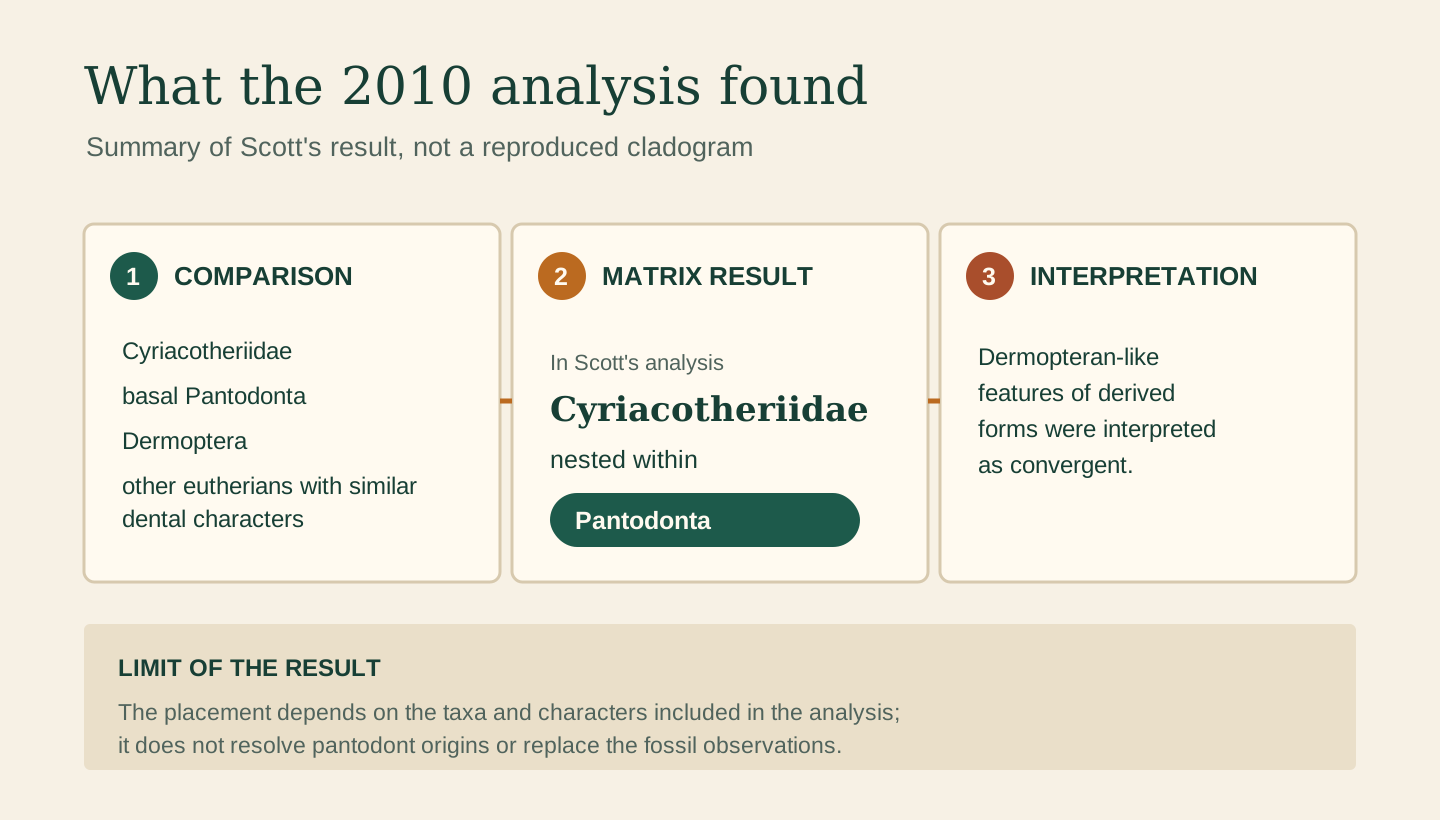
S. G. Lucas later argued that cyriacotheriids were closer to dermopterans than to pantodonts. In 2010 Craig Scott described older family members from Alberta and analysed them together with pantodonts, dermopterans and other placental mammals. His phylogenetic analysis placed Cyriacotheriidae inside a monophyletic Pantodonta and interpreted some dermopteran-like traits as convergent.
This was a testable result of a character matrix, not a direct property visible on one bone. The analysis strengthened the pantodont hypothesis but did not resolve broader questions about pantodont origins. Different taxon samples or new fossils can alter how the same characters are interpreted.
Age and fossil localities
Cyriacotherium is known from Paleocene deposits in the western interior of North America. Records are discussed within regional North American land-mammal biochronology, which uses associated fossils to compare sections. Such zones help organise the record but are not radiometric dates for each tooth or jaw.
The fossils come from more than one locality and interval. Separate quarry samples should not automatically be assembled into a single skeleton or treated as one moment in a local ecosystem. For each specimen, its museum number, collecting locality and stratigraphic context matter as much as its proposed identification.
Body, diet and the limits of reconstruction
The family is described as small-bodied relative to many other pantodonts, but a complete skeleton of Cyriacotherium is not known. Body mass, limb proportions, coat, ears and tail cannot be reconstructed directly from the dental material. Any complete animal illustration is necessarily a cautious artistic hypothesis.
Dental form can suggest how food was mechanically processed, but the published record does not provide stomach contents or remains of a specific food. Claims about exact diet, locomotion, social behaviour, reproduction and pathologies go beyond the available fossils. Better-preserved jaws and postcranial bones would help test those questions.
Frequently asked questions
When did Cyriacotherium live?
The genus is known from Paleocene deposits of western North America. Different specimens come from separate localities and biochronological intervals.
What does the C. argyreum holotype preserve?
YPM-PU 18821 is a crushed snout with parts of the upper tooth row and alveoli. It is a diagnostic fragment, not a complete skull or skeleton.
Why have its relationships been debated?
Its teeth combine features compared with pantodonts and dermopterans. Scott's 2010 analysis supported pantodont affinities, but the result remains an inference based on comparative characters.
Can its exact diet and appearance be reconstructed?
No. Teeth inform comparisons of food processing, but no complete skeleton, stomach contents or soft tissues are known. Many details of a life reconstruction remain speculative.