

Dasyceps was an Early Permian temnospondyl amphibian. A large opening is visible in the bones at the front of the elongated snout, ahead of the paired nostrils. Related zatracheids had comparable openings, whose shape and size help identify different genera.
Quick facts
| Group | Temnospondyls, zatracheids |
|---|---|
| Age | Early Permian |
| Region | Europe and North America (England and Texas) |
| Type species | Dasyceps bucklandi |
| Scientific name | Dasyceps |
| Diet | Exact prey is unknown |
What can the fossils tell us?
The English skull preserves elongated premaxillae, relatively small orbits and a large median opening ahead of the nostrils.
Similarities in the outline and arrangement of the skull roof bones led researchers to assign the Texas animal to the same genus as the English Dasyceps.
The fossil shows the outline of the opening. It does not preserve the soft tissue that occupied it.
The skull from Kenilworth
George Lloyd described the British skull in 1850 as Labyrinthodon bucklandi. Thomas Huxley later erected the genus Dasyceps for it. The holotype, G42, is held in the Warwickshire Museum collection. Its bones are preserved on the matching faces of a split block. It comes from Early Permian deposits at Kenilworth, though the exact site within the district remains uncertain.
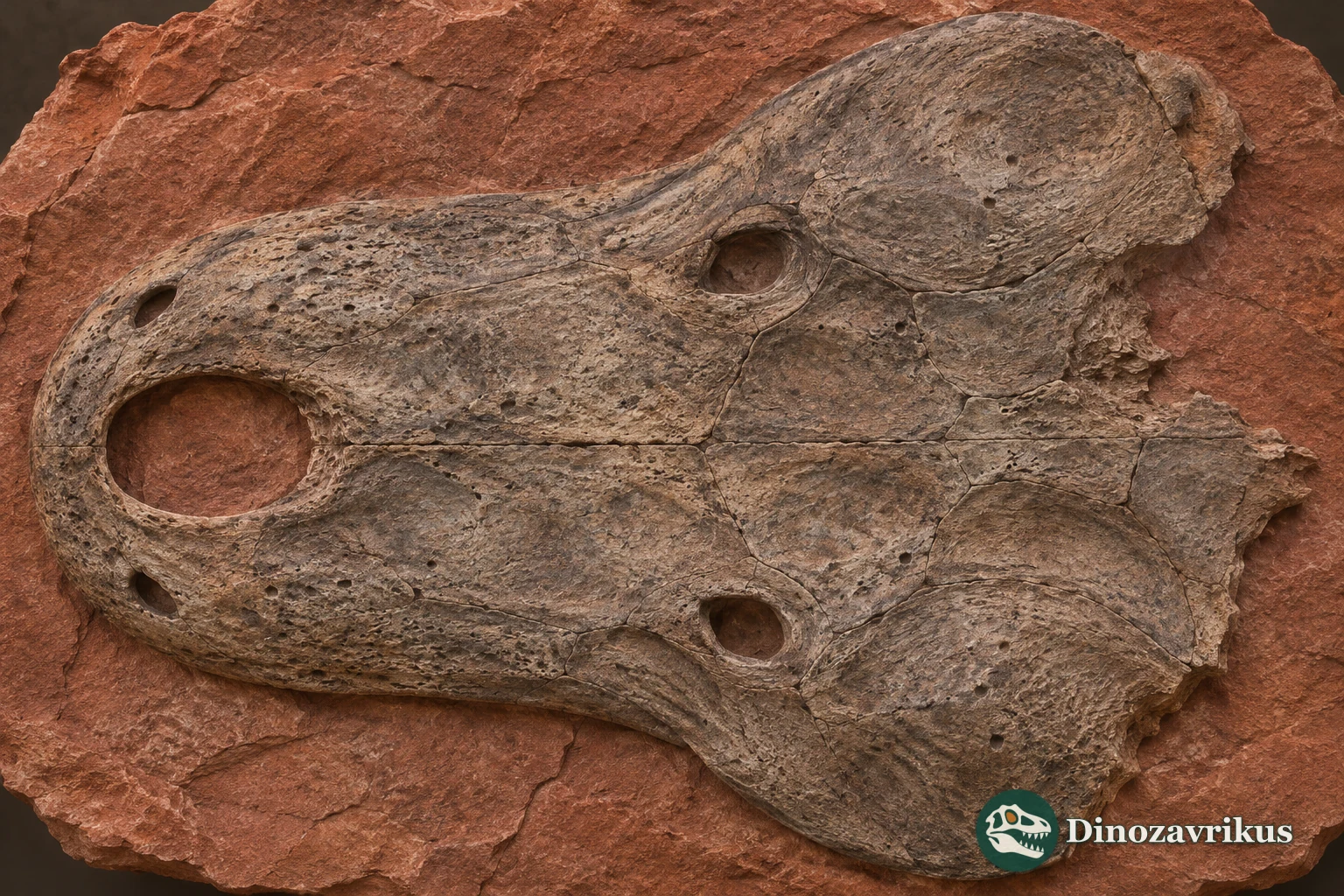
The bones of the snout
The snout is elongated with a rounded outline at the front. Large premaxillae border a median opening with an almost teardrop-shaped outline. The quadratojugal bones flare on either side of the skull without the pronounced cheek spikes seen in Zatrachys. Roberta Paton proposed that the opening might have held a soft-tissue organ, possibly a gland. The skull alone cannot confirm that interpretation.
Fossils outside England
The Texas species Dasyceps microphthalmus was originally assigned to Zatrachys. Paton transferred it to Dasyceps after comparing the skulls. An incomplete skull from Obora in the Czech Republic has also been assigned to Dasyceps. Its preserved features support comparison at genus level, and it has been left without a species identification.
What the fossils suggest about its habits
Paton proposed that Dasyceps may have spent much of its time on land, based on a comparison of the skull with those of other temnospondyls. Both named species are represented by cranial fossils. Limb and trunk material would help clarify how Dasyceps moved and how dependent it was on water.
Frequently asked questions
Where was Dasyceps found?
The type species is from England and the second named species is from Texas. A Czech skull has also been referred to the genus.
When did Dasyceps live?
The established finds are from the Early Permian.
What was the opening in its snout for?
One proposal is that it housed a soft-tissue organ, possibly a gland. The organ itself is not preserved.
Did Dasyceps have spikes on the sides of its head?
The cheek bones widened on either side but lack the pronounced lateral spikes of Zatrachys.