

Dawsonerpeton polydens was a Late Carboniferous temnospondyl from Bohemia. Its fragmentary skull bones come from coal-bearing deposits. They have been compared with those of other dvinosaurs, with the proportions of the complete animal still unclear.
Quick facts
| Group | Temnospondyls, dvinosaurs (Dvinosauria) |
|---|---|
| Age | Late Carboniferous, Gzhelian |
| Region | Europe (central Bohemia, Czech Republic) |
| Type species | Dawsonerpeton polydens |
| Scientific name | Dawsonerpeton |
| Diet | Exact prey is unknown |
What can the fossils tell us?
Lectotype M 419 is held by the National Museum in Prague. The Czech specimen catalogue records Kounov and Záboř.
The skull fragments support comparison with dvinosaurs. Finer placement depends on characters beyond those preserved.
Body proportions, adult length and exact diet are unresolved.
The first description and a new genus name
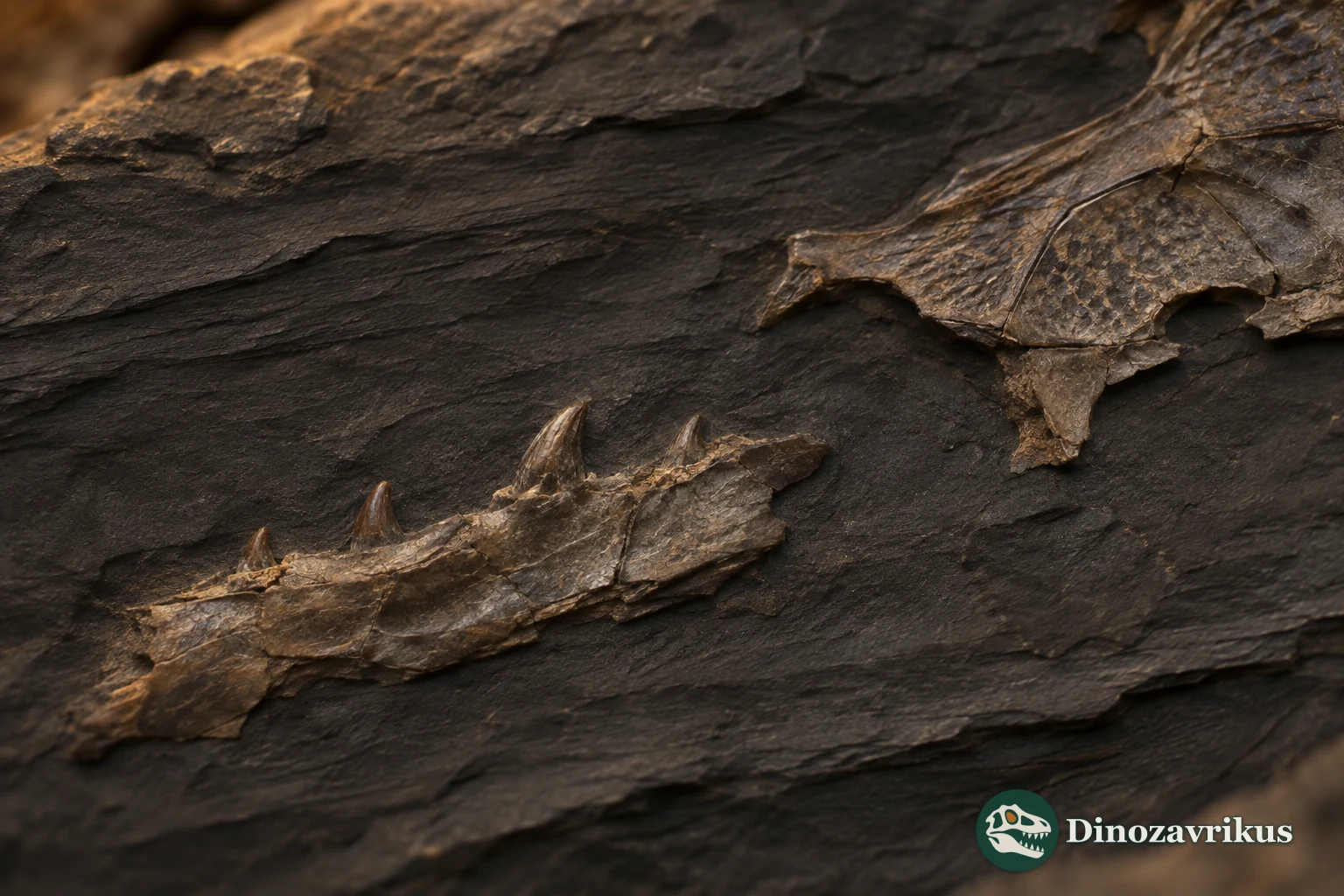
Antonín Frič first published the name Dawsonia polydens in 1879. M 419, one of his figured specimens, is the lectotype and is held in Prague. Jaroslav Zajíc supplied Dawsonerpeton as a replacement genus name in 1984. The species epithet polydens was carried over.
Where it fits among temnospondyls
Alfred Romer compared the fragments with temnospondyls whose skulls are better known and drew attention to the limited material. Subsequent studies have discussed possible affinity with the family of Trimerorhachis and similarities to dvinosaurids. Features of the skull support the broad association with dvinosaurs. The finer relationships are difficult to test, given the missing parts.
The age of the coal-bearing beds
The Czech fossil inventory lists Kounov and Záboř for Dawsonerpeton. Both are associated with the Kounov Member of the Slaný Formation in central Bohemia. The Kounov coal is Gzhelian in age. A volcanic ash layer within the coal records an age of around 301.5 million years. That dating applies to the layer and provides context for the fossils.
Frequently asked questions
Where was Dawsonerpeton found?
In central Bohemia. Published specimen records list Kounov and Záboř.
Where is the type specimen kept?
Lectotype M 419 is held by the National Museum in Prague.
Why do older works call it Dawsonia?
Frič described the species under that genus name. Zajíc supplied Dawsonerpeton as the replacement name in 1984.
Can its whole body be reconstructed?
The skull fragments can be compared with those of other amphibians. They give too little information to reconstruct the proportions of the whole body.