

Denazinosuchus kirtlandicus was a Late Cretaceous crocodyliform from the San Juan Basin of New Mexico. An incomplete skull was first assigned to Goniopholis and later became the type of a separate genus. Its position among related crocodyliforms is still debated.
Quick facts
| Species | Denazinosuchus kirtlandicus |
|---|---|
| Group | Neosuchian of disputed affinities |
| Age | Late Cretaceous, late Campanian |
| Locality | San Juan Basin, New Mexico |
| Principal evidence | Partial skull without the lower jaw |
| Rock unit | De-na-zin Member, Kirtland Formation |
What can the fossils tell us?
Bones of the snout and skull roof are visible. The lost parts have to be reconstructed in comparisons, leaving the exact outline uncertain.
This part of the Kirtland Formation is late Campanian. Historical field records give an approximate locality.
Depressions found on many goniopholidid maxillae are unreported in this skull. Other characters leave a relationship with that family possible.
A skull from Sternberg’s collections
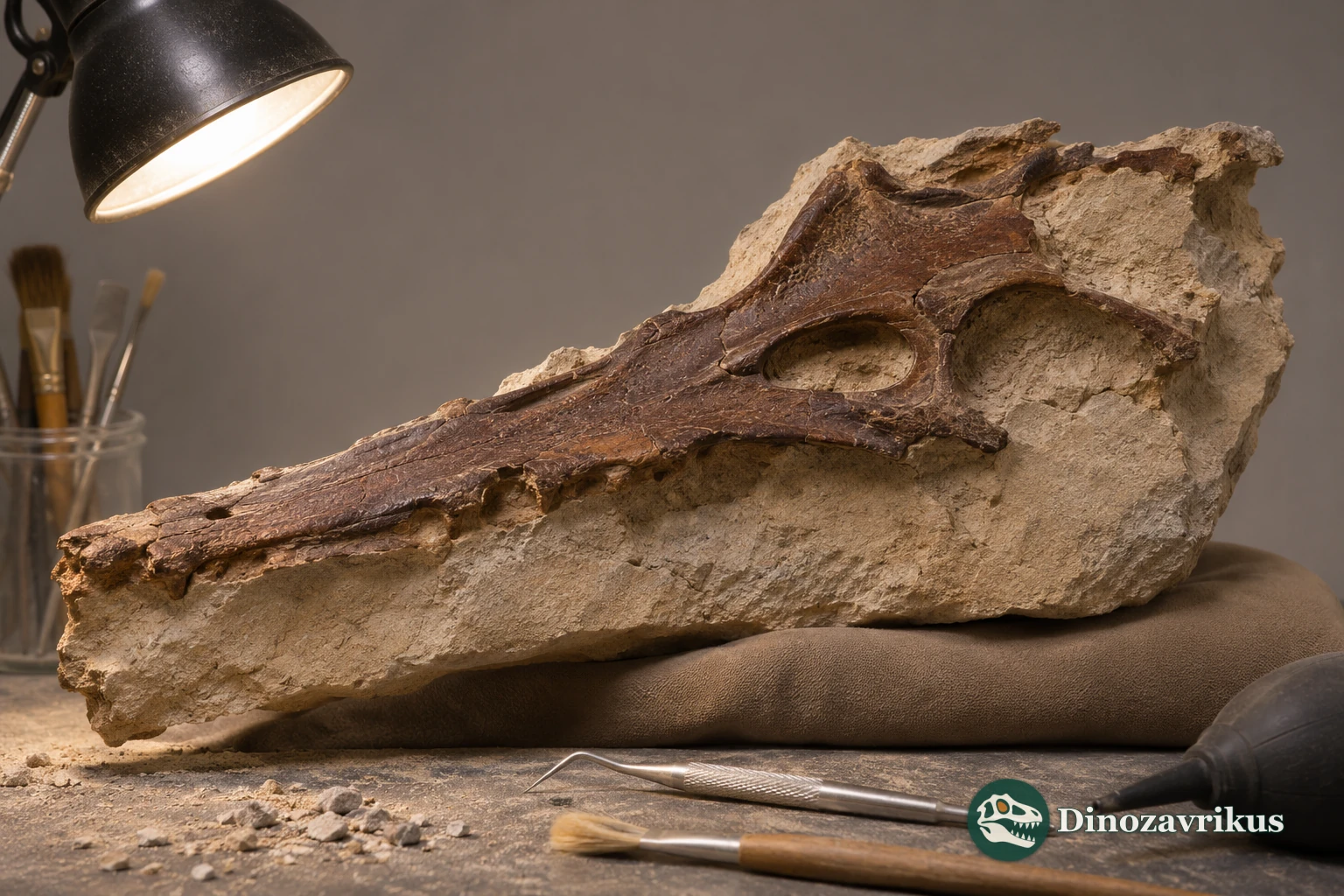
Charles Sternberg collected Late Cretaceous fossils in New Mexico for Uppsala University in 1921. One skull became Goniopholis kirtlandicus in Carl Wiman’s description of 1932. It is now catalogued as PMU 24847 and was formerly numbered PMU.R230.
Historical locality records place the discovery around Barrel Springs. The skull comes from the De-na-zin Member of the Kirtland Formation, of late Campanian age. The genus name introduced by Spencer Lucas and Robert Sullivan in 2003 refers to that rock unit.
What the type shows
The best preserved bones are on the right side. They include the premaxilla at the front of the muzzle, the lacrimal and part of the skull roof. Both nasals and prefrontals are also present. Much of the back of the skull and the lower jaw are missing.
An early reconstruction gave the skull a triangular outline in dorsal view, with the nostrils near the front. The missing portions limit attempts to restore its exact width, the complete tooth row and the proportions of the body.
Placement in a new genus
The depressions on the maxillae of several goniopholidids have not been identified in Denazinosuchus. Differences revealed by comparison with Goniopholis supported placing the New Mexico species in a separate genus. Lucas and Sullivan left its family-level affinities open.
In an exploratory analysis published in 2011, Marco de Andrade and colleagues recovered it among goniopholidids. A 2018 study omitted it from some calculations because it moved between positions on the evolutionary tree. The fragmentary skull provides relatively few characters for testing these alternatives.
Frequently asked questions
When did Denazinosuchus live?
The type comes from the De-na-zin Member of the Kirtland Formation, which is late Campanian in age.
Where is the type fossil held?
It is catalogued as PMU 24847 in the palaeontological collection at Uppsala University in Sweden.
Why was it originally called Goniopholis?
Carl Wiman assigned it to the genus based on the skull. Later comparisons highlighted differences including features of the maxilla.
Can its total length be estimated?
Reliable body proportions are difficult to infer. The skull is incomplete and no associated trunk or tail is preserved.