

Dentaneosuchus crassiproratus was a large terrestrial crocodylomorph from the middle Eocene of southern France. It was long known from the front of a lower jaw. Discoveries at Réalmont added cranial, limb and pelvic bones that helped resolve its relationships among sebecids.
Quick facts
| Species | Dentaneosuchus crassiproratus |
|---|---|
| Group | Sebecid |
| Age | Middle Eocene |
| Localities | Issel and Réalmont, France |
| Principal evidence | Jaws, skull fragments, humerus and ischium |
| Skull length | About 90 cm in reconstruction |
What can the fossils tell us?
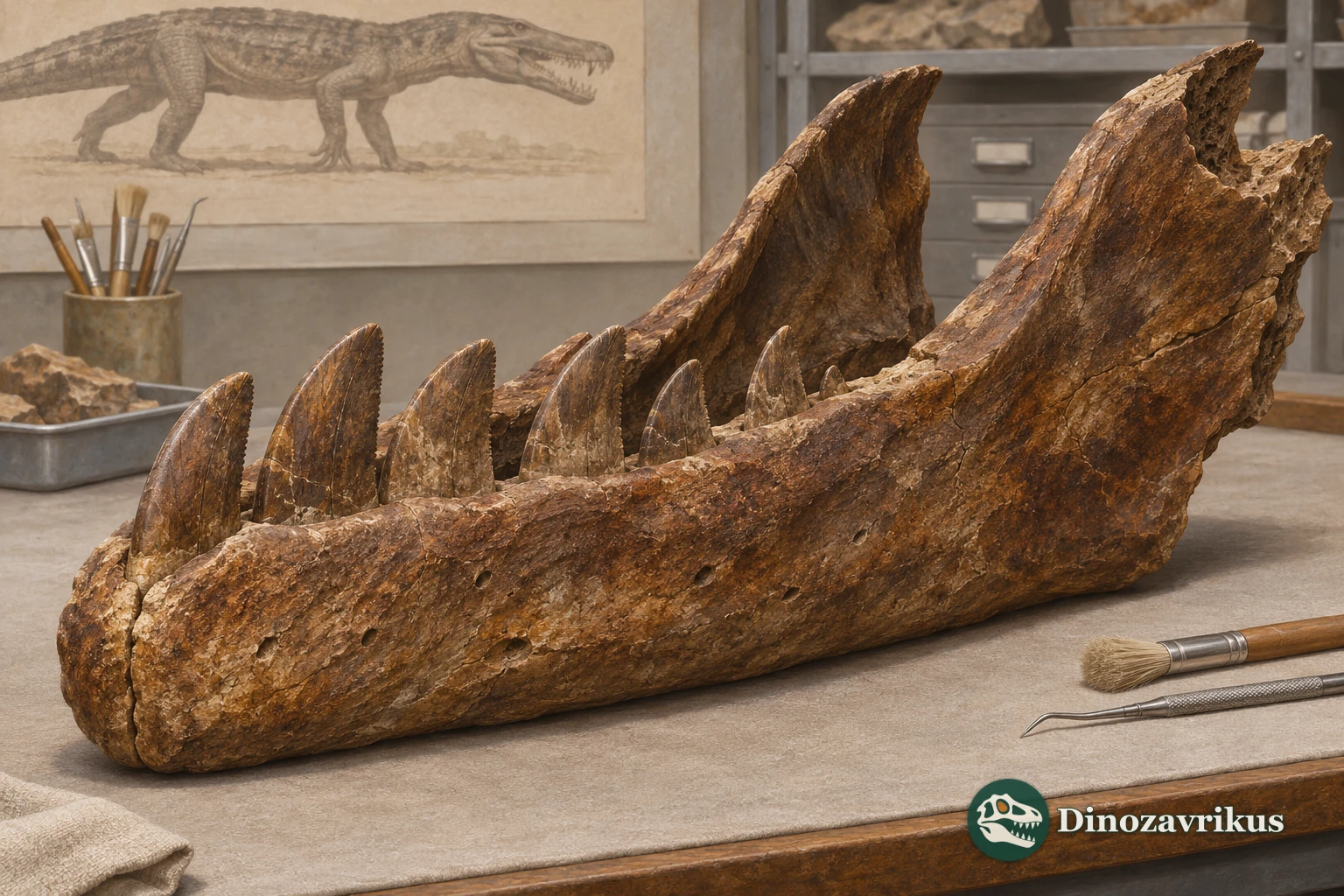
The measurement is for the preserved bone of the left jaw branch. It indicates the size of the head, while overall body length remains uncertain.
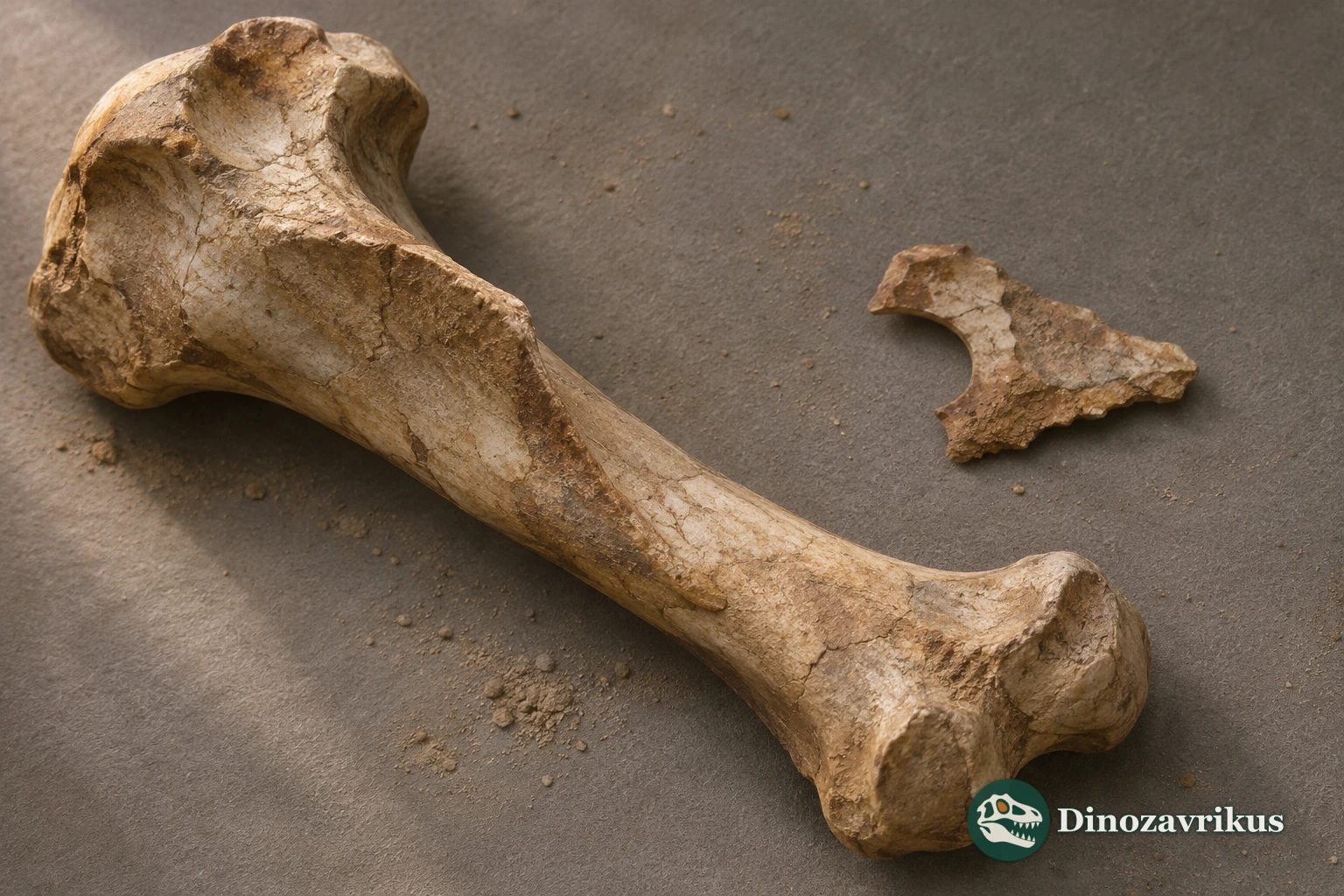
The crest and pelvic anatomy support terrestrial movement. Neither provides a direct measure of speed.
The flattened crowns could slice into food. The teeth alone do not establish which animals it preyed on.
From an Issel jaw to new fossils in the Tarn
Gaston Astre named Atacisaurus crassiproratus in 1931 from the front of a lower jaw found at Issel in the Aude department. The type, MHNT.PAL.2006.0.53, includes the region where its lower jaw halves meet. In 1996 the species was tentatively referred to Iberosuchus.
In 2023 Jérémy Martin and colleagues compared the type with new material from near Réalmont in the Tarn department and established the genus Dentaneosuchus. The Réalmont fossils date to the Bartonian stage of the middle Eocene. The material is held by the Natural History Museum of Toulouse.
The size and teeth of the head
The Réalmont fossils include a left dentary about 70 cm long, a premaxilla, bones from the back of the lower jaw and part of the skull roof. The Toulouse Museum gives approximately 90 cm for the reconstructed skull length. This is comparable with estimates for the large South American sebecid Barinasuchus.
An approximate total length of five metres has been suggested. The trunk and tail are too incomplete for that number to be checked against a skeleton. The tooth crowns were laterally compressed and serrated, suitable for cutting tissue. The fossils leave the identity of typical prey open.
Limb evidence and relationships
The material includes a dorsal vertebra, thick osteoderms, a left humerus and part of a right ischium. A prominent crest on the humerus anchored muscles around the shoulder. Its form and that of the pelvic bone are consistent with a terrestrial animal.
Martin and colleagues recovered Dentaneosuchus on an early branch of Sebecidae. Its position alone cannot settle the route by which the group dispersed. It establishes the presence of a large terrestrial sebecid in Europe, while much of the family’s record comes from South America.
Frequently asked questions
Why has the name of this animal changed?
The first jaw was named as a species of Atacisaurus and later attributed tentatively to Iberosuchus. New discoveries supported a separate genus.
Which measurements come from actual bones?
One dentary measures about 70 cm. The roughly 90 cm skull length is a reconstruction because no complete skull is preserved.
Did Dentaneosuchus move on land?
The shape of the humerus and pelvis supports a terrestrial habit. The fossils leave details of its gait uncertain.
What did it prey on?
The serrated cutting teeth support predation. They cannot identify particular prey species.