

Deslongchampsina larteti was a marine crocodylomorph of the Bathonian stage of the Middle Jurassic. The species was named from a skull found in Normandy, which was later lost. An English skull now serves as the type and preserves the snout, the pointed crowns and large openings in front of the eyes.
Quick facts
| Species | Deslongchampsina larteti |
|---|---|
| Group | Machimosaurid |
| Age | Middle Jurassic, Bathonian |
| Localities | Normandy and Oxfordshire |
| Principal evidence | Partial skull from Enslow Bridge |
| Neotype repository | Oxford University Museum of Natural History |
What can the fossils tell us?
The replacement type shares features and a Bathonian age with the French original. It is a separate fossil from across the Channel.
Their shape and size distinguish the skull from some other teleosauroids. Their precise function cannot be established from this skull.
The crowns suit grasping a range of prey. They give little support to a specialised shell-crushing diet.
The French specimen and its casts
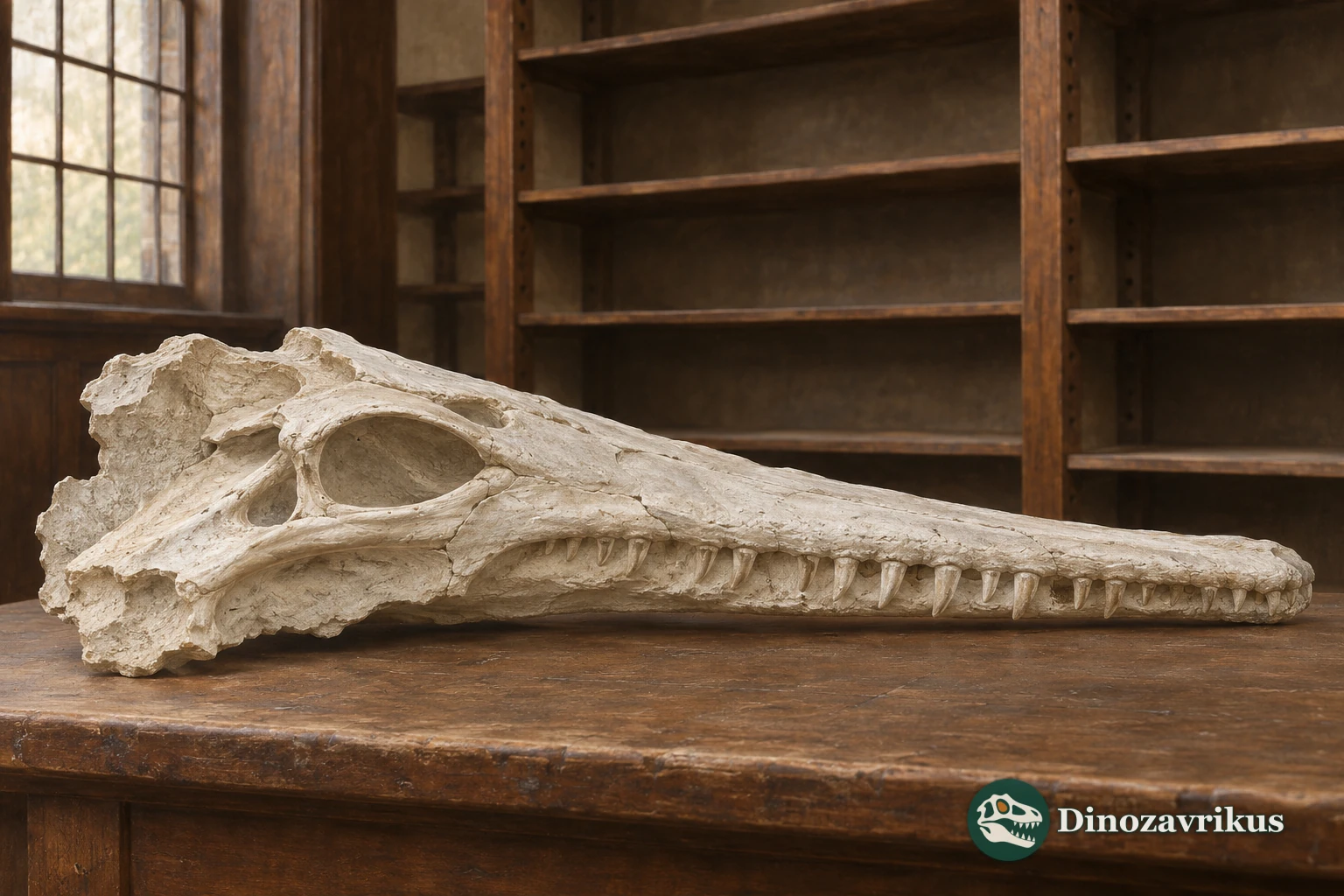
Jacques Amand Eudes-Deslongchamps described Teleosaurus larteti in 1866. The species name honours Lartet, who provided the skull for study. The species was later transferred to Steneosaurus. The original skull came from Bathonian rocks in Calvados and is presumed to have been destroyed during the bombing of Caen in 1944.
Printed illustrations and historical plaster casts survive. One cast is held by the Natural History Museum of Toulouse. It preserves the shape seen by earlier researchers, while the original bone is unavailable for direct examination.
Why another skull became the type
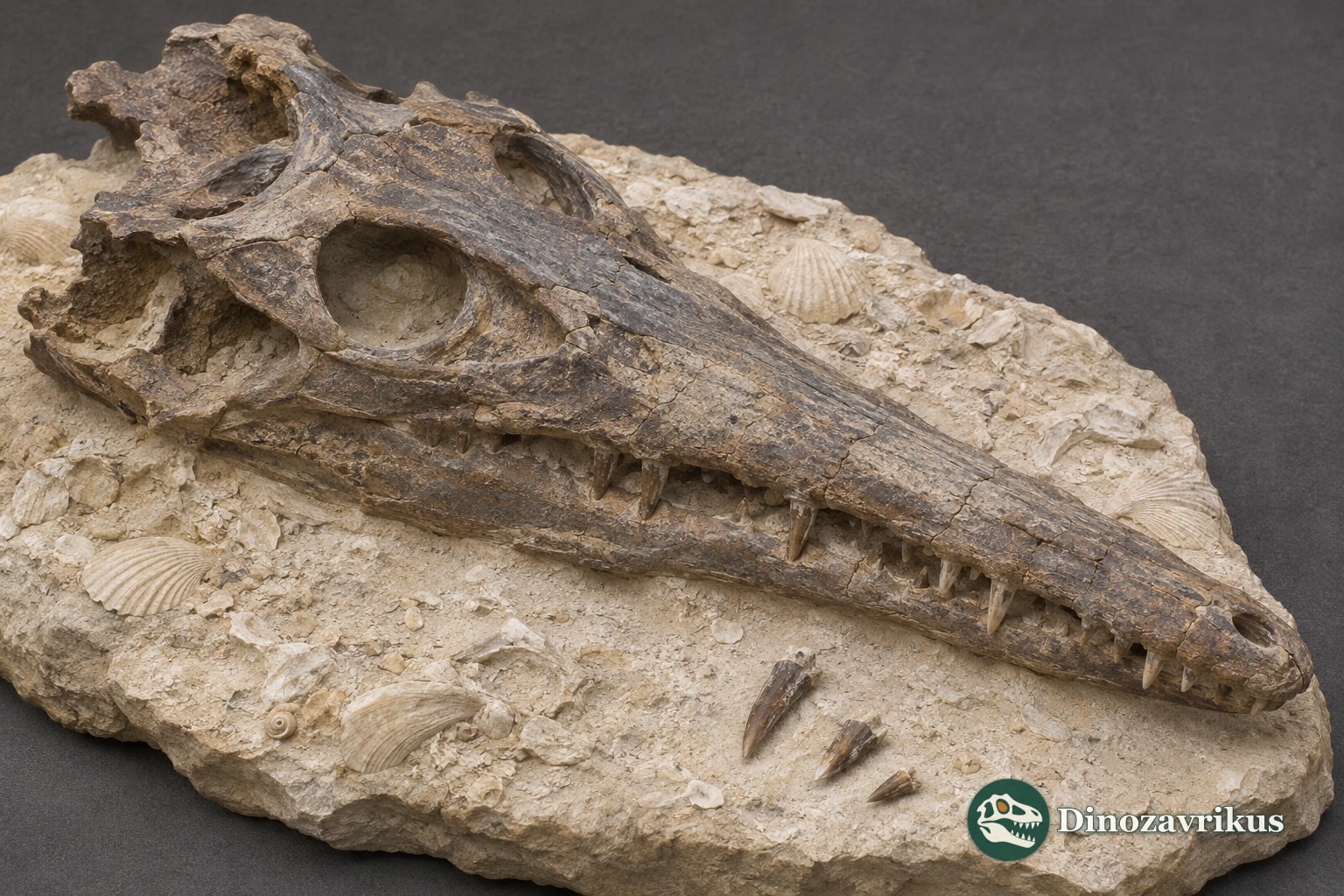
Michela Johnson, Mark Young and Stephen Brusatte established a separate genus in a paper published online in 2019. The name honours Jacques Amand and Eugène Eudes-Deslongchamps, the father and son who studied the French fossil. They designated OUMNH J.29851, a partial skull in two pieces, as the neotype. It came from the Cornbrash Formation at Enslow Bridge in Oxfordshire.
The original and replacement types come from different countries and the same Jurassic stage. The English skull matches the old description in its snout proportions, oval orbits, large antorbital openings and robust pointed teeth.
Snout shape, teeth and probable prey
The snout was moderately long, with little narrowing behind its tip. The elongated openings in front of the eyes measure close to half an orbit’s diameter. The robust crowns are slightly curved and pointed. The crowns of Machimosaurus had blunter tips.
The revising authors inferred a generalist feeding habit from the proportions of the snout and the form of the teeth. The fossil material contains no stomach contents that could establish which prey were most common.
Frequently asked questions
Why was a neotype designated?
The original French skull is presumed lost. The replacement type fixes the name to a fossil that can still be examined.
Where is the English skull held?
OUMNH J.29851 is held by Oxford University Museum of Natural History.
Did it specialise in crushing shells?
Its teeth had pointed tips. Researchers inferred a broader way of feeding, although the available bones cannot identify its prey.
Whom does the genus name honour?
It honours the French naturalists Jacques Amand and Eugène Eudes-Deslongchamps, who studied the original specimen.