

Devonian animal life was dominated by water. Between about 419.6 and 358.9 million years ago, jawless vertebrates, armoured placoderms, early sharks and bony fishes occupied seas, reefs, lakes and rivers. Near the end of the period, several lobe-finned lineages document stages in the origin of limbed vertebrates, but the first tetrapods still retained many aquatic adaptations.
The label “Age of Fishes” captures a major radiation without describing the entire fauna. Trilobites, brachiopods, corals, stromatoporoids, molluscs and eurypterids remained important, while arthropods established increasingly complex communities on land.
The Devonian was not the moment when one fish walked onto land. It records branching experiments in jaws, armour, fins, breathing, support and digits across tens of millions of years.
Marine invertebrates
Reefs built by stromatoporoid sponges and corals created firm surfaces, crevices and current gradients. Brachiopods filtered food above the seabed, crinoids raised feeding arms into moving water, and molluscs occupied both bottom and open-water roles. Trilobites remained diverse even though their long evolutionary history had begun hundreds of millions of years earlier.
Eurypterids, often called sea scorpions, ranged from small forms to large predators. Not every species lived in the open sea. Brackish and freshwater deposits show that different branches entered estuaries, lagoons and rivers. The ancient arthropod catalogue compares individual genera rather than treating them as one ecological type.
Jawless vertebrates
Jawless fish-like vertebrates included heavily armoured bottom-dwellers and less encased forms. Their feeding modes varied. Some collected particles or small organisms, while others probably filtered or scraped food. The absence of jaws did not make them one uniform primitive stage.
Many armoured jawless lineages declined as jawed fishes diversified, but the transition was not an immediate replacement. They overlapped for long intervals and occupied different habitats. Modern lampreys and hagfishes are living jawless vertebrates, not unchanged Devonian armoured forms.
Placoderms and the rise of powerful jaws
Placoderms carried bony armour over the head and front of the trunk. Behind it, the body could be lighter and more flexible. The group included flattened bottom dwellers, smaller open-water forms and large predators. Dunkleosteus used sharpened bony jaw plates rather than ordinary teeth.

Body length in giant placoderms is difficult to estimate because skull armour preserves more readily than the rest of the skeleton. Different body models produce different totals, so an old exact figure should not be repeated without its method. Placoderms also preserve evidence beyond size: an embryo and associated structures in Materpiscis provide direct evidence of internal fertilisation and live birth in one branch.
Sharks and bony fishes
Early chondrichthyans diversified during the Devonian. They were not simply modern sharks in older rocks. Fin spines, teeth and rare body fossils reveal combinations absent in living groups. Cartilage usually decays, so isolated hard parts can overrepresent some species and hide others.
Bony fishes split into ray-finned and lobe-finned branches. Ray-finned fishes would later dominate most aquatic environments. Lobe-finned fishes possessed robust internal supports in paired fins. Most were not close ancestors of tetrapods, but one tetrapodomorph branch accumulated traits later incorporated into limbs.
The guide to lobe-finned fishes follows this branching history, while the ancient fish catalogue provides complete profiles for genera already covered on the site.
From fin support to digits
Eusthenopteron preserves a strong internal fin skeleton within a fish-like body. Panderichthys had a flattened head and reduced median fins. Tiktaalik combined fin rays with a mobile neck, strong ribs and joints capable of transferring force into the bottom. None had a hand or foot with digits.
Acanthostega and Ichthyostega had digits but retained strongly aquatic anatomy. More than five digits occurred in some early forms, showing that the familiar five-digit plan was not present at the beginning. Limbs with digits first evolved before ordinary walking on land.
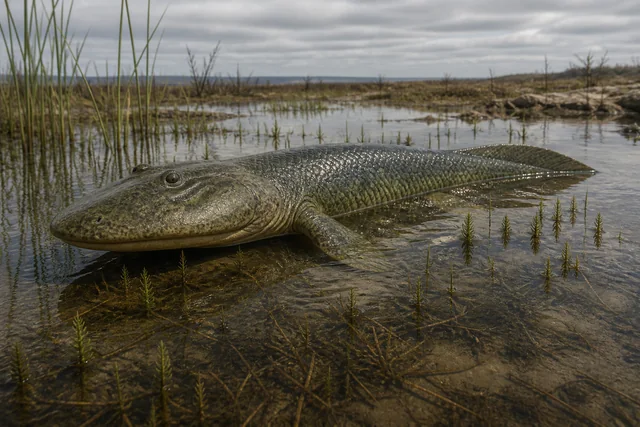
Tiktaalik
A tetrapodomorph fish with fin rays, strong internal fin bones, a mobile neck and broad ribs. It remained aquatic and had no fingers or toes.
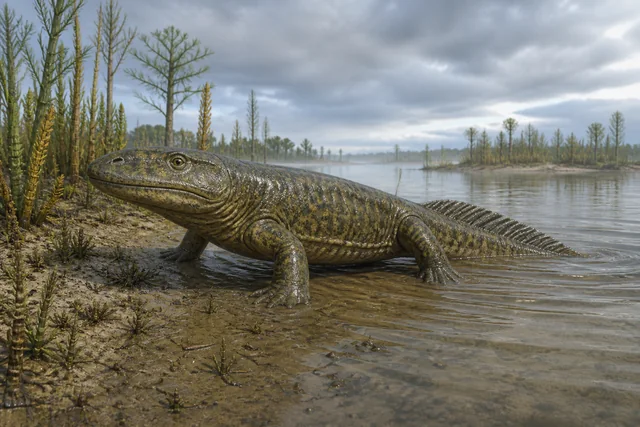
Ichthyostega
A digit-bearing stem tetrapod with a strengthened trunk and seven-toed hind foot, but also a finned tail and strongly aquatic anatomy.
These illustrated animals already have clean catalogue imagery and detailed English profiles, so the page reuses those assets rather than inventing duplicate pictures. Their anatomy documents different points on a branching tree, not a straight sequence in which one named genus transformed into the next.
Animals on Devonian land
Land vegetation changed from low communities into ecosystems with rooted plants and the first forests. Arthropods occupied this expanding habitat. Millipede-like myriapods, mites, arachnids and early hexapods are recorded by body fossils and traces, although the record is patchy.
Some terrestrial arthropods were herbivores or detritivores; others were predators. Tracks and burrows can reveal movement where body fossils are absent, but the maker is not always identifiable. A footprint establishes activity on a surface more securely than it establishes the exact genus that made it.
Early tetrapods were not yet dominant land animals. Even digit-bearing forms remained closely tied to water. The rise of forests changed riverbanks, sediment, shade and organic input, creating new shallow-water habitats as well as terrestrial ones.
Why Devonian ecosystems changed
The later Devonian contained several extinction pulses rather than one instantaneous event. Reef systems declined severely, and many placoderm and trilobite groups disappeared. Black shales record widespread low oxygen in many basins, while carbon-cycle changes, climate shifts, volcanism, nutrient input and sea-level movement probably interacted.
Cause and timing differed among regions. Expansion of rooted forests may have increased weathering and nutrient transport to water, but it should not be treated as the sole proven cause. The detailed Devonian Period guide follows the Kellwasser and Hangenberg crises and distinguishes measurements from proposed mechanisms.
How the evidence is read
| Evidence | What it can establish |
|---|---|
| Articulated skeletons and armour | Anatomy, size range and association of body parts in particular individuals |
| Teeth, scales and fin spines | Presence and distribution, but often not a complete body or exact lifestyle |
| Tracks and burrows | Movement and behaviour on a surface, sometimes without a known maker |
| Sediment and geochemistry | Water depth, oxygen conditions, salinity and environmental change within a basin |
| Living relatives and models | Testable functions and ranges, not direct observation of extinct behaviour |
Colour, courtship, exact hunting scenes and the social life of most Devonian animals remain reconstruction. Good artwork is constrained by bones, armour, scales and environment but should not be mistaken for a direct fossil record.
Frequently asked questions
Why is the Devonian called the Age of Fishes?
Jawless vertebrates, placoderms, early sharks and both main bony-fish branches diversified greatly during the period.
Were there animals on land in the Devonian?
Yes. Myriapods, mites, arachnids and early hexapods lived in terrestrial habitats, while early tetrapods remained strongly tied to water.
Did Tiktaalik walk on land?
There is no secure evidence of terrestrial walking. Its fins could brace the body in shallow water, but they retained fin rays and lacked digits.
What happened to Devonian animal life?
Several later Devonian crises reduced reefs and many marine groups. Low oxygen, climate, sea level, nutrient flow and volcanism probably interacted.