

Dibothrosuchus elaphros was a small early crocodylomorph from Yunnan, China. Its skeleton had slender limbs and a long tail. The fossils offer two ways to study the animal: its proportions on land and the spaces concealed inside the bones of its skull.
Quick facts
| Species | Dibothrosuchus elaphros |
|---|---|
| Age | Early Jurassic |
| Locality | Near Dawa village, Lufeng Basin, China |
| Holotype | CUP 2081, partial skull and skeleton |
| Better-preserved specimen | IVPP V 7907, skull, jaws and partial skeleton |
| Estimated length of IVPP V 7907 | About 1.3 m |
What can the fossils tell us?
The name is based on CUP 2081. The more complete skull IVPP V 7907 was first assigned to another species and later referred to the type species.
Those proportions are consistent with movement on land. The figure of 1.3 m is a reconstructed total length.
The braincase bones next to the inner ear have well-developed air spaces. The many small spaces in the shaft of the quadrate lie between bony struts.
Early Jurassic specimens from Yunnan
David Simmons described Dibothrosuchus in 1965 from CUP 2081 in the Lower Lufeng deposits. Fossils near Dawa village include a more complete skull and partial skeleton, IVPP V 7907, originally named Dibothrosuchus xingsuensis. Xiao-Chun Wu and Sankar Chatterjee compared it with the holotype and found insufficient grounds to recognise a second species.
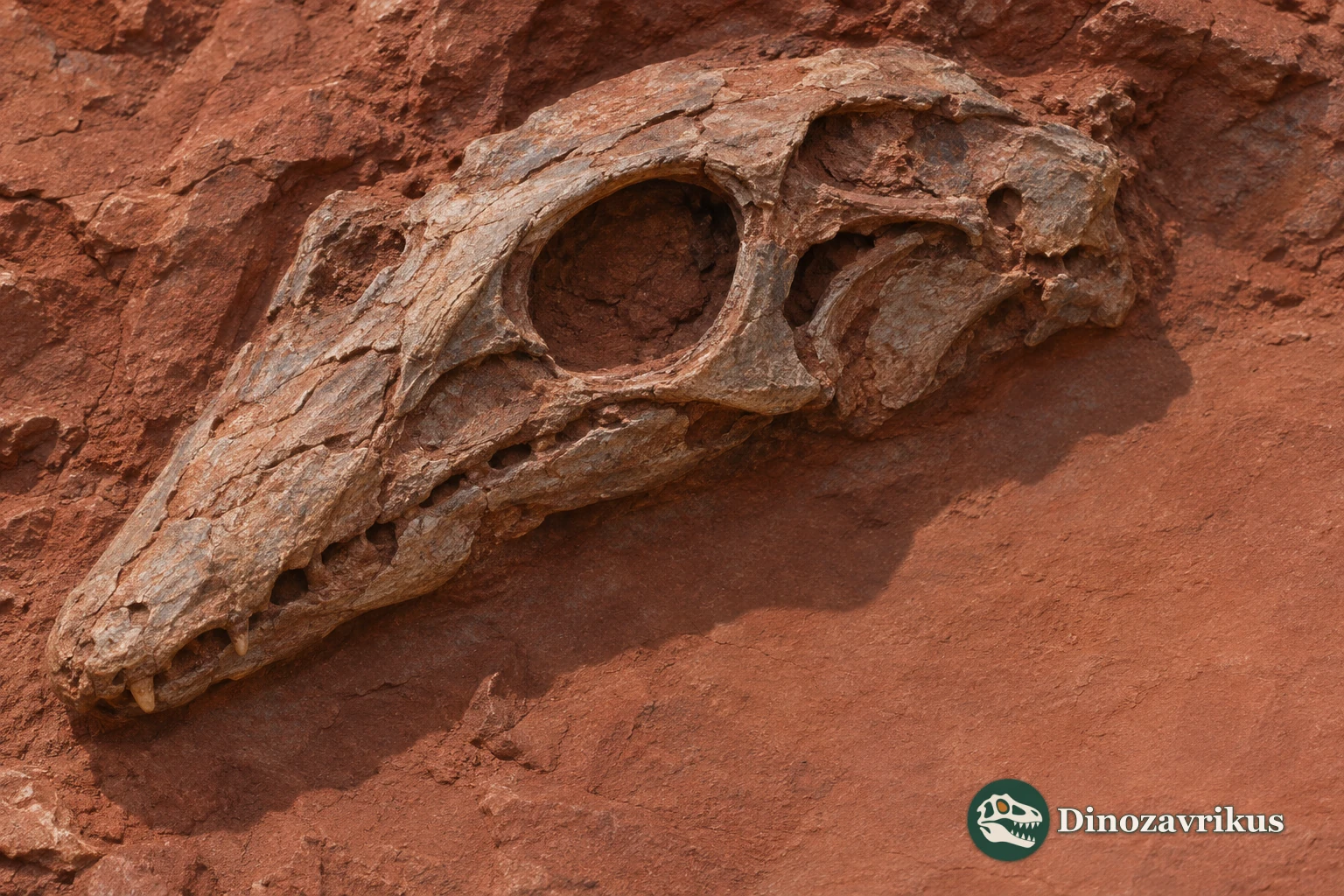
The skull of IVPP V 7907 measures 164 mm from the snout to the occipital condyle. Its total length was estimated at about 1.3 m from the reconstructed skeleton. The slender limbs support a terrestrial interpretation. The earlier European crocodylomorph Terrestrisuchus also preserves elongated limbs, providing a comparison from a different time and place.

Inside the back of the skull
The quadrate forms part of the jaw joint. In Dibothrosuchus, its upward projections join the roof and side of the skull firmly around the braincase. The contacts help show how the bones were braced near the joint.
CT scans of IVPP V 7907 reveal air spaces in the prootics, bones of the braincase near the inner ear. The shaft of the quadrate contains smaller spaces between bony struts. These details are useful in anatomical comparisons across crocodylomorphs. They provide limited evidence about hearing sensitivity.
An early branch of crocodylomorph evolution
Dibothrosuchus was traditionally grouped with other early crocodylomorphs as a sphenosuchian. Recent analyses test the separate features that underpin that grouping across skulls and skeletons. The historical name has covered several early branches, and Dibothrosuchus helps trace features later found in crocodyliforms.
Frequently asked questions
How large was Dibothrosuchus?
The better-preserved individual has an estimated total length of about 1.3 m and a measured skull length of 164 mm.
Which specimen carries the name?
CUP 2081 is the holotype. IVPP V 7907 was later referred to the same species.
What did CT scanning add?
It revealed the interiors of several skull bones, including large air spaces in the prootics and smaller spaces in the quadrate shaft.
Why is it interpreted as a land animal?
Its elongated, slender limbs are consistent with terrestrial movement.