

Didelphodon vorax was a relatively large metatherian mammal from the final part of the Cretaceous in western North America. A near-complete skull from the Hell Creek Formation makes it unusually informative: researchers can examine the braincase, jaw mechanics and even parts of the inner ear, rather than relying only on isolated teeth.
Metatheria includes living marsupials and many extinct relatives. Calling Didelphodon a metatherian does not show that it had the same pouch, reproductive anatomy or behaviour as a modern opossum. Its place among late Cretaceous mammals is explored alongside other lineages in the ancient mammal catalogue.
Quick facts
| Scientific name | Didelphodon vorax Marsh, 1889 |
|---|---|
| Group | Metatheria, an extinct relative of marsupials |
| Age | Late Cretaceous, Maastrichtian, about 69–66 million years ago |
| Range | Western North America, including the Hell Creek Formation |
| Best-preserved specimen | NDGS 431, a near-complete skull of a young adult |
| Skull length | 94.7 mm in NDGS 431; 122.1 mm reconstructed for UWBM 94084 |
| Estimated mass | About 2.4 kg and 5.2 kg for two specimens; model-based |
| Diet | Varied omnivory with substantial animal food is supported; exact menu unknown |
What can the fossils tell us?
NDGS 431 preserves much of the cranium, jaws, palate, teeth and braincase. CT scans reveal internal anatomy, including the right semicircular canals. It is not a complete skeleton, and the missing body cannot be reconstructed from this specimen alone.
Bulbous premolars and shearing molars indicate a strong bite capable of crushing and slicing. Microwear comparison supports a varied diet. Neither tooth shape nor wear identifies a particular animal eaten.
Bite force, body mass and prey-size estimates were calculated from skull measurements and comparative equations. They are useful testable estimates, not direct measurements of a living Didelphodon.
Didelphodon is securely a metatherian. Broader evolutionary trees place Cretaceous North American metatherians near the ancestry of living marsupials, but some branching relationships receive limited support and depend on taxon sampling.
A skull from the Hell Creek Formation
The key specimen, NDGS 431, was collected in 2007 in Slope County, North Dakota. It came from a channel-lag deposit in the upper third of the Hell Creek Formation, a setting where currents concentrated durable remains. The specimen preserves substantial parts of the skull, upper jaws, palate, teeth and braincase. CT imaging also made it possible to inspect internal structures, including the right semicircular canals of the inner ear.
Wilson and colleagues compared NDGS 431 with three additional specimens: a snout, UWBM 94084, and upper-jaw fragments UWBM 94500 and SCNHM VMMa 20. These finds extend the anatomical sample but do not make a complete skeleton. They represent separate individuals, so their measurements should not be combined into one idealised animal without noting differences in size and maturity.
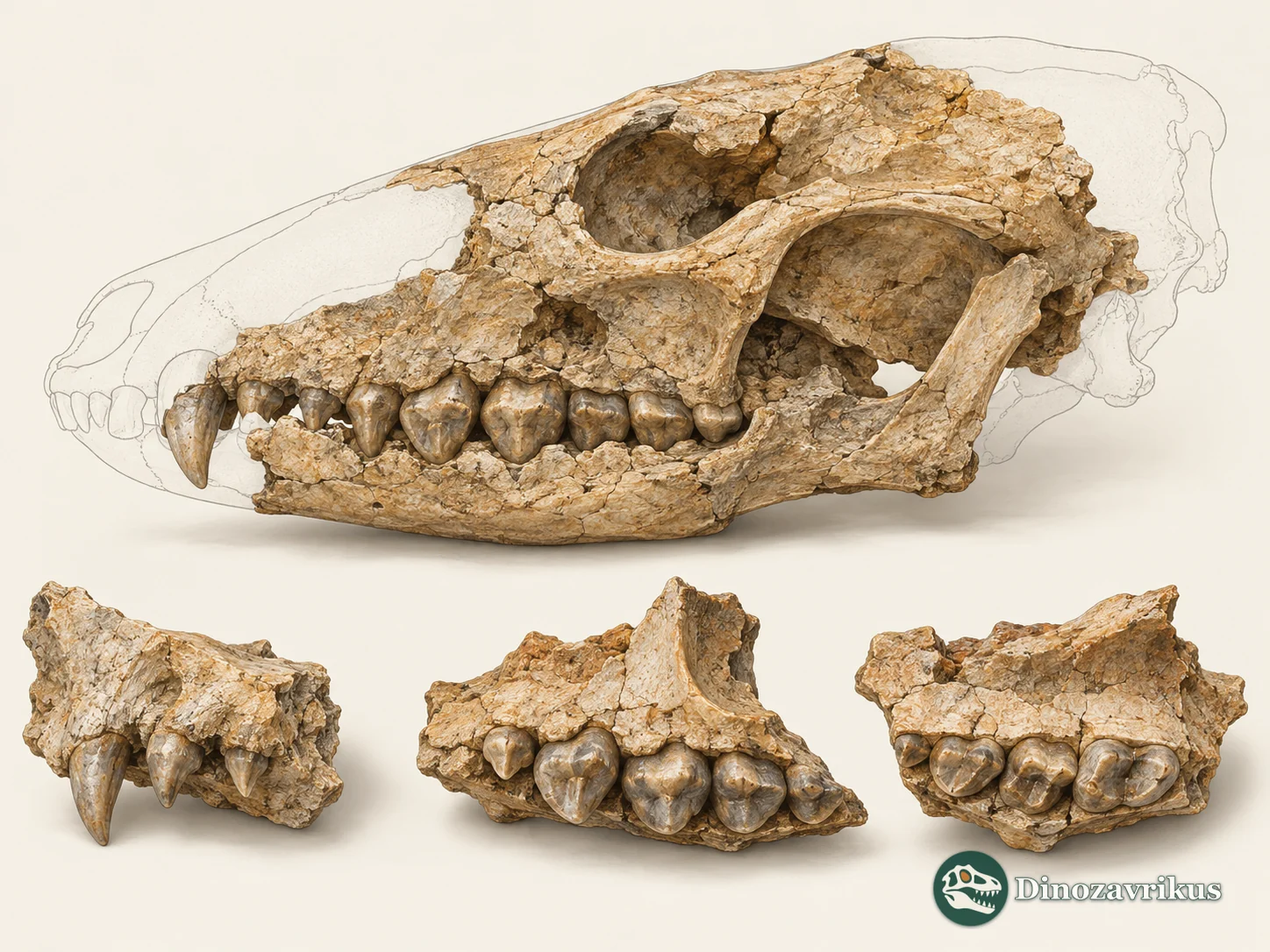
Short snout, broad skull and specialised teeth
NDGS 431 measures 94.7 millimetres long and 59.3 millimetres wide. Its snout is short relative to the skull, and the cheek arches are broad. Large, rounded premolars sit ahead of shearing molars. Together, these features suggest a jaw able to crush and cut a range of foods rather than a tooth row specialised for only one task.
The canine bite-force estimate for NDGS 431 is about 218 newtons. The calculation uses skull geometry and reconstructed muscle leverage; it is not a direct measurement. A high relative bite estimate indicates potential mechanical strength, but it cannot by itself establish habitual bone-crushing or reveal how often the animal used its strongest bite.
How large was Didelphodon?
Researchers estimated body mass from cranial measurements using comparative regressions. NDGS 431 gives an estimate near 2.4 kilograms, with a reported interval of about 2.1–2.7 kilograms. The larger UWBM 94084 skull gives about 5.2 kilograms, with an interval of roughly 4.2–6.2 kilograms. These are estimates for two individuals, not a precise universal range for the species.
The result depends on the chosen measurement, the modern comparison animals and the assumption that the same relationship between skull size and body mass applies across distant mammal groups. A heavier individual may have been an adult while the smaller skull belonged to a younger animal. The fossils do not preserve a complete skeleton on which to measure total body length directly.
A varied diet, not a proven bone-crusher
Large canines and robust jaws make animal prey plausible, while tooth wear provides a separate line of evidence. In the comparative microwear analysis, Didelphodon falls among omnivorous forms, including animals whose diets contain substantial animal matter. The combined evidence is consistent with flexible feeding on vertebrates, shelled invertebrates and some plant foods. It does not specify how often each item was eaten.
A model of maximum prey size produced an estimate around five kilograms, but the 95 per cent interval is broad, about 2.2–11.4 kilograms. This is a model of mechanical capacity under stated assumptions, not a fossil record of captured prey. The suggestion that Didelphodon could attack small or juvenile dinosaurs is therefore an extrapolation. No stomach contents or preserved hunting event link this mammal to a dinosaur meal.
The species name vorax and the enlarged teeth can invite an image of a dedicated bone-crusher. Tooth geometry, microwear and bite-force modelling support powerful processing, but they do not justify that narrow feeding label. A strong-jawed omnivore is a better description of what the evidence currently supports.
Evolutionary relationships and the limits of comparison
Some phylogenetic analyses place Late Cretaceous North American metatherians close to the ancestry of living marsupials, while several South American fossil lineages fall elsewhere. Support for individual branches is limited, and the result can shift as researchers change the taxa and anatomical characters in the analysis. The secure statement is that Didelphodon belongs to Metatheria; its exact branching position remains open to revision.
That uncertainty also cautions against transferring soft-tissue traits from modern marsupials. No known fossil establishes a pouch, fur pattern, external ear shape or precise reproductive strategy for Didelphodon. Those details are unknown rather than miniature versions of an opossum's biology.
Life in a Late Cretaceous floodplain
The Hell Creek Formation records river channels, floodplains and wooded habitats near the end of the Cretaceous Period. Its fossil assemblages include dinosaurs, crocodilians, turtles, fishes and mammals. Sharing a formation records broad geological association, not proof that two animals met at one place or interacted directly.
Channel deposits can mix remains transported from different parts of a landscape. The position of NDGS 431 helps establish its geological context, but it does not reveal a daily route, a den or a specific hunting ground. The same distinction applies to food: the anatomy suggests capability, while an actual meal would require direct evidence such as gut contents or an unmistakable feeding trace.
What the fossils leave unresolved
The known material is rich for a Cretaceous metatherian but remains incomplete. The skull is the strongest source of evidence; body mass and bite force are calculated, diet is inferred from teeth and microwear, and behaviour is more uncertain still. Fur, colour, social life and a particular hunting sequence belong to artistic reconstruction unless new evidence emerges.
Keeping these levels separate does not make the animal less interesting. It shows why one well-preserved skull can revise the picture of an extinct mammal while still leaving much of its life beyond direct observation.
Frequently asked questions
Was Didelphodon an opossum?
No. It was an extinct metatherian relative of marsupials, not a member of a living opossum genus. Its fossils do not demonstrate an opossum-like pouch or life cycle.
How large was Didelphodon?
Cranial regressions estimate about 2.4 kilograms for NDGS 431 and about 5.2 kilograms for the larger UWBM 94084 specimen. These are model-based estimates for individual fossils.
Did Didelphodon crush bones?
Its jaws were powerful, but tooth wear and other evidence fit varied omnivory better than a proven specialised bone-crushing diet.
Did it hunt dinosaurs?
A prey-size model has been used to discuss small dinosaurs as possible prey, but no stomach contents or direct hunting evidence confirms that behaviour.