

Diplocaulus is a Permian lepospondyl tetrapod best known from Early Permian deposits of Texas and Oklahoma. Its low skull and long lateral projections form an unmistakable boomerang outline, but that shape changed substantially as some species grew.
The genus belongs in the ancient amphibian catalogue. Skulls are far more common than securely associated postcranial skeletons, so the famous head is better documented than the complete animal. Comparison with Diploceraspis helps place its unusual skull among nectrideans without assuming identical behaviour.
Quick facts
| Genus | Diplocaulus; type species D. salamandroides |
|---|---|
| Group | Lepospondyl; traditionally grouped with nectrideans |
| Age | Permian; best-known samples are Early Permian |
| Region | Texas and Oklahoma, United States |
| Key material | Numerous skulls; associated postcranial skeletons are much rarer |
| Best-known species | D. magnicornis |
| Total body length | Not securely established for the genus |
What can the fossils tell us?
Everett Olson compared a large series of D. magnicornis skulls. In many specimens, the posterolateral corners expanded especially rapidly around skull lengths of roughly 80–100 mm. This helps explain some shape differences but does not settle every species boundary.
Olson’s 1951 study compared many skulls, but only a small fraction of the available sample offered vertebrae useful for comparison, and associations with skulls were often uncertain. Museum records document additional individual specimens, not a standard complete skeleton.
Cruickshank and Skews measured lift, drag and pitching moment on a model in airflow used to approximate movement through water. The experiment documents physical properties of the shape; how a living animal swam or captured prey remains an interpretation.
The Arroyo Formation includes nonmarine clays and sandstones in Texas. Fragmented bonebeds illuminate transport and burial, but a mixed fossil assemblage is not a direct snapshot of animals living together.
From early names to a large skull sample
Edward Drinker Cope introduced the name Diplocaulus in 1877 for D. salamandroides, based on limited material. Additional Permian collections from the southern United States later produced skulls and separate bones that were assigned to several named species.
Everett Olson’s 1951 monograph remains a landmark because it compared a substantial sample from the Arroyo Formation and treated growth as a taxonomic problem. The skull series showed that proportions do not stay constant through life. A shape difference between two fossils can reflect age as well as species identity.
Museum catalogues record particular specimens in several collections. UMMP VP 3280 at the University of Michigan is a Diplocaulus skull from Texas; the Smithsonian records an Arroyo Formation specimen with cranial and postcranial material. Such records document individual objects, not equally complete or equally studied skeletons.
How the skull changed with growth
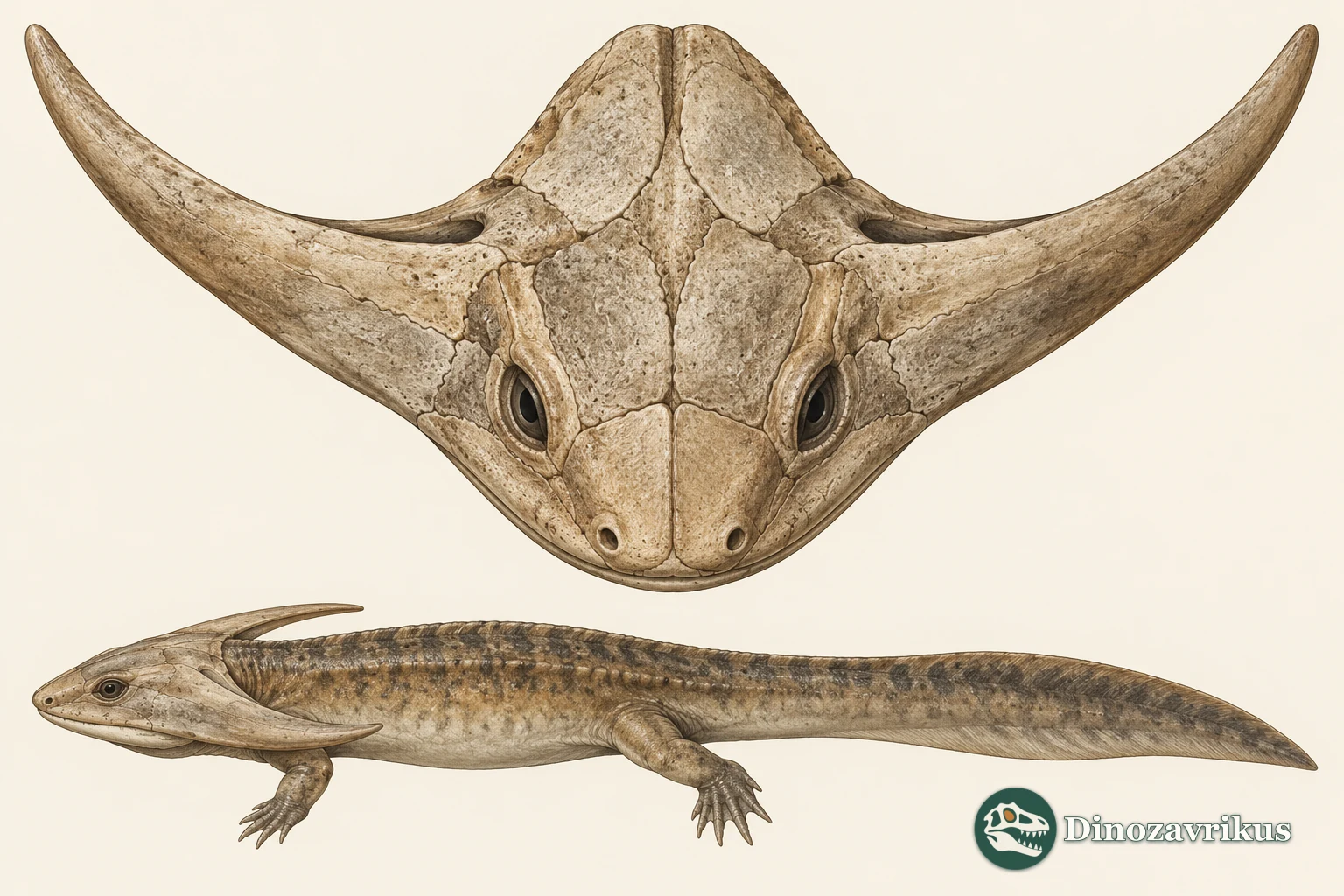
Small skulls have a narrower outline, while the lateral projections become much more prominent in many larger specimens of D. magnicornis. Olson found especially rapid expansion of the posterolateral corners across part of the growth series. A skull around 100 mm long could therefore differ in width from another of similar length.
This observation complicated species diagnosis. Olson distinguished D. brevirostris from D. magnicornis using a combination of adult proportions, while noting that the sample of the former was small. The safest reading is not that all wide skulls belong to adults, but that age, preservation and multiple anatomical characters must be assessed together.
What forms the boomerang outline?
The skull was low and broad. Elongated bones at its posterolateral corners created the long projections commonly called tabular horns. Olson’s 1951 monograph discussed a competing identification of one contributing bone as a supratemporal, while later functional literature adopted the term tabular horns. The projecting bones themselves are clear; their homology and names reflect anatomical interpretation.
Postcranial remains are less often associated with skulls. Olson noted that although vertebrae occur in deposits yielding skulls, only a small subset could be compared reliably, and association was often uncertain. A composite restoration should not be mistaken for a fully articulated fossil skeleton.
Permian water and a hydrodynamic hypothesis
Nonmarine clays and sandstones of the Arroyo Formation preserve Diplocaulus alongside other vertebrates. A study of a Lower Permian bonebed in Wichita County described fragmented, mixed remains and interpreted the deposit as a product of sedimentary and transport processes. The assemblage helps reconstruct the site’s burial history; it does not prove all listed animals shared one habitat at the same time.
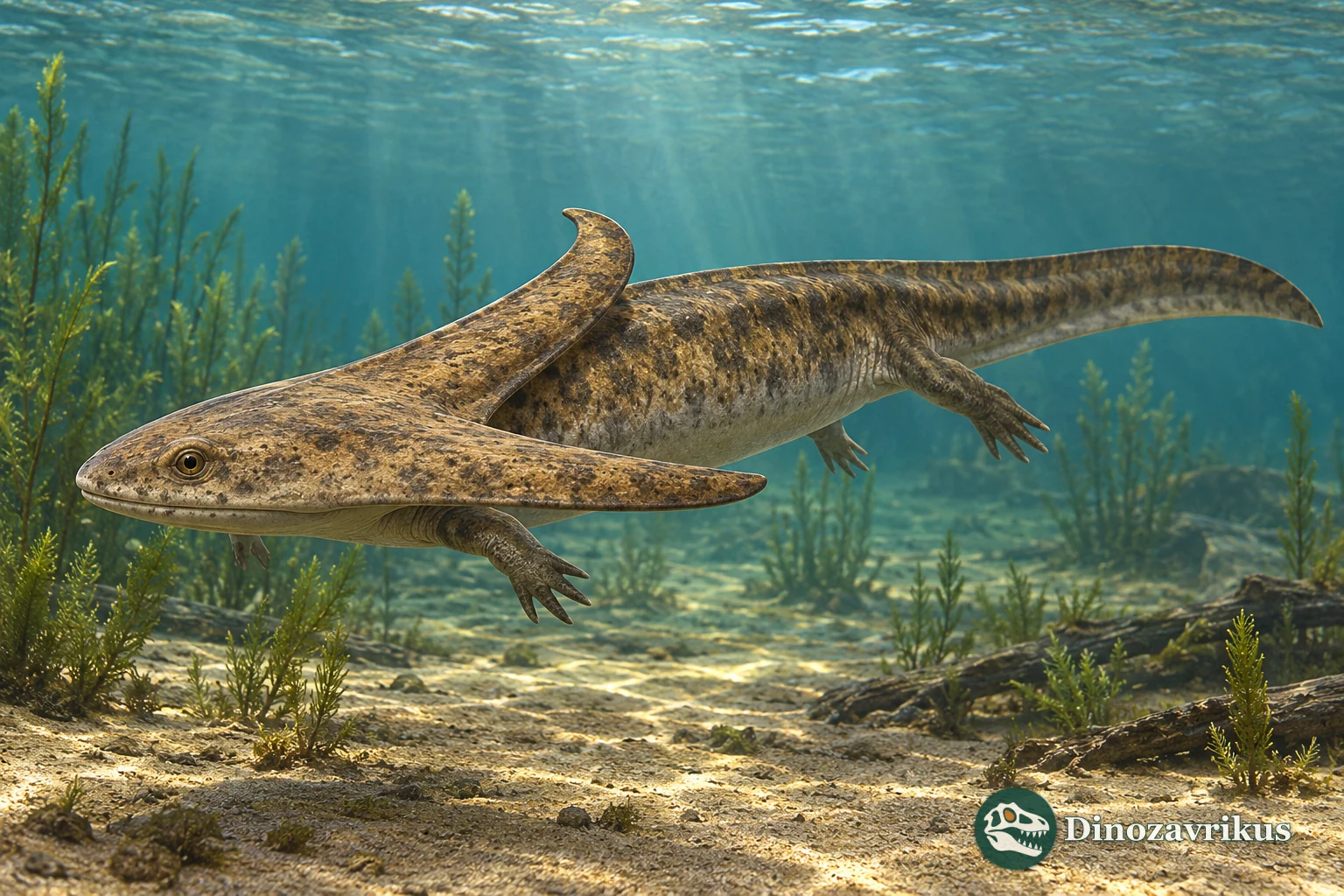
In 1980, A.R.I. Cruickshank and B.W. Skews tested a model skull in a low-speed wind tunnel. They measured lift, drag and pitching moment under conditions intended to approximate movement through water. The model displayed distinctive flow properties, and the authors proposed that the head could assist steep rises from the bottom to capture prey. This is a functional hypothesis built from a model, not a fossil record of a feeding event.
Species, size and limits of reconstruction
The genus has a complicated history of species names. D. magnicornis is the best-represented form; D. brevirostris was distinguished by Olson using a skull, vertebrae and parts of the appendicular skeleton. Other historical names have been reassessed as doubtful or synonymous, so a list copied from an old source can overstate current certainty.
Skull length varies across growth stages, but it cannot be converted into a dependable body length without a secure articulated skeleton and a justified proportional model. The available evidence supports an aquatic or water-associated animal with an unusually broad head. Exact swimming behaviour, diet, skin and the function of each skull projection remain open questions.
Frequently asked questions
Why was the skull of Diplocaulus so broad?
The lateral projections grew disproportionately in many specimens of D. magnicornis. Growth studies document the shape change, but the projections’ full biological function remains uncertain.
Were the projections horns?
They are bony extensions of the skull, not keratin horns. Older studies differed over the identity of some contributing bones, so the anatomical terminology has changed.
Did the skull act like an underwater wing?
That idea was tested with a wind-tunnel model and remains a functional hypothesis. The experiment measured forces on a model, not the behaviour of a living animal.
How long was the whole animal?
A secure total body length is not established from an articulated skeleton. Skull measurements should not be reported as whole-body length.