

Dolichochampsa minima was a small, long-snouted crocodilian from what are now Argentina and Bolivia. The bones of one Bolivian individual suggest a total length of about a metre. That specimen also revealed details of the palate and vertebrae used to test the animal’s relationship to gharials.
Quick facts
| Type species | Dolichochampsa minima |
|---|---|
| Group | Crocodylia, probably a gavialine |
| Age | Near the Cretaceous–Palaeogene boundary |
| Localities | Salta Province, Argentina, and southern Bolivia |
| Key specimens | Type dentary and partial skeleton FCGV-8178 |
| Estimated length | About 1 m in the Bolivian specimen |
What can the fossils tell us?
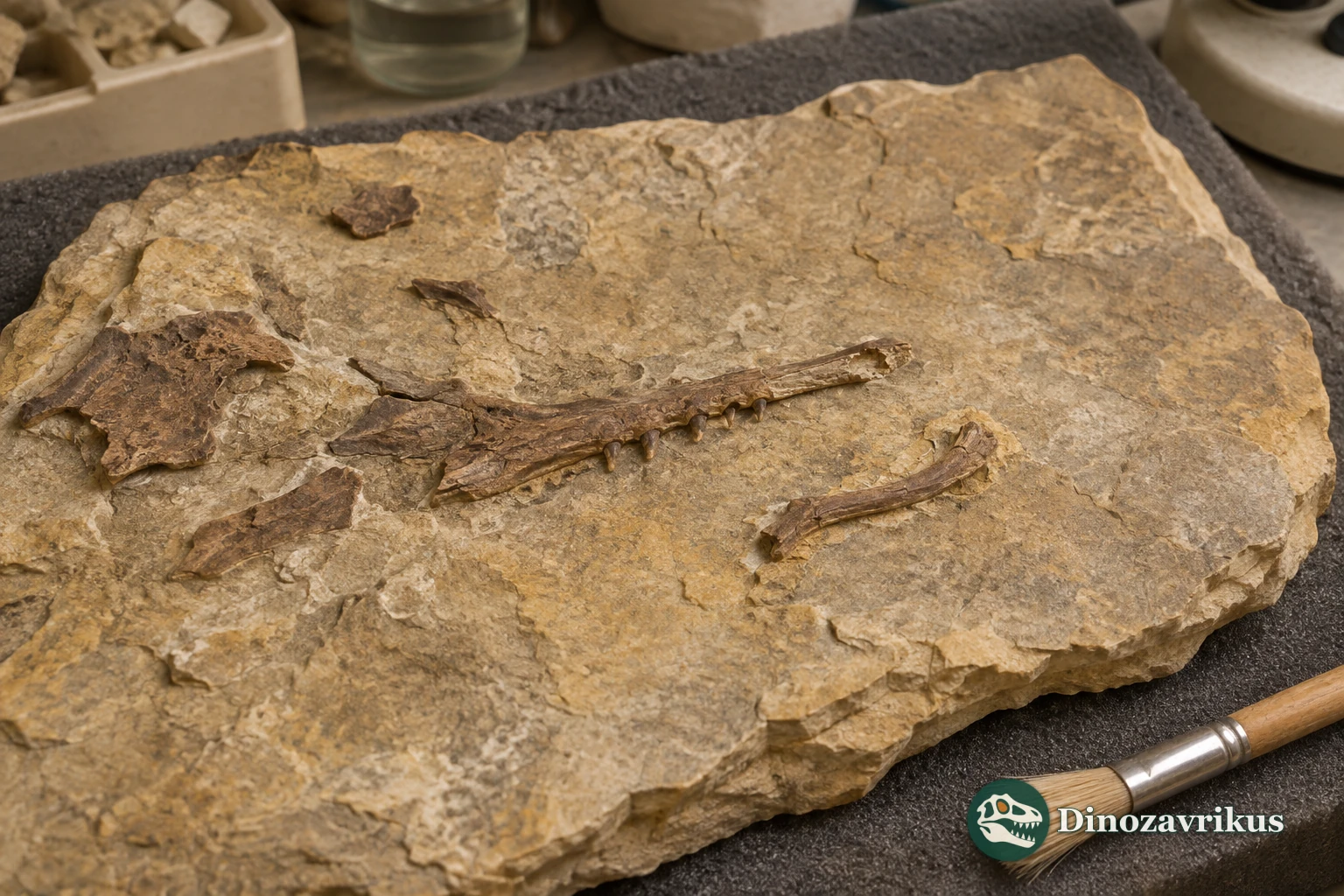
Notches for the lower teeth survive along the upper jaw. Their spacing helped the authors estimate how many teeth the maxilla held.
The lump of mudstone contained pieces of the skull, a vertebra and limb bones. Its femur provided a means of estimating body length.
A 2025 analysis placed Dolichochampsa among gavialines. It found several possible placements within the group because so much anatomy remains unscored.
From an Argentine jaw to a partial skeleton
Zulma Gasparini and Éric Buffetaut named the species in 1980 from material in the Yacoraite Formation of northern Argentina. The holotype is part of a dentary, a bone of the lower jaw. Buffetaut later described a similar right dentary from La Palca near Potosí, Bolivia. The area where it joined its opposite half appeared unusually short for a long-snouted crocodilian.
In 2025 Kevin Vélez-Rosado and colleagues described FCGV-8178 from near Maragua, west of Sucre. Parts of one animal occurred close together in a 15 × 7 × 3 cm block of mudstone. The specimen includes part of the palate, braincase and maxilla, a back vertebra, parts of the shoulder and pelvis, and hindlimb bones.
How big was it, and how did the jaws close?
The researchers estimated a length of about one metre using the femur. Its shaft is straight, as in the compared Argentine specimen. The maxilla in the block is 68.9 mm long as preserved. Most of the snout is missing from this fossil.
The preserved bone is nearly straight and lacks a pronounced expansion along its sides. Notches along it received the lower teeth. From the spacing between sockets and the extent of the notched area, the authors estimated 15 to 18 teeth in one maxilla. A slender row of small teeth could seize small prey. The fossils give no direct record of what it ate.
The early record of gharial relatives
The internal nostril opened at the rear of the palate and was incompletely divided by a bony partition. The back vertebra has a developed convex articular surface at its rear, comparable to living crocodilians. Together with other characters, this evidence supported a gavialine placement in the 2025 study.
The team could score only 35 out of 248 characters for Dolichochampsa. The result therefore leaves more than one position possible within the group. The much younger South American Piscogavialis also had a slender snout. The shape alone cannot establish an ancestor–descendant relationship.
The mudstone at Maragua
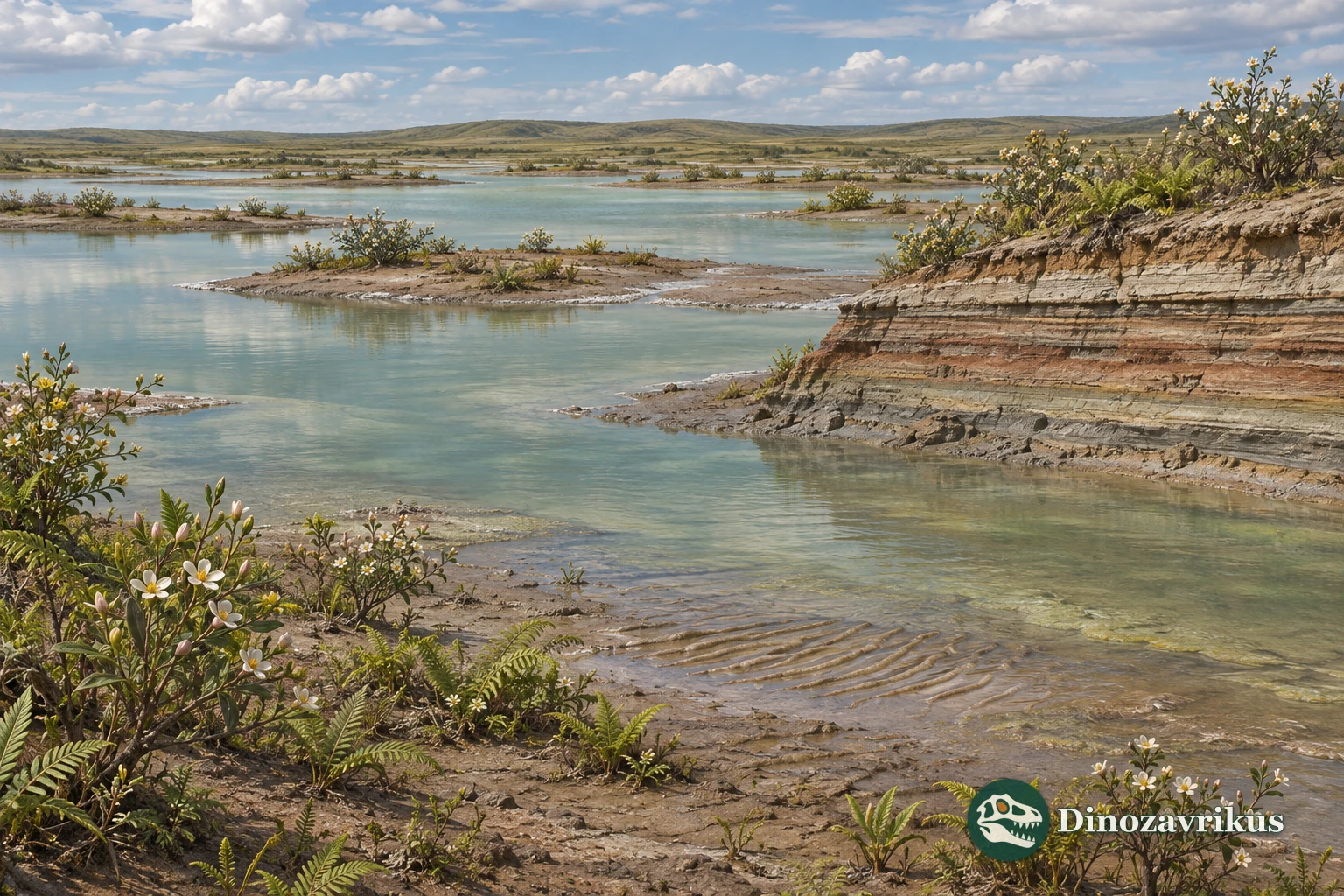
The Maragua individual came from reddish-brown mudstone in the middle part of the El Molino Formation. The local deposits span an estimated 73–64 million years ago. That range crosses the Cretaceous–Palaeogene boundary and applies to the stratigraphic context. Basin sedimentation responded both to local changes in water bodies and to changes in sea level.
Frequently asked questions
How long was Dolichochampsa?
The femur of one Bolivian specimen gave a body length estimate of about one metre. The largest size attained by the species remains unknown.
Where did the type fossil come from?
The type came from the Yacoraite Formation of Salta Province in northern Argentina. Bolivian specimens are from El Molino deposits.
Why is the tooth count a range?
The upper tooth row is incomplete. The authors estimated the number using the spacing of the surviving sockets and the extent of the notched margin.
Did gharials originate in South America?
The fossil supports an early South American occurrence of gavialines. On its own it does not identify the geographical origin of the group.