

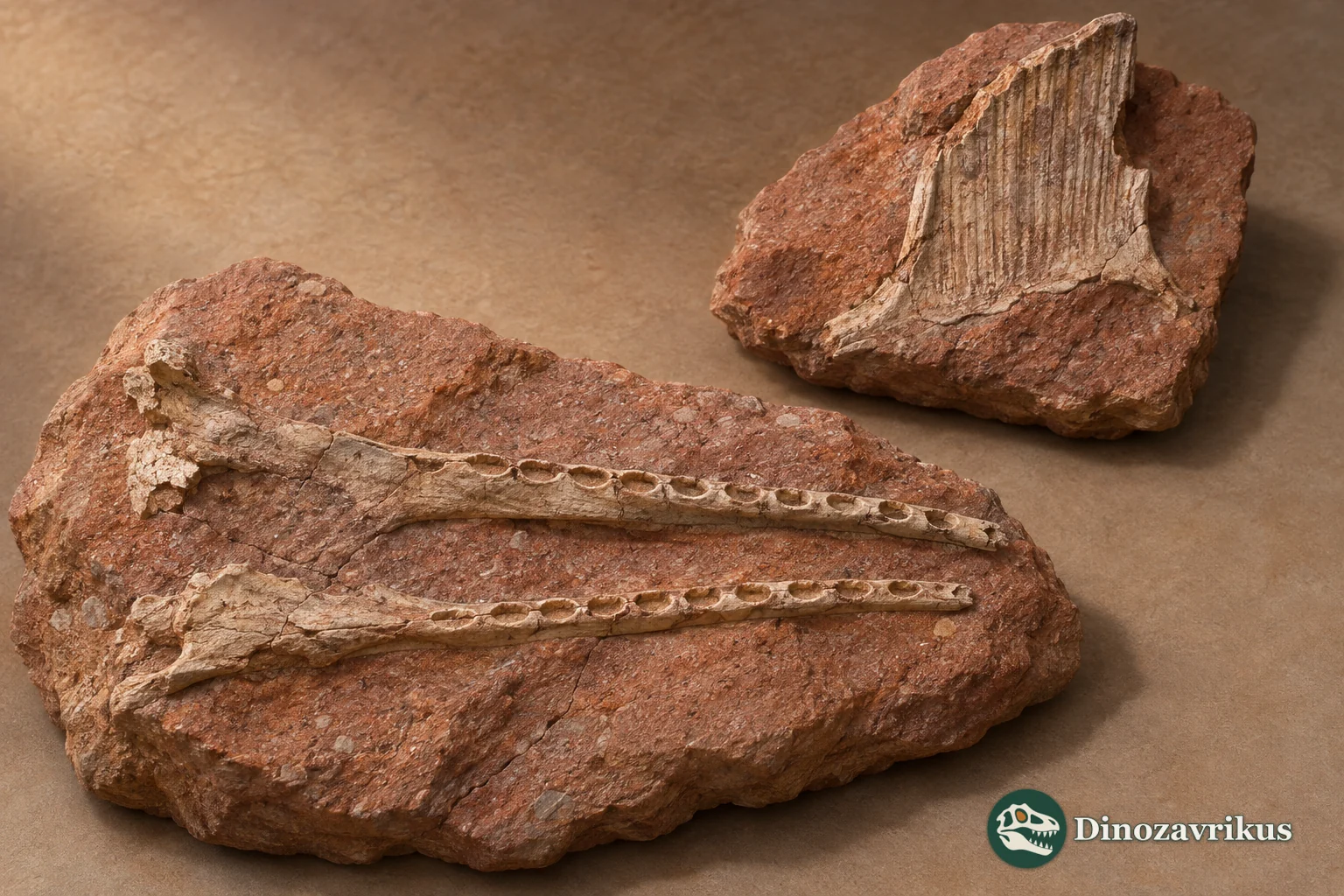
Domeykodactylus ceciliae was named after two small cranial fragments from northern Chile were re-examined. Striations once interpreted as the fine filtering teeth of Pterodaustro belong instead to a bony crest. An incomplete lower jaw provides the type specimen. The whole animal pictured above is an artistic reconstruction: no wing or body skeleton has been found with these bones.
Quick facts
| Scientific name | Domeykodactylus ceciliae, Martill and colleagues, 2000 |
|---|---|
| Holotype | Specimen 250973, incomplete lower jaw |
| Associated fragment | Part of the upper skull bearing a crest |
| Locality | Quebrada La Carreta, Antofagasta Region, Chile |
| Age | Probably Early Cretaceous; precise stage undetermined |
| Jaw | At least 16 raised tooth-socket margins on each side |
| Wingspan | Cannot be measured from the surviving fossils |
What can the fossils tell us?
The incomplete lower jaw retains raised alveolar rims and broken tooth roots. It yields no direct measurement of wings or body.
Vertical bony struts once mistaken for fine teeth belong to a crest. Matching rock and preservation associate the fragment with the jaw, without proving both came from one individual.
The original authors considered a Late Jurassic to Early Cretaceous range and favoured the latter. The exact stage of specimen 250973 is not established.
The protruding tooth sockets support a dsungaripterid comparison, but the specimen preserves no food remains or direct feeding traces.
From an apparent filter feeder to a new name
Guillermo Chong Díaz discovered the fragments during stratigraphic fieldwork at Quebrada La Carreta. The material is catalogued as specimen 250973 in the geology collection of Universidad Católica del Norte in Antofagasta; casts were held in Karlsruhe. An earlier study attributed the fossils to Pterodaustro, whose fine teeth suggested a very different jaw. David Martill and colleagues prepared and redescribed the material in 2000, naming it for the Domeyko Cordillera and Cecilia Demargasso.
The apparent fine teeth are vertical struts inside a fragmentary cranial crest. The crest and mandible have similar matrix and preservation and came from the same locality, but they do not join. The authors therefore designated the lower jaw alone as the holotype; whether both fragments belong to one animal cannot be demonstrated.
The anatomy left in the rock
Parts of both mandibular rami and the symphysis survive. Crushing, weathering and breaks obscure the original cross-section and both ends of the jaw. Fifteen raised alveolar rims remain on one side and sixteen on the better-preserved other side. Several retain tooth roots under magnification, whereas the crowns are broken. The rims become lower and more crowded toward the front.
The raised socket margins led the original authors to place the fossil among dsungaripterids. That is a classification from jaw anatomy, not evidence for a particular prey animal. No complete skull, wing, torso or tail accompanies specimen 250973. Kunpengopterus preserves a different pterosaur's bones and cannot supply the missing Domeykodactylus anatomy.
Age and geological limits
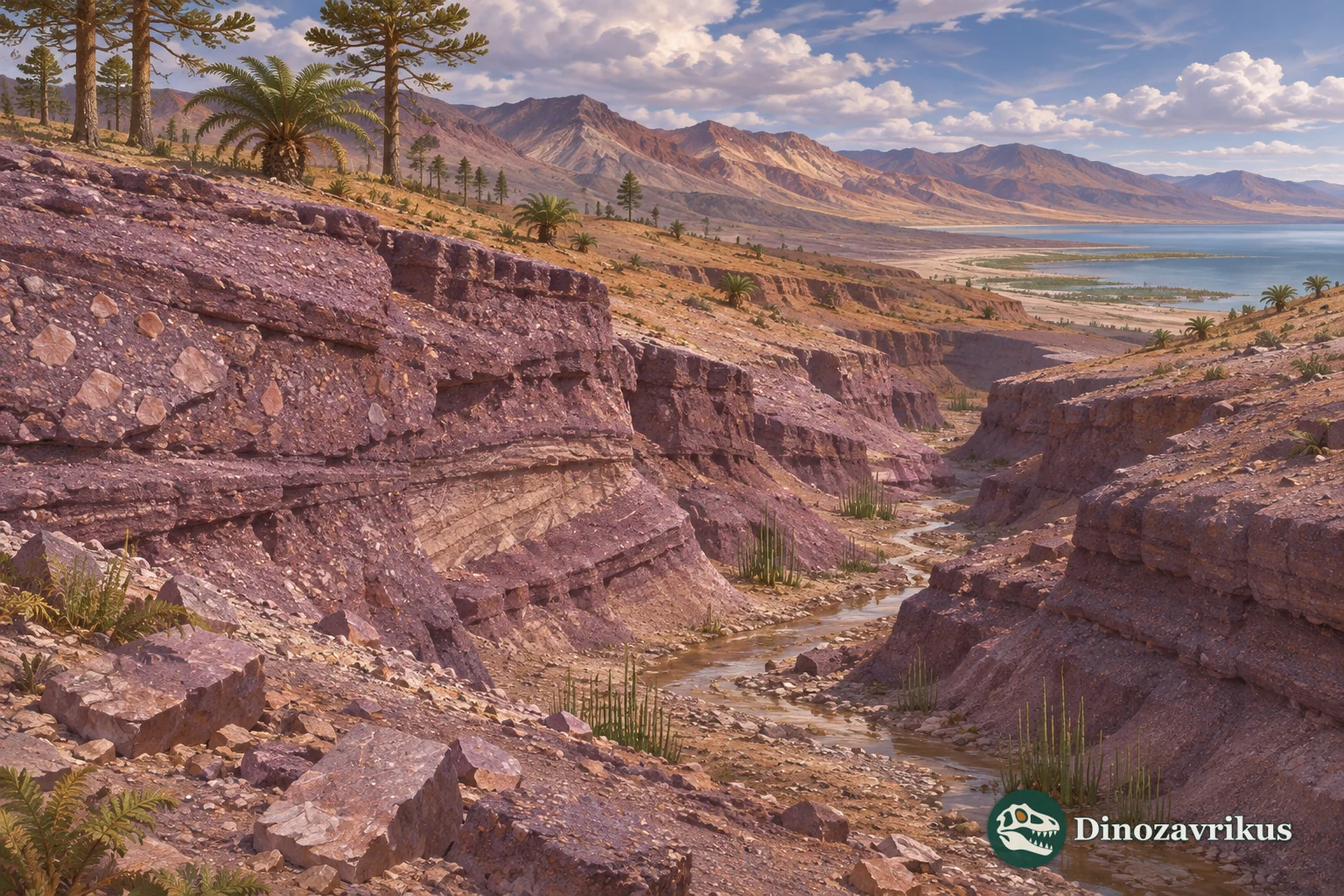
The fragments came from purple arkosic rock in an incised ravine of northern Chile. The fossil-bearing layer lacks the diagnostic fossils needed for a precise date. The describing authors allowed a Late Jurassic to Early Cretaceous age and considered Early Cretaceous more likely from correlations with nearby beds. A later museum review also treated the locality as Early Cretaceous, but described its geological unit as informal.
The fossil does not support an exact geological stage, a numerical date for the animal, or a measured wingspan. The full silhouette, head crest outline and environment in the accompanying artwork are plausible choices, not preserved details.
Frequently asked questions
Why was it removed from Pterodaustro?
The fine lines once taken for filtering teeth were identified as internal struts of a cranial crest. The actual tooth sockets are on the separate lower jaw.
Is a complete skull known?
No. The holotype is an incomplete lower jaw, with a separate crest-bearing fragment associated by locality and preservation.
Which geological stage did it live in?
No exact stage has been established. The original study favoured Early Cretaceous while allowing a Late Jurassic alternative.
What did Domeykodactylus eat?
Its diet is unknown. Jaw anatomy supports comparison with dsungaripterids but no direct food evidence survives.