

Dormaalisaurus was a small Eocene lizard. Both named species came from jaws found at Dormaal in Belgium. Their bones are similar in size, but the teeth differ. In one species a small extra cusp appears on the back teeth. The other has more rounded or flattened tips.
Quick facts
| Group | Lacertoids (Lacertoidea), early lacertid lineage |
|---|---|
| Age | Eocene |
| Region | Europe, Belgium, France and Spain |
| Type species | Dormaalisaurus girardoti |
| Scientific name | Dormaalisaurus |
| Diet | Exact prey is unknown |
What can the fossils tell us?
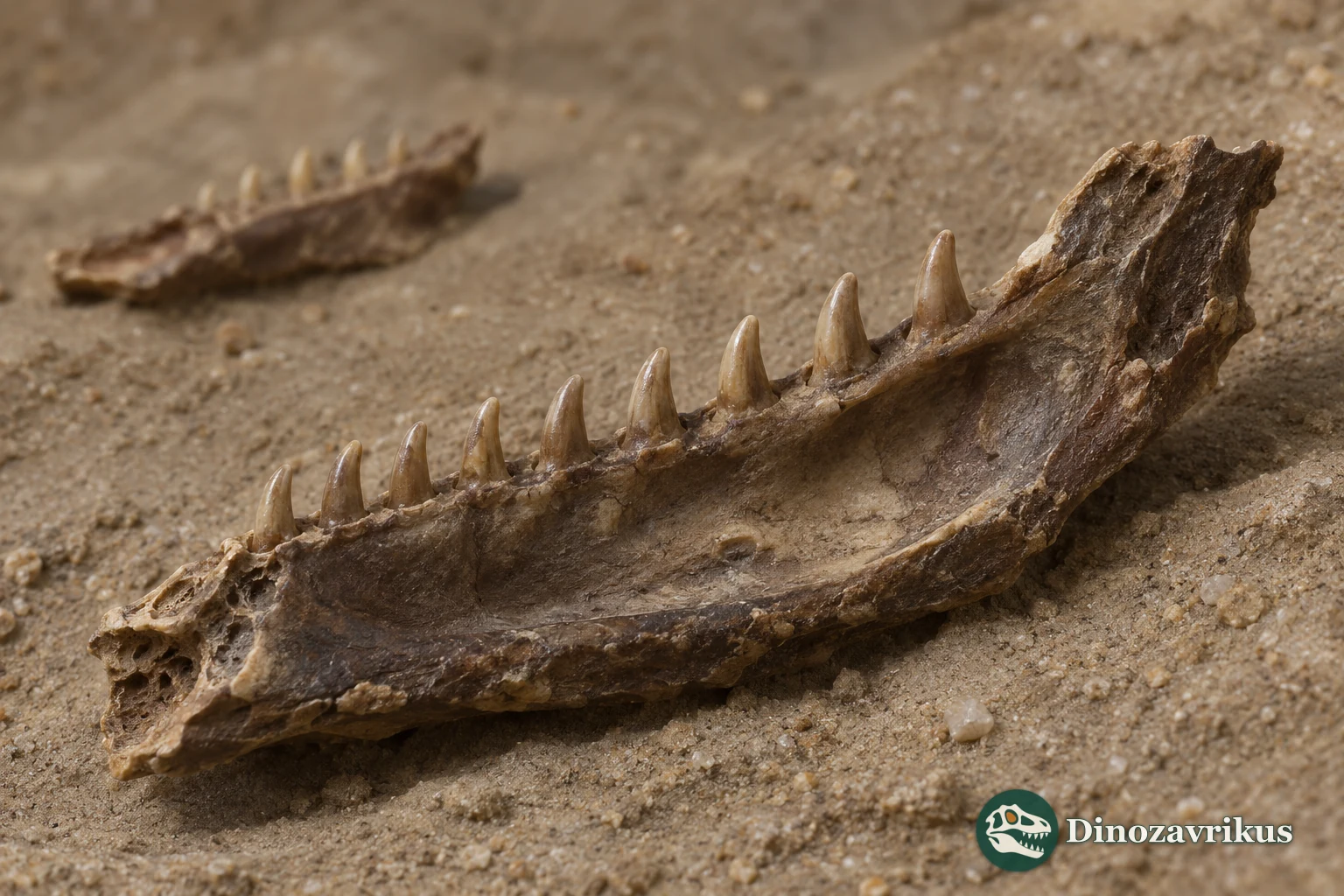
The type dentaries of the two species, IRSNB R 205 and IRSNB R 206, came from bed DIII at Dormaal. Their tooth rows can be compared directly.
Accessory cusps and fine striations help researchers compare teeth from different sites. The combination is more useful than the size of a fragment alone.
Most of the material consists of isolated bones. They support lacertid affinities. An articulated skull would help researchers place the genus more precisely along that lineage.
Two species from Dormaal
Marc Augé and Richard Smith named the genus in 2002. The holotype of Dormaalisaurus girardoti, IRSNB R 205, is a lower jaw bone with twenty-three tooth positions. A small anterior cusp appears beside the sharp main tip on teeth farther back in the row. The holotype of Dormaalisaurus rossmanni, IRSNB R 206, came from the same horizon. Its crowns are more rounded or flattened and lack a well-defined accessory cusp. The species also differ in how the groove on the inner side of the jaw opens near the front.
From Belgium to France and Spain
Both species are also known from Early Eocene Prémontré in the Paris Basin, where upper jaws and other isolated bones were found. Some specimens can be assigned only to the genus. Arnau Bolet and Susan Evans later identified jaw fragments of both species at Late Eocene Sossís in Catalonia. They drew on fine striations on the inner tooth surface and the shape of the crowns. Middle Eocene fossils from Mazaterón also resemble Dormaalisaurus, but their assignment is less certain.
What the bones reveal about relationships
Some features of a frontal from Prémontré, including the way it fitted against the parietal, support a position close to true lacertids. Dormaalisaurus is regarded as an early representative of that lineage. More complete skeletons of Eocene Eolacerta offer a comparison. In these fossils researchers can examine skull bones and body proportions in the same specimen.
Frequently asked questions
Which is the type species of Dormaalisaurus?
Dormaalisaurus girardoti. Its holotype IRSNB R 205 is a dentary from Dormaal.
How do the teeth of the second species differ?
Dormaalisaurus rossmanni lacks a distinct accessory cusp. The tooth tips are more rounded or flattened.
Where has Dormaalisaurus been found?
The type material comes from Belgium. Jaws have also been described from France and Spain.
How large was Dormaalisaurus?
The size of the jaws suggests a small lizard. Those bones do not give a complete body or tail length.