

Dorsetisaurus is one of the earliest known anguimorph lizards. Robert Hoffstetter named the genus in 1967 from material collected in the Purbeck beds of southern England. Its teeth offer some of the clearest clues to identification. In the type species, the crowns narrow towards the tip and have sharp keels at the front and back.
Quick facts
| Group | Anguimorphs (Anguimorpha) |
|---|---|
| Age | Late Jurassic and Early Cretaceous |
| Region | Europe and North America |
| Type species | Dorsetisaurus purbeckensis |
| Scientific name | Dorsetisaurus |
| Diet | Exact prey is unknown |
What can the fossils tell us?
The type specimen from the Beckles Collection preserves disarticulated skull bones and some parts of the rest of the skeleton. Separate jaws assigned to the genus have also turned up at nearby sites.
Ridges and sharp crown edges helped link a jaw from the Morrison Formation to English material. Comparisons based primarily on teeth leave more uncertainty than comparisons based on skulls.
The second English species has shorter, broader crowns. Comparable skull bones would help establish whether similar North American jaw fragments belong to that species.
Two different jaws from the Purbeck beds
The type species, Dorsetisaurus purbeckensis, is based on NHMUK PV R 8129 from Durlston Bay. Hoffstetter described disarticulated skull bones and other parts of the skeleton from the collection of Samuel Beckles. More isolated dentary and maxillary bones are known from the Berriasian deposits of the Lulworth Formation. A second English species, Dorsetisaurus hebetidens, was described from the right maxilla NHMUK PV R 8109. On that jaw the teeth are conspicuously shorter and broader than those of the type species.
Fossils from Portugal and North America
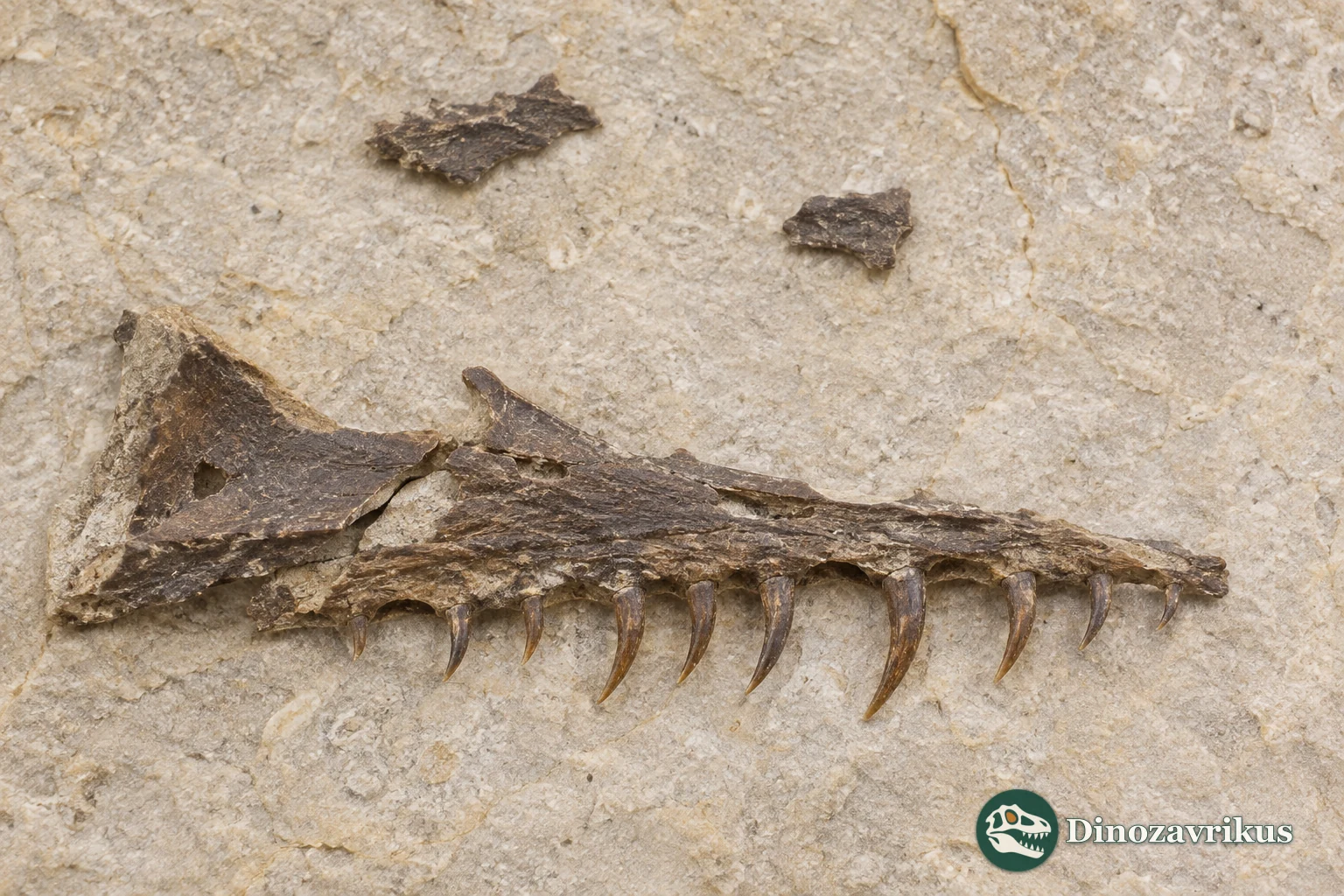
Late Jurassic fossils from Guimarota in Portugal and the Morrison Formation in western North America have been assigned to the genus. The fragmentary dentary DINO 15915 preserves twelve tooth positions, out of an estimated original row of fifteen or sixteen. Evans and Chure found that its crowns closely match English material, with differences in the strength of some ridges. A jaw from Fruita, Colorado, has more rounded tooth cross-sections. Its identification at species level is less secure.
Where the genus fits among lizards
Features of the jaws, teeth and palate have been used to compare Dorsetisaurus with early branches of Anguimorpha. Its position matters because the fossils help constrain the age of that lineage. Another Purbeck lizard, Paramacellodus, also occurs in the Morrison Formation. When studying records from different continents, researchers benefit from jaw fragments bearing several teeth, which show how crown shape changes along the row.
Frequently asked questions
Where was the Dorsetisaurus type specimen found?
It came from Durlston Bay near Swanage in Dorset, southern England. The partial skeleton NHMUK PV R 8129 is held by the Natural History Museum in London.
How do the two English species differ?
Their upper jaws have distinctive teeth. The second species has shorter, broader crowns than the type species, whose teeth taper to a sharper tip.
Why are North American jaws assigned to Dorsetisaurus?
Some jaws from the Morrison Formation repeat the distinctive shape of the English teeth. Their resemblance supports comparison at genus level, with more uncertainty over the exact species.
What did Dorsetisaurus eat?
Its exact diet remains unknown. The shape and ridges of the teeth can be described in detail, but the teeth alone do not identify the food it ate.