

Dorudon atrox was a medium-sized ancient whale that lived in Eocene seas around Fayum, Egypt. Its skeleton was already adapted to life in water: the forelimbs formed flippers, the tail supplied the main thrust, and the hind limbs were greatly reduced. At about five metres long, it was smaller than the basilosaurid Basilosaurus found in the same deposits.
Dorudon belongs in the Ancient mammals catalogue. Wadi Al Hitan preserves evidence of a shared marine community as well as individual skeletons; young Dorudon remains and bite damage are discussed in our profile of Basilosaurus.
Quick facts
| Scientific name | Dorudon atrox (Andrews, 1906) |
|---|---|
| Group | Cetaceans, family Basilosauridae |
| Age | Middle to Late Eocene |
| Range | Fayum, western Egypt |
| Length | About 5 m in skeletal reconstructions |
| Evidence | Skulls, teeth, vertebrae, limbs and nearly complete skeletons |
What can the fossils tell us?
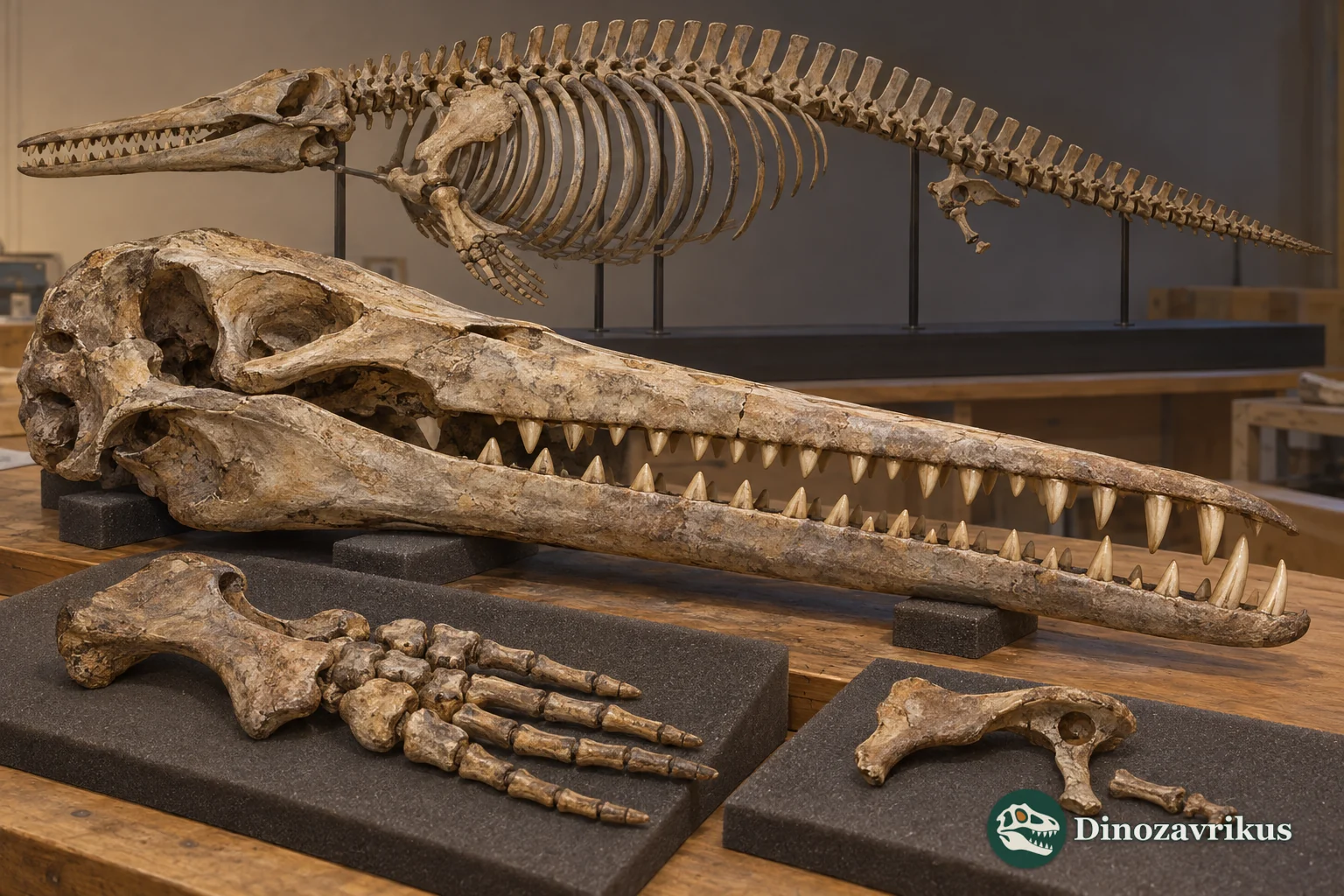
Charles W. Andrews named Prozeuglodon atrox in 1906 from holotype CGM 9319, a cranium and lower jaw from Fayum. Dental and skeletal maturity indicate that this was a juvenile. The holotype anchors the name, but the modern reconstruction draws on many later finds.
Vertebrae, flipper-like forelimbs and reduced hind limbs show a whale adapted to life in water and propelled by its tail. Nearly complete skeletons support an estimated body length of about five metres. The remaining hind limbs do not show that Dorudon could walk on land.
Milk teeth and open vertebral growth plates identify juvenile animals. Bite damage and juvenile Dorudon remains among material associated with Basilosaurus support predation. A shallow-water nursery is a plausible interpretation, not a directly observed breeding site.
Discovery and the name
Wadi Al Hitan, the “Valley of the Whales,” entered scientific accounts after geological surveys of Fayum in the early twentieth century. Hugh Beadnell reported fossil whales, and British palaeontologist Charles William Andrews studied material from Egypt. In 1906 Andrews named the species Prozeuglodon atrox. Its holotype, CGM 9319, is a cranium and lower jaw of a juvenile whale held by the Cairo Geological Museum.
The species was later transferred to the older genus Dorudon, first named by Joshua Gibbes for a different whale. The accepted combination is Dorudon atrox (Andrews, 1906); the original combination Prozeuglodon atrox remains part of its taxonomic history. Old collective uses of “zeuglodon” should not be mistaken for a separate modern genus.
The type specimen is incomplete and immature. A fuller understanding came from later fieldwork and more complete Fayum skeletons. Mark Uhen’s monograph assembled cranial, dental and postcranial material and compared it with related basilosaurids. Museum mounts are often composites or casts, rather than one fully articulated individual.
Age and localities
Most D. atrox fossils come from the Gehannam and Birket Qarun formations in Fayum, roughly 140 to 150 kilometres southwest of Cairo. These marine deposits span the transition from the middle to late Eocene. Ages depend on the horizon and dating framework; studies place sampled formations broadly between about 41 and 37 million years ago rather than assigning one date to the entire species.
The formations include clays, marls, sandstones and limestone deposited in shallow seas with changing shorelines. The desert landscape now exposed at Wadi Al Hitan differs sharply from the environment in which the whales lived. The fossil community also includes sirenians, turtles, crocodilians, bony fish and sharks.
Dorudon is known from isolated bones, partial skeletons and nearly complete individuals. Smithsonian collections include an Egyptian skull and skeleton, while the University of Michigan holds casts and composite mounts alongside individual specimens. Features of one fossil should not be applied to every individual without checking its age, formation and preservation.
Body and locomotion
Nearly complete skeletons support an estimated adult length of about five metres. This is a reconstruction from preserved bones and their proportions, not a direct measurement of soft tissue. Values vary slightly with the specimens and proportions used.
The vertebral column and tail indicate propulsion by waves travelling through the rear body. The forelimbs retained the bones of the upper arm, forearm and hand but were enclosed in flippers; their shape and joints were not suited to normal weight-bearing on land. The pelvis and short hind limbs retained ancestry from terrestrial mammals but were too small to support walking. Their presence does not imply that Dorudon routinely hauled itself onto shore. A role in manoeuvring or mating has been proposed, but bones do not establish it.
Skull, teeth and feeding
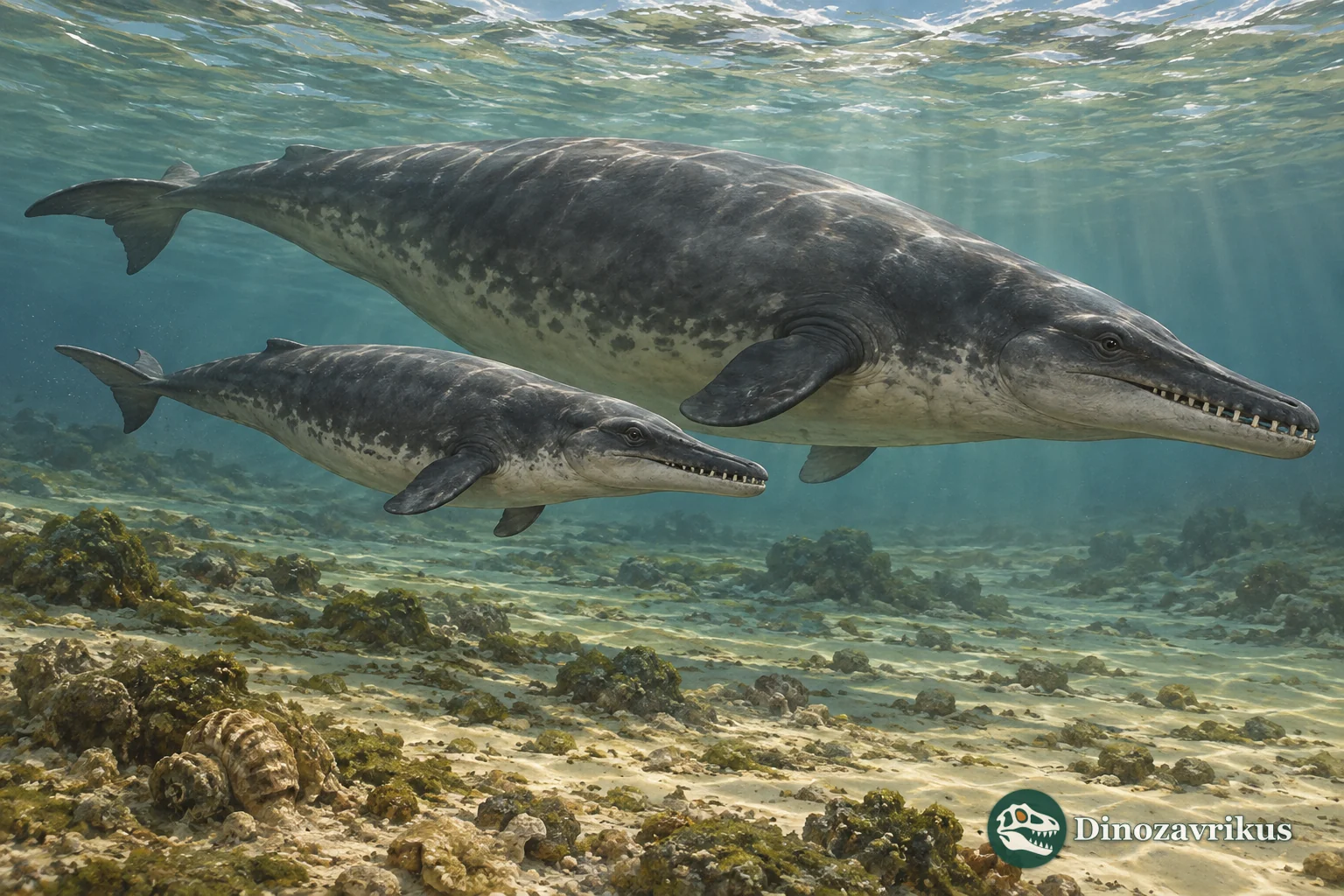
The elongated jaws carried different kinds of teeth. Pointed front teeth and more complex cheek teeth were suited to grasping and processing food. This supports a predatory diet, but the exact prey of Dorudon itself is less directly known than its general feeding anatomy. Fish and sharks found in the same deposits cannot be listed as prey simply because they co-occur.
More direct evidence concerns Dorudon as prey. Researchers described marks on the frontal bones of juvenile animals that match the dimensions and shape of teeth from the larger Basilosaurus isis. During excavation of Basilosaurus skeleton WH 10001, the team also recovered juvenile Dorudon bones among remains associated with the large whale. The authors interpreted these as stomach contents after checking their position and preservation. Bite marks alone might also result from scavenging, but the combined evidence supports attacks on young Dorudon.
Growth and reproduction
Wadi Al Hitan contains both adult and juvenile Dorudon. Researchers distinguish growth stages from the replacement of milk teeth by permanent teeth and from the closure of vertebral growth plates. Some juvenile remains represent animals around 1.5 to 2 metres long, a reconstruction of particular age classes rather than the average size at birth.
The abundance of juveniles and damage to their skulls led researchers to suggest that the shallow sea at Wadi Al Hitan may have served as a calving or nursery area. The evidence highlights the role of young whales in the food web, but it does not directly record a birth, seasonality or parental care. No fossil preserves Dorudon parenting behaviour.
Palaeoenvironment and preservation
At Wadi Al Hitan, whale bones were buried in marine sediments. Some skeletons remained articulated, while currents, scavengers and weathering separated others. Studies of stomach contents and tooth marks mapped bone positions and compared them with other specimens. Without that work, the proximity of two species would not be enough to infer predation.
Dorudon shared the late Eocene sea with other whales, sirenians, turtles, fish and sharks. Nearly complete skeletons and smaller isolated bones let researchers investigate the community, but a fossil formation may accumulate over a substantial interval rather than record one brief event.
Frequently asked questions
Was Dorudon a dinosaur?
No. It was a cetacean mammal, one of the fully aquatic early whales in the family Basilosauridae.
How long was Dorudon atrox?
About five metres in reconstructions based on nearly complete skeletons. This is an estimate of body length, not a preserved soft-tissue outline.
Could Dorudon walk on land?
There is no good evidence that it walked. Its forelimbs were flippers, the pelvis and hind limbs were reduced, and the tail and spine were adapted for swimming.
Did Basilosaurus hunt Dorudon?
Bite marks on juvenile skulls and young Dorudon remains among material interpreted as Basilosaurus stomach contents support predation. They do not show that Dorudon was its only or constant prey.