

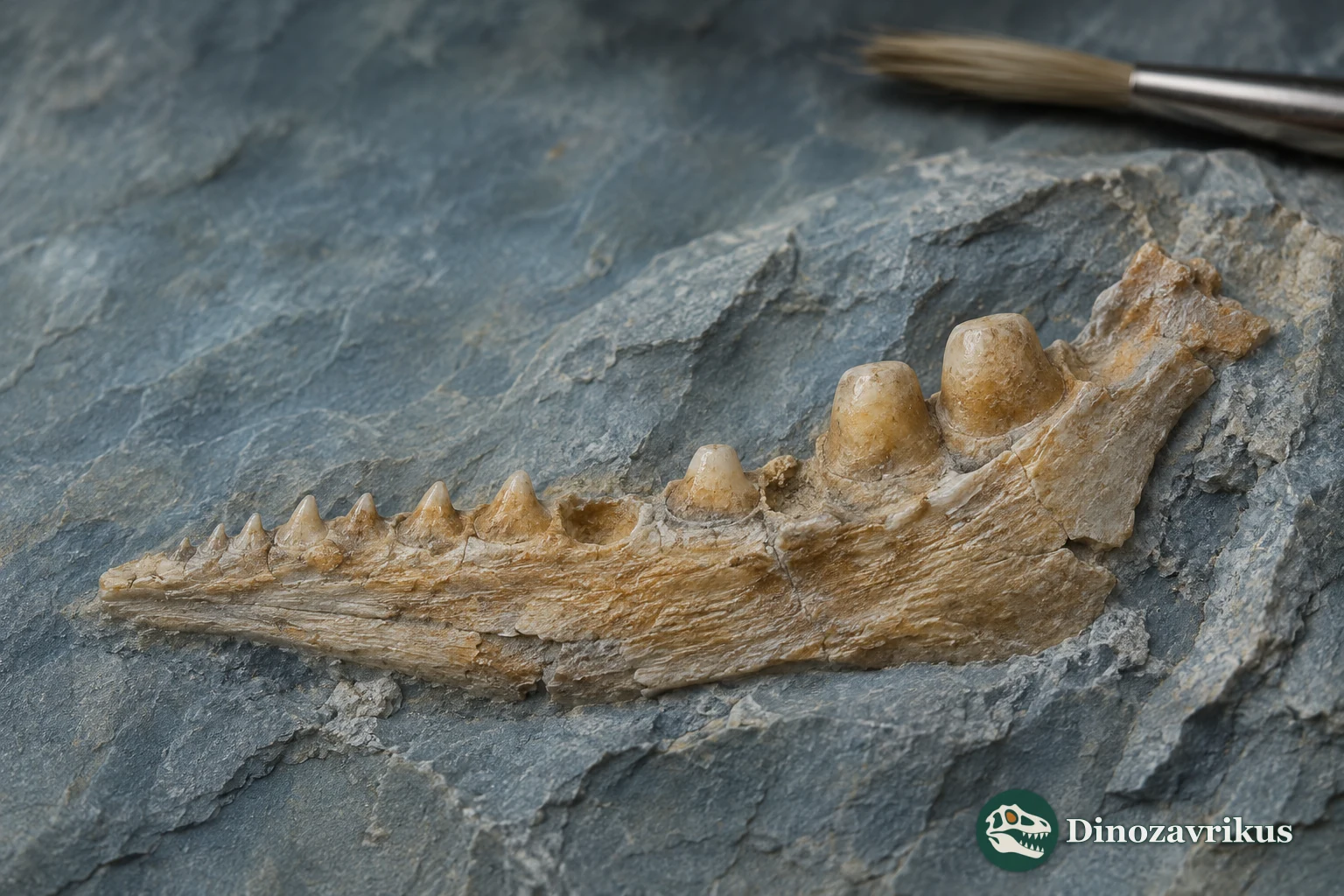
Dracaenosaurus was a lacertid lizard from Oligocene Europe. French fossils include a nearly complete skull, while German finds include isolated jaw bones. The front teeth are slender. The far larger, blunt teeth at the back suggest that the jaws bore substantial loads when processing hard food.
Quick facts
| Group | Lacertoids (Lacertoidea), lacertid lizards (Lacertidae) |
|---|---|
| Age | Oligocene |
| Region | Europe, France and Germany |
| Skull length | 46 mm in the Cournon specimen |
| Type species | Dracaenosaurus croizeti |
| Scientific name | Dracaenosaurus |
| Diet | Hard food processing inferred. Exact prey unknown |
What can the fossils tell us?
MNHN.F.COR7 preserves both sides of the lower jaw, most of the skull and a few bones from the neck and forelimb. The total measured skull length is 46 mm.
Blunt teeth, a robust cheekbone and large surfaces for the jaw muscles are consistent with crushing hard food.
Snail shells occur in the lake deposits at Cournon. They make molluscs plausible prey, but the fossils preserve no direct record of a meal.
From the first descriptions to CT imaging
Auguste Pomel proposed the genus in 1846, and the type species Dracaenosaurus croizeti is cited from Paul Gervais's work of 1848–1852. The especially informative specimen MNHN.F.COR7 comes from late Oligocene deposits at Cournon in south-central France. Micro-CT revealed details in the parts of the skull still enclosed in rock. A neck vertebra and several forelimb bones were associated with it.
How the crowns change along the jaw
The front teeth are relatively slender and the rear teeth have much larger and blunter crowns. The difference is stronger than in Mediolacerta, another Oligocene lacertid. At Cournon, the robust cheekbone meets the maxilla along a broad contact. A fossa on the lower jaw provides a large area for muscle attachment. These features support the inference that the jaws could bear high forces.
Shells near the skull
The Cournon specimen was embedded in calcareous marl laid down in a lake. The local sediments contain land and freshwater snails. The thick crowns could have crushed shells and other hard items, with no direct evidence for a particular prey species. The sediment around the skull also leaves open how much time the lizard spent in water.
The German jaw record
Late Oligocene jaws reported from Herrlingen resemble those of the French species. One fragment with less massive rear teeth was left without a species name. Differences between isolated bones can reflect variation. Comparisons with better-preserved skulls make it possible to check several features together.
Frequently asked questions
How large was Dracaenosaurus?
The Cournon skull measures 46 mm in length. That measurement does not establish the animal's total length with its tail.
Has it been found outside France?
Yes. Jaw bones from late Oligocene deposits in Germany have also been assigned to the genus.
Did it eat snails?
The robust jaws and blunt rear teeth fit shell crushing. The specimens preserve no direct evidence of a meal.
What did the CT scans add?
They exposed the shape and positions of bones still enclosed in the rock without requiring physical preparation first.