

Dromornis was a genus of enormous flightless birds that lived in Australia long before humans reached the continent. The largest well-studied species, Dromornis stirtoni, could exceed half a tonne in estimated mass. Its massive bill looks formidable, but skull studies favour plant feeding. Fossils reveal more than size: they also preserve evidence about growth, differences between the sexes and even probable hearing capabilities.
Quick facts
| Group | Flightless dromornithid birds |
|---|---|
| Distribution | Australia |
| Main fossil record | Late Oligocene and Miocene |
| Male D. stirtoni mass | About 528 kg on average, estimated |
| Genus named by | Richard Owen, 1872 |
What can the fossils tell us?
Skulls and limb bones provide measurable characters. Leg-bone dimensions support mass estimates, while medullary tissue helps identify females.
Thin sections reveal changes in growth rate and tissue remodelling. They indicate that Dromornis stirtoni took many years to reach adulthood.
Cranial and inner-ear cavities are studied digitally. They provide indirect evidence of vision and hearing, not a preserved brain or a recording of the bird’s voice.
The discovery of the genus and its four species
Richard Owen introduced Dromornis in 1872 for Dromornis australis from Peak Downs in Queensland. Early identifications of giant birds relied mainly on limb bones. The age of the deposits yielding this species’ type material is insufficiently constrained, so it should not be assigned a precise date with confidence.
Three other species have a better documented history. Dromornis murrayi comes from Riversleigh in northwestern Queensland, including late Oligocene and early Miocene deposits. Dromornis planei occurs in middle Miocene beds at Bullock Creek in the Northern Territory. Dromornis stirtoni is represented by abundant remains from late Miocene Alcoota in the same broad region of Australia.
The Bullock Creek species was long called Bullockornis planei. Studies of cranial material supported its inclusion in Dromornis; the older name still appears in publications and museum accounts. Species differed in size and head proportions as well as age. A proposed evolutionary succession should not be mistaken for a demonstrated chain of direct ancestors and descendants.
Neither an ostrich nor an oversized modern duck
Small wings, a heavy body and powerful legs show that Dromornis could not fly. Its outward resemblance to ostriches influenced early classification. Cranial anatomy instead linked dromornithids with Galloanserae, the major bird branch containing landfowl and waterfowl.
Their exact position within that branch remains debated. Different analyses have placed dromornithids near waterfowl, close to the base of landfowl, or alongside extinct gastornithids. Comparison with Gastornis is especially interesting because both combined a large body with a deep bill. Dromornis should nevertheless not be treated as a simply enlarged modern duck.
Estimating the mass of a giant
A 2016 study of Dromornis stirtoni favoured estimates based on the minimum shaft circumference of the tibiotarsus, the main lower-leg bone. The equations relate the dimensions of a weight-bearing bone to body mass in living birds. Estimates from the femur could overstate mass in an animal with such unusual proportions.
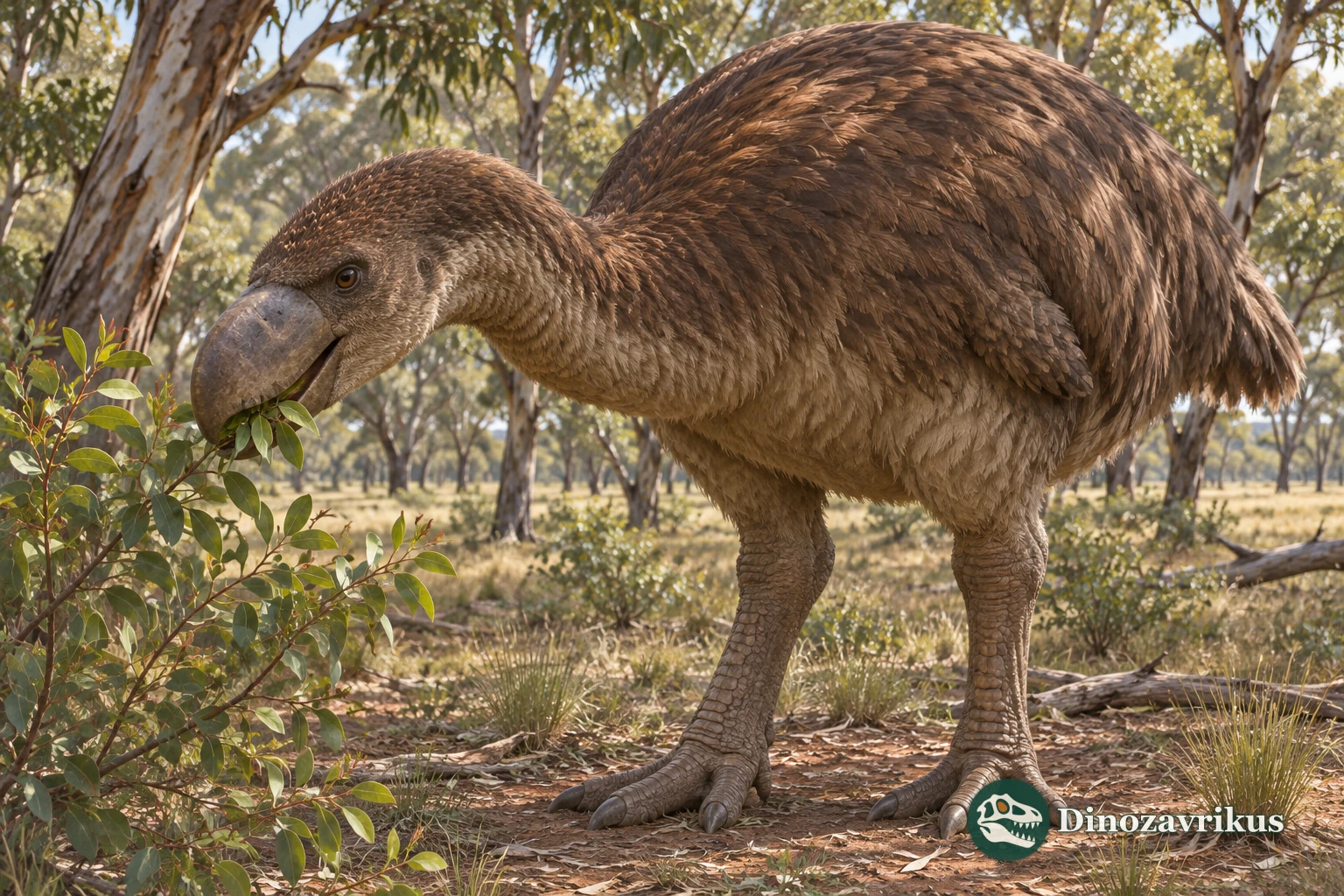
Estimated mean mass was approximately 528 kg for the male group and 451 kg for females. Males were primarily more robust, rather than dramatically taller. Large individuals are commonly reconstructed at around 3 m tall, although neck posture affects such estimates. Neither mass nor standing height was measured from a living bird.
Sex identification relied on more than bone size. The less robust group contained medullary tissue, a temporary calcium reserve associated with eggshell production in females. Combining skeletal form with histology makes the inference of sexual dimorphism stronger than merely sorting bones into large and small categories.
A huge bill and probable plant feeding
The deep, tall bill prompted debate about possible carnivory. Its imposing appearance alone does not show that the bird tore apart prey. Research on the interior of the skull supports a different interpretation: Dromornis may have selected soft leaves and shoots, using well-developed depth perception.
Computed tomography allows researchers to model the cavity occupied by the brain and assess the relative development of different regions. Features associated with vision are consistent with precise selection of plant food. This is a functional interpretation, not preserved stomach contents. The particular plants eaten by Dromornis stirtoni remain unidentified.
A growth period lasting many years
A study of 22 long bones of Dromornis stirtoni, published in 2023, revealed prolonged growth. Bone tissues indicate that reaching adult body size took several years, probably more than a decade. Growth then slowed before full skeletal maturity was attained.
Some bones contained medullary tissue before developing the outer layer associated with the end of active growth. At least some females therefore began reproducing before their skeletons had completely matured. This does not establish a precise age at first breeding for the entire species.
The later relative Genyornis followed a different growth pattern and survived into the Pleistocene. Its overlap with people must not be transferred to Miocene Dromornis stirtoni: the two birds are separated by millions of years.
What the inner ear suggests about hearing
A study appearing in a 2026 journal issue compared the bony inner-ear canals of dromornithids with those of living birds. Relative cochlear-duct dimensions were used to estimate aspects of auditory sensitivity.
The model predicted an especially low region of best hearing in Dromornis stirtoni compared with the other dromornithids studied. The relationship between canal dimensions and hearing has limitations, however. It cannot reproduce the bird’s actual voice or establish that it heard only within a narrowly defined numerical band.
Waterholes, crocodiles and bone concentrations
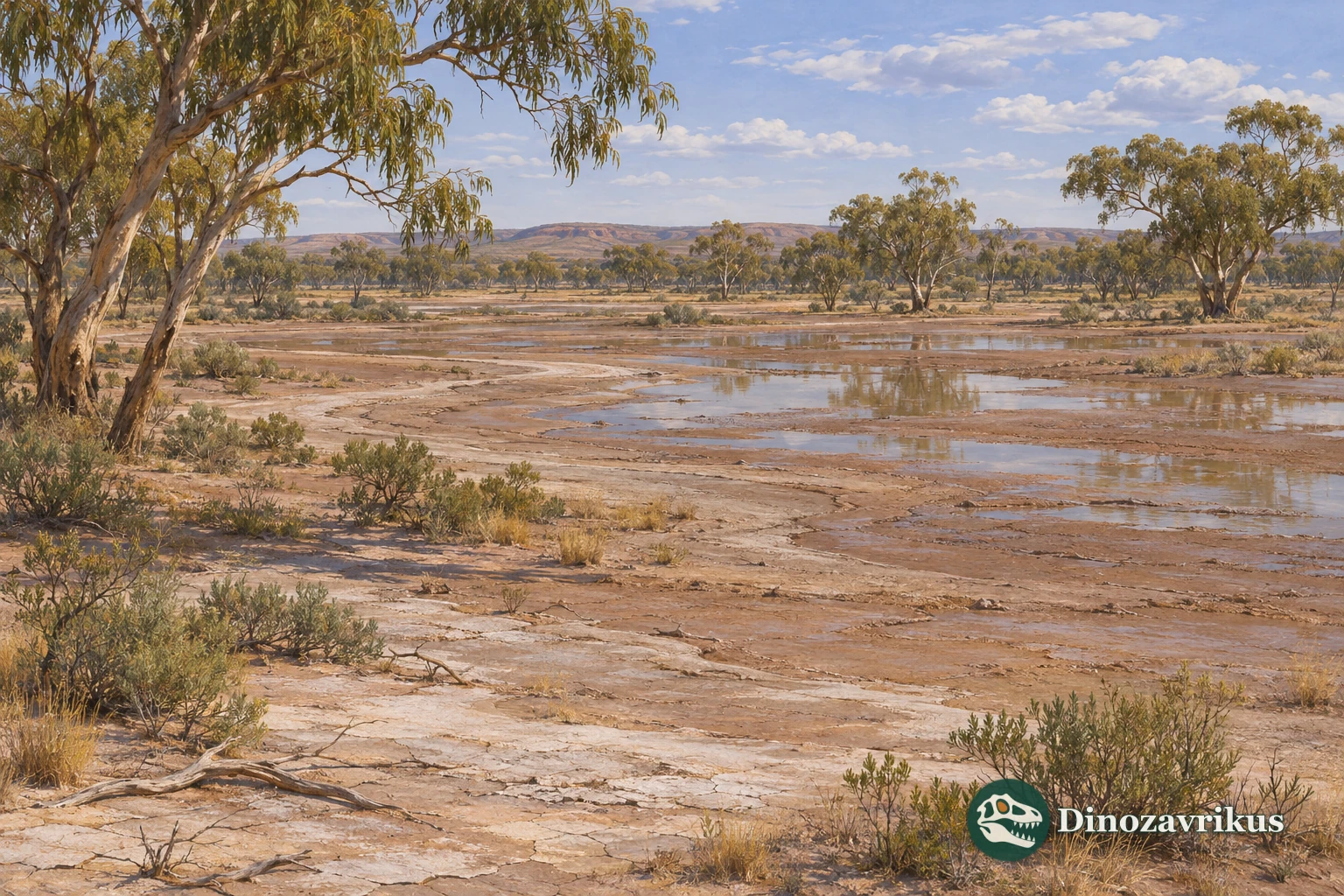
Bullock Creek preserves evidence of freshwater environments. Some bones of large animals, including Dromornis planei, bear punctures matching crocodile teeth and damage sustained while the bone was fresh. These are interpreted as evidence of attacks or carcass consumption, showing that enormous size did not provide complete protection.
Alcoota records a different history of fossil accumulation. Bones are concentrated in fine river sediments, with transport and repeated changes in moisture contributing to their preservation. A rich concentration of disarticulated elements therefore should not automatically be illustrated as an entire herd dying together in one place.
The localities span a long history of the genus. No single established cause explains the disappearance of every Dromornis species. Evidence for slow growth clarifies aspects of their biology, but does not by itself identify the cause of extinction.
Frequently asked questions
Was Dromornis the heaviest bird ever?
Dromornis stirtoni was among the heaviest known birds. Comparisons with giant elephant birds depend on estimation methods, sex and the completeness of fossils, so an unqualified record is difficult to defend.
Did Dromornis hunt other animals?
There is no convincing confirmation of a predatory lifestyle. Cranial anatomy and functional studies favour plant feeding, although its exact diet remains unknown.
Why is Bullockornis now called Dromornis?
Reassessment of cranial material showed close similarities between the Bullock Creek species and other Dromornis species. It was included in the genus as Dromornis planei.
Could people have seen Dromornis stirtoni?
No. It is known from the late Miocene, millions of years before humans arrived in Australia. It is sometimes confused with the much later dromornithid Genyornis.