

Dusisiren was a genus of sea cows from the North Pacific during the Miocene. Its fossils record changes in the skull, teeth and forelimbs within the hydrodamaline lineage that also includes Steller’s sea cow. These changes have been arranged into an evolutionary sequence, but the fossils do not show every population or prove that one named species directly became another.
The genus belongs in the ancient mammal catalogue. Its California and Japanese records help compare eastern and western North Pacific sirenians across the Miocene.
Quick facts
| Scientific name | Dusisiren Domning, 1978 |
|---|---|
| Type species | Dusisiren jordani, first described as Metaxytherium jordani |
| Group | Sirenia; Dugongidae; Hydrodamalinae |
| Age | Miocene; individual species come from different intervals |
| Range | Eastern and western North Pacific, including California and Japan |
| Known remains | Skulls, vertebrae, ribs and forelimb elements, variably associated |
| Estimated length | About 4–5 m in secondary summaries; incomplete skeletons limit precision |
| Main question | How far the hydrodamaline fossils form a direct line toward Steller’s sea cow |
What do the Dusisiren fossils show?
Described skulls, vertebrae, ribs and forelimb bones allow anatomical comparisons. The specimens come from different localities and are not one composite skeleton.
Dusisiren dewana retained functional but reduced teeth. Researchers compare them with earlier dugongids and later Hydrodamalis, but the sequence is a phylogenetic interpretation.
The Japanese skeleton preserves greatly reduced metacarpals and phalanges that form a claw-like edge to the flipper. Fossils do not preserve the soft tissues of that limb.
A recent lipid isotope study of one Dusisiren bone produced a carbon signal consistent with seaweed, including kelp. The result depends on molecular preservation and cannot represent every species automatically.
Naming and species
Daryl P. Domning established Dusisiren in 1978 while revising fossil sirenians from the North Pacific. The type species is the animal Remington Kellogg named Metaxytherium jordani in 1925. It was later combined with Halianassa before Domning placed it in Dusisiren. The changing combination reflects revised interpretations of relationships, not a different fossil.
Several species have been referred to the genus, including the well-documented Californian D. jordani and Japanese D. dewana. Other named forms and fragmentary remains are less completely known. The number of species accepted depends on the taxonomic treatment; isolated bones from different horizons should not be treated as one population.
California fossils and collections
D. jordani is known from Miocene deposits in California. The Smithsonian National Museum of Natural History records wrist and hand bones from the Santa Margarita Formation in Santa Cruz County. The collection record names Guruswami-Naidu as collector and records a September 1978 collection date. These bones document part of the forelimb, not a complete skeleton.
Other California specimens preserve more extensive cranial and postcranial material. They let researchers compare body proportions and tooth changes, but museum collections include fossils from separate localities and layers. Each specimen must retain its own catalogue number and geological context.
The Japanese skeleton of Dusisiren dewana
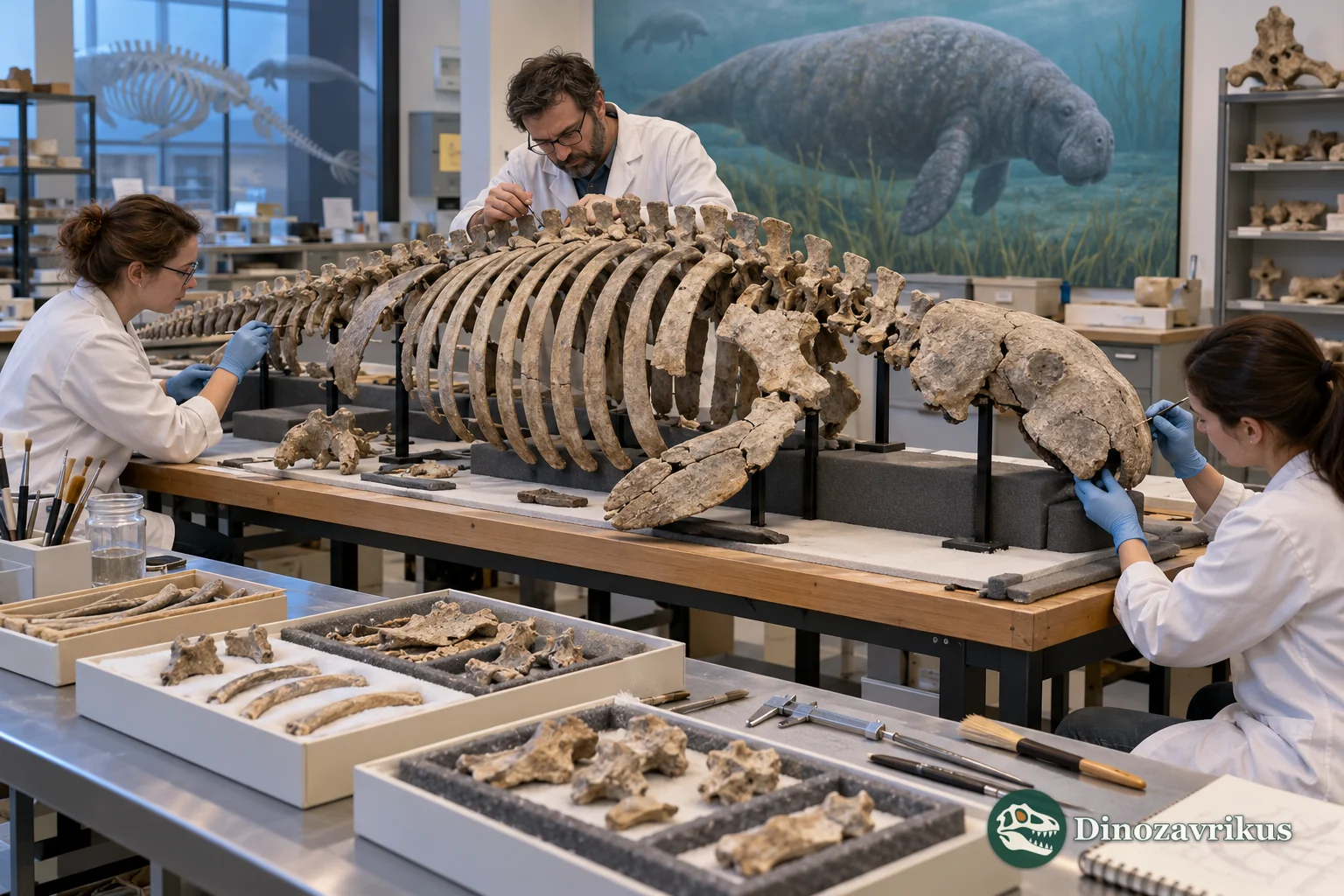
In 1978, during unusually low water, two schoolchildren noticed large bones on the exposed bed of the Mogami River in Yamagata Prefecture. Later excavation recovered a well-preserved front portion of a sea-cow skeleton from the Hashigami Sandstone Member of the Hongo Formation. Diatom biostratigraphy places the layer at roughly 9.0–10.4 million years old.
The 1986 description reported a skull about 51 centimetres long, shoulder blades, ribs and an extended run of vertebrae. The right forelimb was especially informative: strongly reduced metacarpals and phalanges form an unusual claw-like edge to the flipper. The authors named the animal D. dewana and regarded it as morphologically intermediate between D. jordani and Hydrodamalis cuestae. Their proposal that it was a direct ancestor of Steller’s sea cow is an evolutionary interpretation, not an observed event.
Teeth, flippers and an evolutionary hypothesis
Earlier members of the lineage retained functional teeth. In D. dewana, the teeth were reduced but still functional; later hydrodamalines reduced them further and eventually lost them. Forelimb anatomy, skull form and body size changed along with the dentition, but separate fossils do not preserve a continuous record of every population.
Domning proposed an unbranched hydrodamaline lineage in the North Pacific in which Dusisiren preceded Hydrodamalis. The age and anatomy of D. dewana supported that model. Later reviews continue to use it as a useful framework for the history of Steller’s sea cow, while a direct ancestor–descendant relationship remains harder to demonstrate than a close evolutionary position.
Diet and coastal habitat
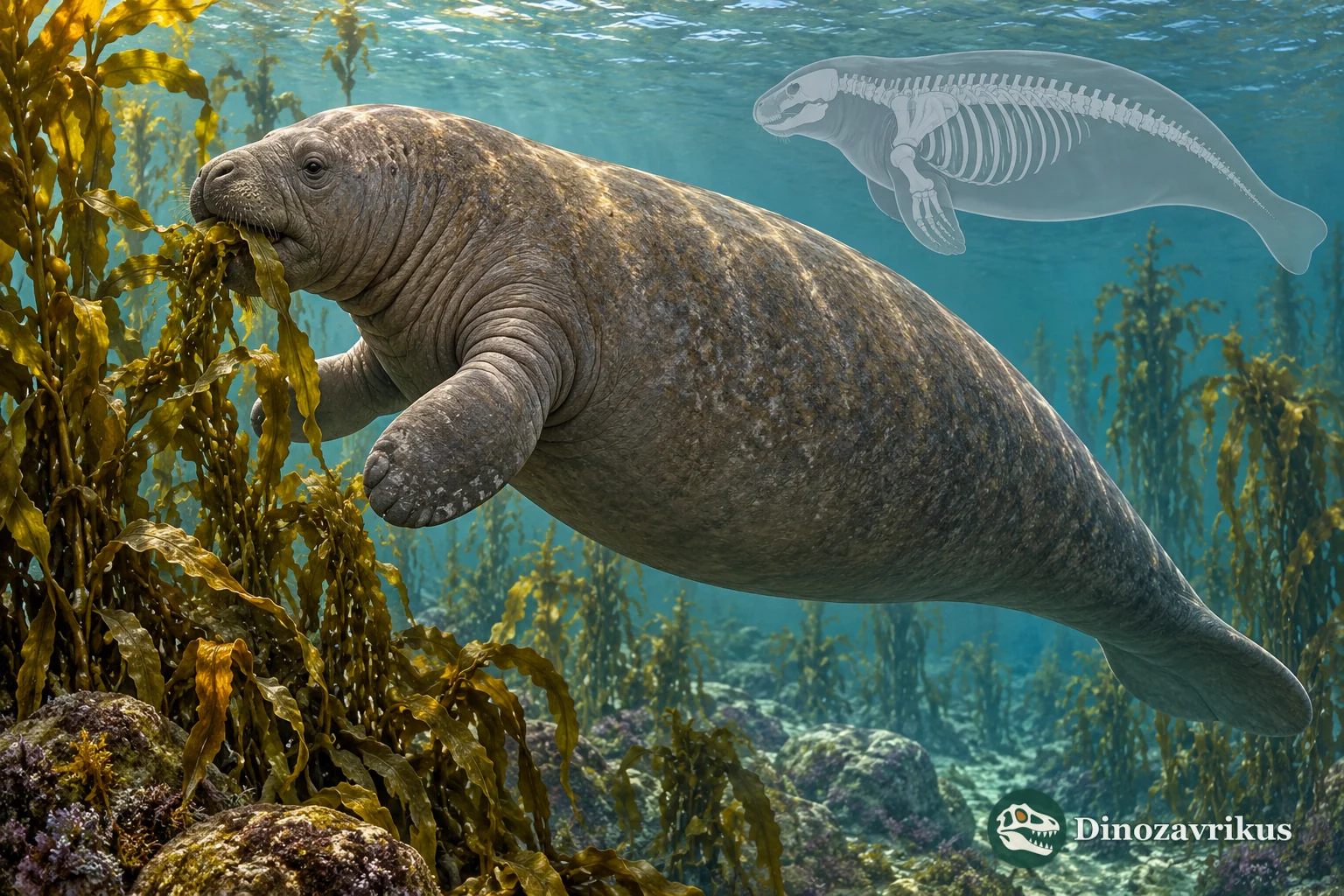
Like other sirenians, Dusisiren was an aquatic herbivore. Its body and limb anatomy are consistent with movement in coastal water, but fossils do not preserve migration routes, dive depth or seasonal movements.
A 2026 study compared carbon isotopes in lipids extracted from fossil sirenian bones in Japan. Values from the studied Dusisiren material were lighter than those of the living dugong, and the authors interpreted them as consistent with a diet rich in seaweed, including kelp. This is an independent line of evidence, not preserved stomach content; its interpretation depends on whether original molecules survived fossilization and should not be generalized to every species.
Size and appearance
Secondary summaries give a body length of roughly 4–5 metres for members of the genus. This is not a single measurement applicable to every species: the range comes from incomplete skeletons and comparison with other sirenians. The Japanese D. dewana is best measured in parts of its front body; its tail and complete proportions are not preserved.
Streamlined bodies, flippers and tail flukes in reconstructions follow the general anatomy of sirenians. Skin colour, blubber thickness and the precise outline of the lips are unknown. Teeth and forelimb bones are direct evidence; soft tissues in artwork are comparative reconstruction.
Frequently asked questions
When did Dusisiren live?
Fossils assigned to the genus are Miocene in age. The interval differs among species and sites; the Hongo Formation with D. dewana is dated to roughly 9.0–10.4 million years ago.
Was Dusisiren an ancestor of Steller’s sea cow?
Some authors place D. dewana on a direct line toward Hydrodamalis. It is a supported evolutionary hypothesis, but an incomplete fossil record cannot exclude closely related side branches.
How did it differ from Steller’s sea cow?
Studied Dusisiren species retained reduced functional teeth, whereas Steller’s sea cow had lost its teeth. The Japanese D. dewana also has extremely reduced finger bones in the forelimb.
What did Dusisiren eat?
It was an herbivorous sea cow. Isotope data from one Japanese specimen are consistent with a substantial seaweed component, but the exact diet of each species is unknown.