

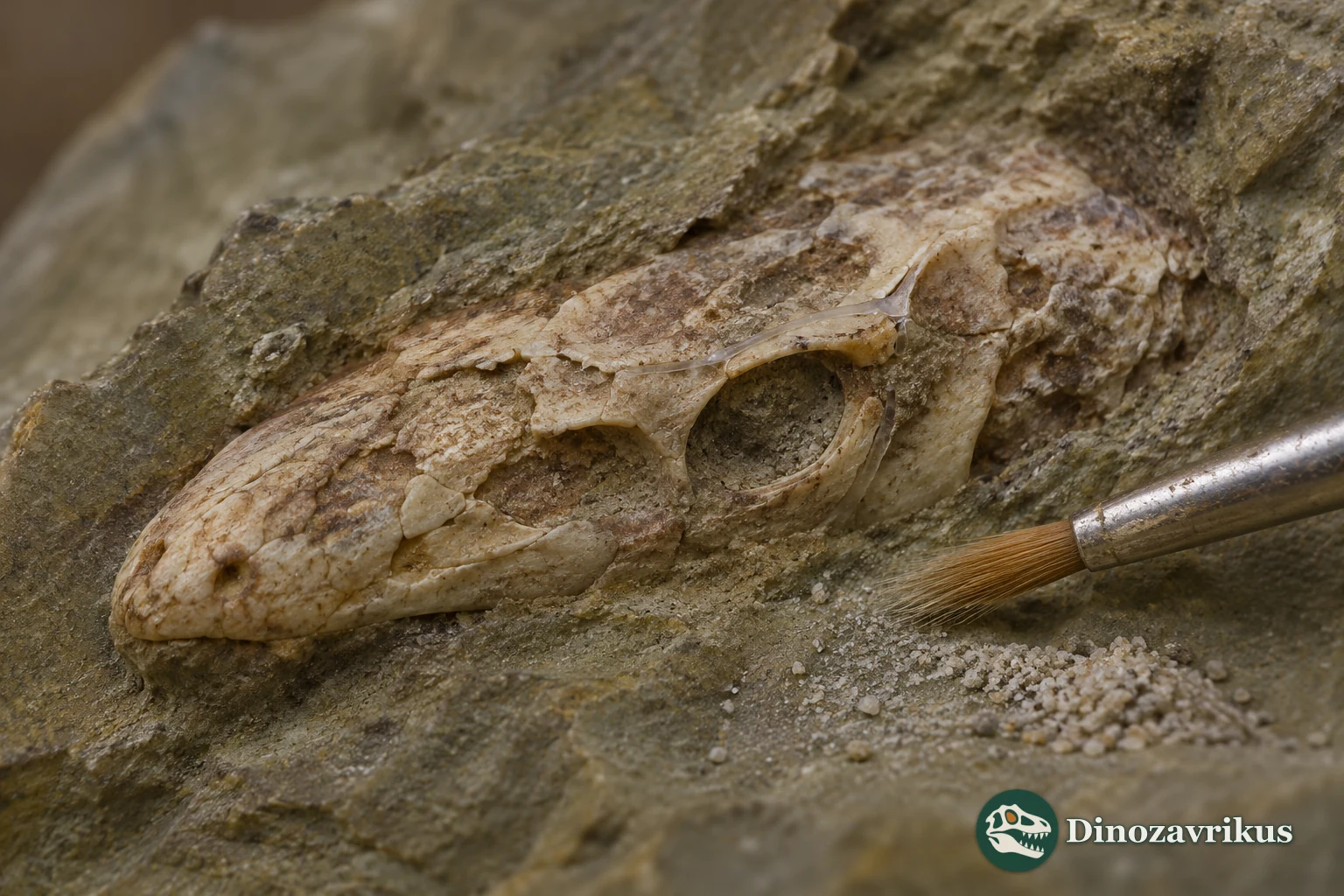
Dyticonastis was a fossil worm lizard from the John Day Formation of Oregon. Its small skull preserves a distinctive contact. The cheekbone meets the frontal beneath the eye socket, reinforcing the bony rim around it.
Quick facts
| Group | Worm lizards (Amphisbaenia), rhineurids (Rhineuridae) |
|---|---|
| Age | Oligocene |
| Region | North America, United States, Oregon |
| Type species | Dyticonastis rensbergeri |
| Scientific name | Dyticonastis |
| Diet | No direct evidence |
What can the fossils tell us?
UCMP 76881 is a skull from the Oligocene John Day Formation. The lower jaw is preserved with it.
CT showed the cheekbone and the frontal meeting beneath the eye socket. Similar contacts occur in some other fossil rhineurids.
The skull shape is consistent with head-first digging. Its bony rim cannot establish visual acuity or the depth of any burrow.
Finding and scanning the skull
John Rensberger collected the type specimen in Crook County, Oregon. David Berman named Dyticonastis rensbergeri in 1976. The holotype is held at the University of California Museum of Paleontology in Berkeley. It was scanned at the University of Texas at Austin in 2005. The resulting 990 slices reveal internal contacts that are difficult to see on the outside.
A reinforced orbit
In Dyticonastis the jugal meets the frontal below the orbit and supports its rim. The Eocene worm lizard Spathorhynchus shares that feature. A comparative analysis suggested that the closed orbital rim may have re-evolved in part of the rhineurid lineage after earlier forms lost a complete rim. A closed rim by itself tells us little about the size of the eye.
A head suited to moving through soil
The flattened snout is compatible with pushing into soil. Living worm lizards with a comparable build take the load on the head when digging. Many fossil relatives are known from much less material. The European Palaeoblanus is identified mainly from jaws. Dyticonastis also preserves the bones around the eye and inside the palate and braincase for comparison.
Frequently asked questions
Was Dyticonastis a snake?
It was a worm lizard, a separate group of squamates. Its skull can be compared with that of other rhineurids.
When did it live?
The holotype comes from Oligocene deposits of the John Day Formation. It anchors the confirmed age of the genus.
What did the scans reveal?
They show the contact between frontal and cheekbone beneath the orbit and some of the channels at the base of the skull.
Do we know its diet?
Skull and jaw bones permit anatomical comparisons. They preserve no evidence of an actual meal.