

Ecolsonia was an Early Permian temnospondyl from New Mexico. It had elongated nostril openings and many small bones embedded in its skin. The skull, backbone and skin bones supplied different clues as palaeontologists compared it with two closely related amphibian families.
Quick facts
| Group | Temnospondyls, trematopids |
|---|---|
| Age | Early Permian |
| Region | North America, USA (New Mexico) |
| Type species | Ecolsonia cutlerensis |
| Scientific name | Ecolsonia |
| Diet | Exact prey is unknown |
What can the fossils tell us?
In addition to the partial type skull, the fossil material includes more complete skulls, vertebrae, limb bones and skin bones.
The elongated nostril opening and a combination of other skull traits support a place among trematopids in modern analyses.
Some skin bones are preserved in groups. Their full extent and flexibility in life are hard to judge from those patches.
Two quarries in the Cutler Formation
Peter Vaughn described Ecolsonia cutlerensis in 1969 from UCLA VP 1734, a partial skull from VanderHoof Quarry in northern New Mexico. More complete material turned up in Morfin Quarry in 1983. It included CM 38017, which preserves a skull alongside other parts of the skeleton. Both quarries sample the Cutler Formation.
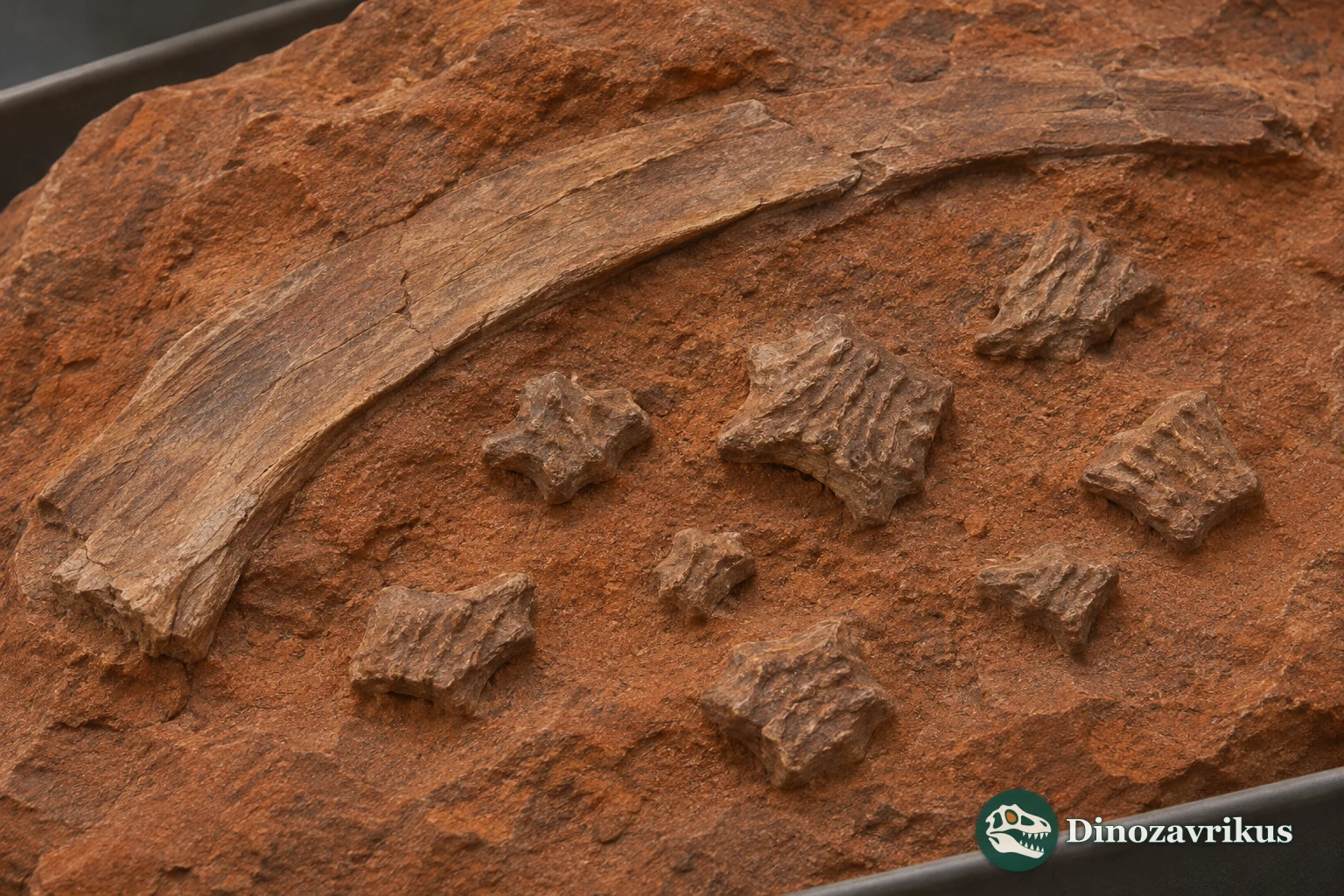
A layer of small skin bones
The osteoderms on the back fitted close together, with little or no overlap. Ridges and pits sculpted the entire outer face. Smaller skin bones also occur in the fossil material. This combination could cover much of the body with a mosaic of small elements. The plates over the spine of typical dissorophids followed a different arrangement.
The backbone and the front of the skull
Ring-shaped bones made up part of each vertebra, and some of the spines above the vertebral column had forked tips. The authors of the redescription interpreted these features as strengthening the trunk. Skull anatomy offers another way of comparing Cutler amphibians. Zatrachys had a large median opening in front of the eyes. Ecolsonia had a pair of conspicuously elongated nostril openings.
Why its family changed
Vaughn took the elongated nostril opening as evidence of trematopid affinities. The 1985 redescription drew attention to the back of the skull, including the bones around the otic notch, and proposed a position among dissorophids. Analyses comparing many traits across more species have since supported the trematopid assignment. The history shows the limits of classifying an amphibian by one prominent feature.
Frequently asked questions
Where was Ecolsonia found?
It comes from Early Permian beds of the Cutler Formation in northern New Mexico. The type specimen is from VanderHoof Quarry.
What were the osteoderms of Ecolsonia?
They were small bones within the skin. The dorsal osteoderms fitted close together in a mosaic.
Why did its classification change?
The nostril openings resembled those of trematopids. Features at the rear of the skull led to a dissorophid interpretation. Recent comparisons favour trematopid affinities.
What parts of Ecolsonia survive besides the skull?
The fossils include vertebrae, ribs, parts of the limb girdles and limbs, and skin bones.