

Edestus was a Pennsylvanian cartilaginous fish recognised chiefly by curved upper and lower tooth whorls at the jaw symphysis. The old image of two blades projecting from the snout is only one proposed reconstruction. A 2019 morphometric study supported four distinguishable species and interpreted transverse tooth wear as consistent with slicing, while a 2020 anatomical model placed the whorls within the mouth. The unusual fossils make Edestus a useful comparison with Helicoprion and a distinct case in the ancient fish catalogue.
Quick facts
| Group | Chondrichthyes, Eugeneodontiformes, Edestidae |
|---|---|
| Type species | Edestus vorax Leidy, 1856 |
| Age | Late Bashkirian to Moscovian, about 313–307 Ma |
| Distribution | Britain, the United States and the Russian Platform |
| Depositional settings | Coastal-marine and estuarine deposits |
| Main fossils | Upper and lower symphyseal tooth whorls, loose teeth and rare cranial fragments |
| Species in the 2019 revision | E. heinrichi, E. minor, E. triserratus and E. vorax |
| Size | A whorl-based model estimated E. heinrichi above 6.7 m; no adult skeleton was measured |
What the fossils establish
A loose tooth may not reveal whether it came from the upper or lower whorl, and adult anatomy is still incomplete.
The result is a taxonomic revision, not proof that every rare or poorly sampled population has been resolved.
Neither wear nor a reconstructed jaw reveals the exact prey, attack sequence or a single definitive bite trajectory.
A tooth fossil that puzzled early collectors
Joseph Leidy introduced Edestus in 1856 after receiving a fossil unlike an ordinary tooth row. Before articulated material was recognised, the long serrated structures were interpreted as fin spines or external weapons. The name became attached to a fish before its distinctive teeth could be confidently positioned in the jaws.
The type species is E. vorax. Its name-bearing material is fragmentary, and early locality information is imperfect. Later discoveries provided more complete tooth whorls and rare cranial fragments, but a complete adult skeleton remains unknown. The genus is therefore unusually well known for the shape of its teeth and poorly known for the outline of its body.
Two tooth rows at the jaw midline
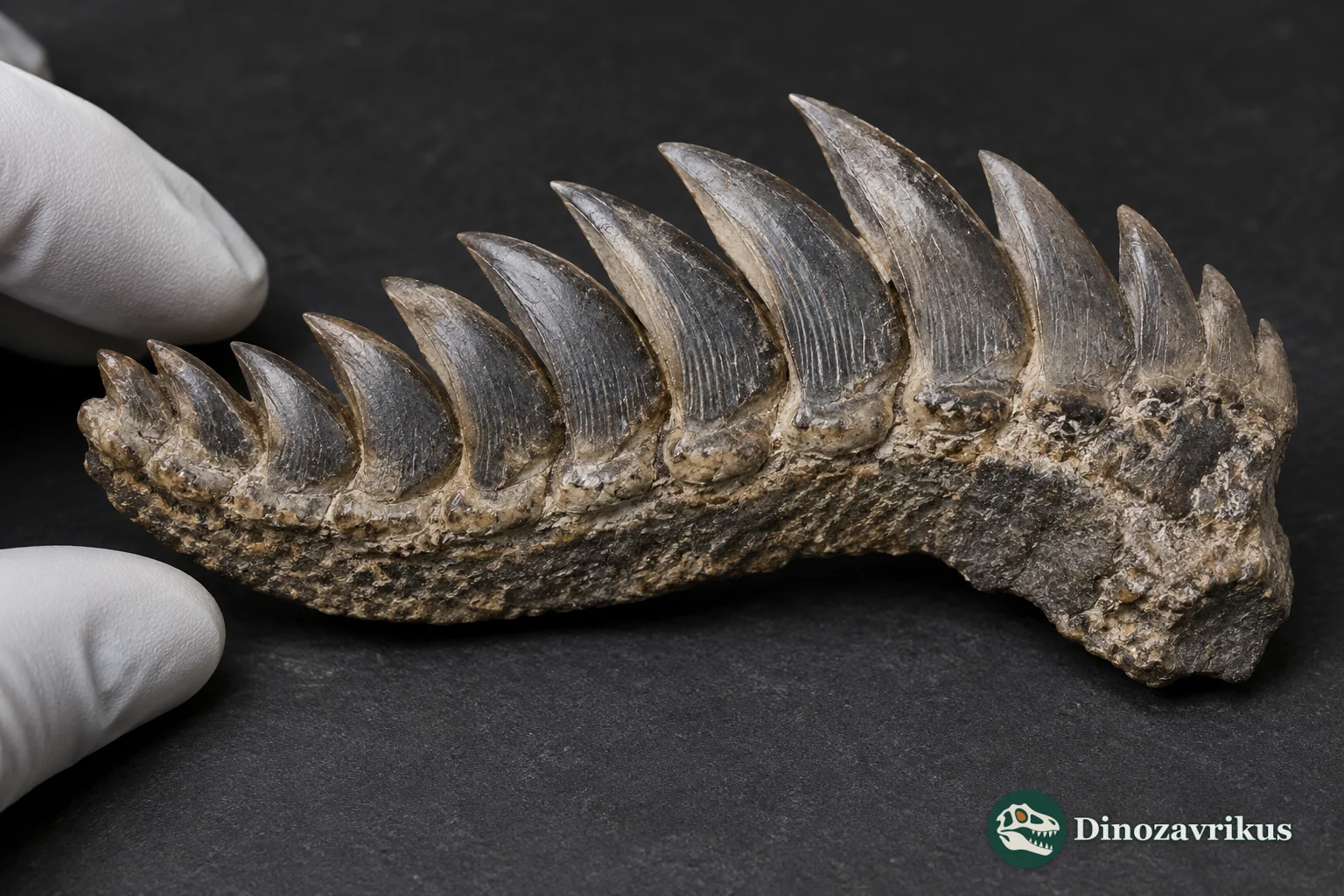
Edestus formed a tooth family at the symphysis, where the left and right halves of a jaw meet. Curved upper and lower whorls are known, and juvenile specimen FMNH PF 2204 preserves part of the skull with both rows in position. New teeth formed at the back of each whorl and moved forward as the tooth family grew, leaving separate crowns and whorl fragments in the fossil record.
The crowns are triangular and denticulate, while elongate roots stack along the whorl base. Their outlines vary by species and by position within a row. Upper and lower teeth also differ, so a single loose crown cannot always identify its original jaw position. Growth further changes tooth proportions.
How many species?
For more than a century, authors named numerous species from isolated crowns or partial whorls. Differences in tooth size, growth stage and position in the upper or lower row could be mistaken for species-level characters. In 2019, Leif Tapanila and Jesse Pruitt analysed more than 200 ejected teeth and intact or fragmentary whorls, comparing the new measurements with type specimens assigned to 13 existing names.
Crown shape, root length and whorl curvature supported four morphological concepts: E. minor, E. triserratus, E. heinrichi and E. vorax. Several historical names were treated as synonyms under that scheme. The sample for E. vorax is especially small, so variation and growth in that species remain less well understood than in forms represented by longer tooth series.
The four-species result is a supported revision, not a claim that every isolated tooth has been securely named. A crown should be assessed with its root, position, whorl curvature and geological context rather than size alone.
How the tooth apparatus may have worked
The arrangement of the whorls within the jaws is clearer than the precise motion of a bite. Tapanila and Pruitt noted transverse wear on teeth and argued in 2019 that it was compatible with a forward-to-backward slicing movement. Wear is a real feature of the fossil, but the proposed cutting action is an interpretation of its orientation and distribution.
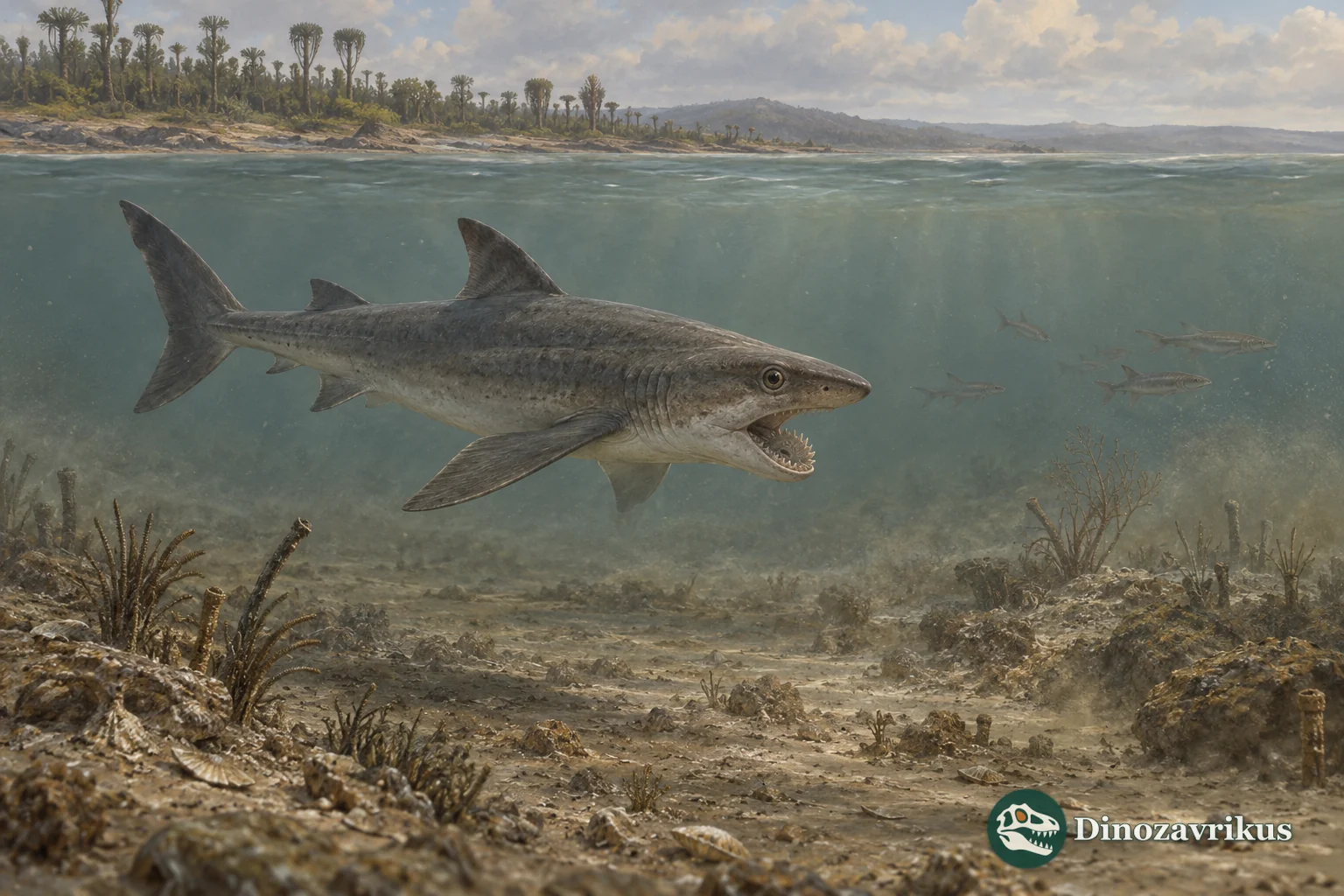
An anatomical study published in 2020 by Leif Tapanila and colleagues offered a different reconstruction. In that model the tooth blades curved inward and remained within the mouth's outline when the jaws closed, rather than projecting far beyond the snout like external scissors. This differs from many older illustrations. The available articulated pieces and wear patterns constrain the possible models, but they do not yet establish one exact jaw trajectory or hunting sequence.
The tooth rows invite comparison with Helicoprion, whose teeth formed a spiral. The two genera share an unusual midline dental apparatus, but their structures differ and should not be treated as identical mechanisms.
Age, geography and depositional setting
The 2019 revision places the accepted record of Edestus between about 313 and 307 million years ago, from the late Bashkirian through the Moscovian. Fossils are reported from Britain, the central United States and the Russian Platform. They occur in coastal-marine and estuarine deposits.
This distribution coincided with changes in sea level and the spread of shallow marine basins across parts of the ancient continents. The layers show where fossils were buried; they do not prove that each fish spent its entire life in an estuary or experienced one salinity regime. Locality and stratigraphy must be evaluated specimen by specimen.
How large was Edestus?
A length exceeding 6.7 metres has been proposed for E. heinrichi. The estimate extrapolates from tooth-whorl length using assumed proportions; it is not a direct measurement of a complete skeleton. It should be reported as a model-based estimate for one named species, not as a measured maximum for every Edestus.
Adult body bones are too poorly known to determine mass and exact proportions confidently. Reconstructions compare rare cranial material with other cartilaginous fishes. Body depth, head outline, fin size and soft tissues remain approximate beyond the features preserved in the fossils.
What the fossils establish
Fossils establish paired upper and lower symphyseal tooth whorls, triangular denticulate crowns and a Pennsylvanian age. Rare cranial material gives context for the teeth, while tooth wear and growth series support competing functional and taxonomic interpretations. The broad revision of 2019 demonstrates why isolated crowns should be studied in relation to whorl anatomy and development.
The complete body shape, exact bite mechanics and maximum adult size remain reconstructions. The familiar image of external tooth scissors is not settled anatomy: later work proposed inward-curving blades within the closed mouth. Keeping those alternatives visible makes the tooth fossils more useful than a single dramatic reconstruction.
Frequently asked questions
What was Edestus?
It was a Pennsylvanian eugeneodontiform cartilaginous fish, known mainly from curved upper and lower tooth whorls at the jaw midline.
Why is Edestus called a scissor-tooth fish?
The name reflects an interpretation of its cutting tooth rows. A 2019 wear study supported a slicing model, while a 2020 anatomical reconstruction placed the blades inside the closed mouth; the exact bite remains debated.
How many Edestus species are recognised?
The 2019 revision distinguished four morphological species: E. heinrichi, E. minor, E. triserratus and E. vorax. The scheme may change with better samples.
How long was Edestus?
A model based on tooth-whorl length estimated E. heinrichi above 6.7 metres. No complete adult skeleton has been measured, so this is an extrapolation rather than a direct length.