

Ehmaniella was a Middle Cambrian trilobite from North America. The Canadian species E. burgessensis had thirteen thoracic segments between a rounded head and a short tail shield. Its history starts with two Burgess Shale fossils that Charles Walcott took to belong to the same species.
Quick facts
| Group | Trilobites |
|---|---|
| Age | Middle Cambrian |
| Region | North America (Canada and United States) |
| Diet | Probable deposit feeding |
| Length | Up to 28 mm in E. burgessensis |
| Holotype | USNM 116245, E. burgessensis |
What can the fossils tell us?
An articulated dorsal shield preserves the count in E. burgessensis. The rings on the tail shield are a separate feature.
The original primary type stayed with Elrathia permulta. Rasetti assigned Walcott’s other specimen to the type series of E. burgessensis.
The genus occurs both in Canadian shale and in sections in the western United States. A zone name on a stratigraphic log is not a specimen identification.
How two specimens acquired different names
In 1918 Charles Walcott illustrated two Burgess Shale trilobites under the name Ptychoparia permulta. Charles Resser recognised that they represented different species, but inadvertently based a new name on the specimen Walcott had already designated as the primary type.
Franco Rasetti returned the original type to Elrathia permulta in 1951 and included the other fossil in his type series of Ehmaniella burgessensis. Resser had established Ehmaniella in 1937. The holotype of the Canadian species, USNM 116245, is held by the Smithsonian’s National Museum of Natural History. A very similar form from the same area was named E. waptaensis.
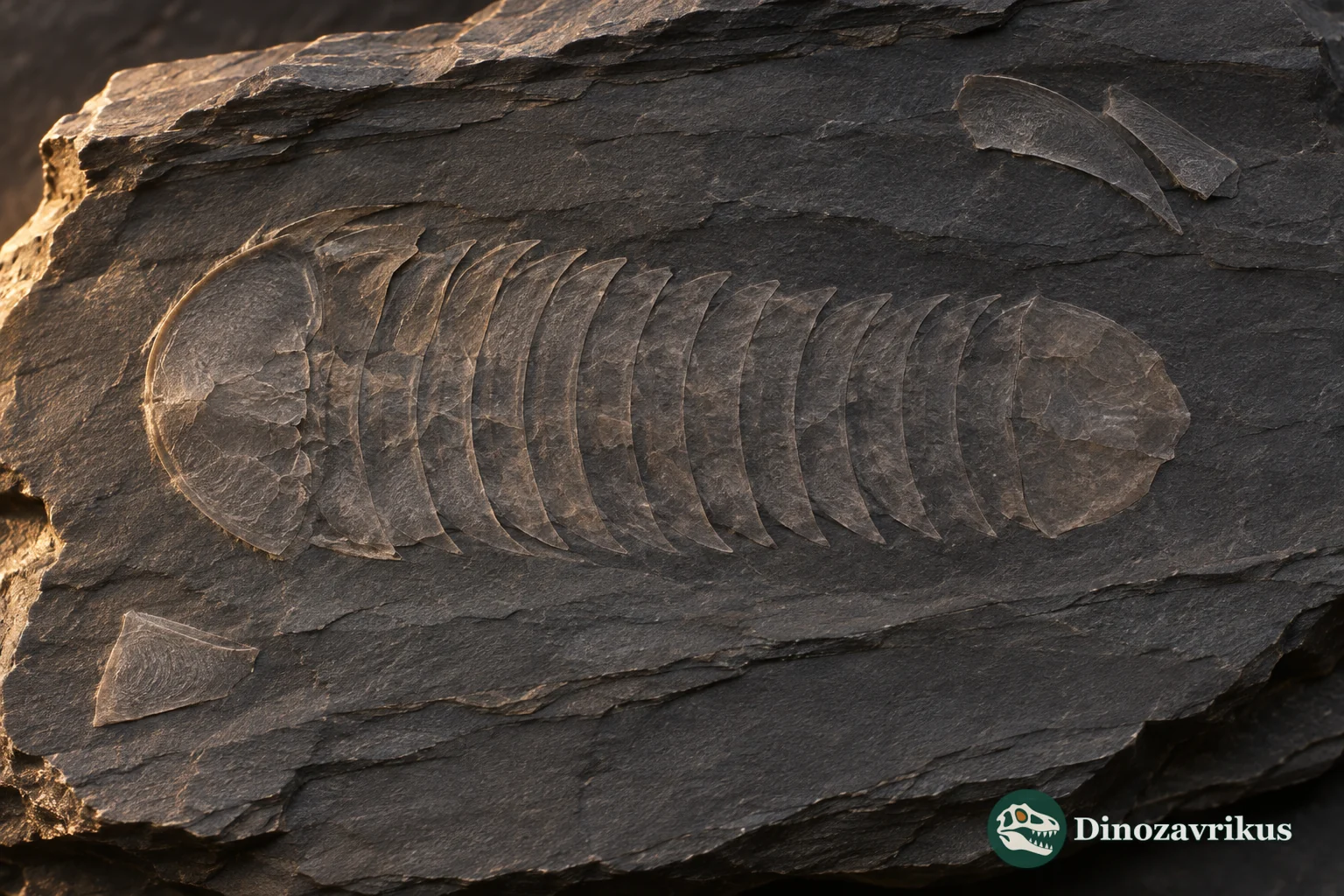
A rounded head and a small tail
The cephalon of E. burgessensis accounts for about one third of its dorsal length. Prominent ridges cross the cephalon towards the eyes, and the free cheeks end in short pointed spines. The adult dorsal exoskeleton could reach 28 mm in length.
Four or five axial rings can usually be traced on the broad, short pygidium. The rings lie behind the thirteen independently articulated trunk segments. Other Cambrian trilobites could have a very different arrangement. In Pagetia, for instance, the thorax had only two segments.
From the Canadian Rockies to the Great Basin
Canadian material comes from the Walcott, Raymond and Collins quarries on Fossil Ridge as well as localities around Mount Stephen. Other members of the genus are known from the United States, including Utah and Nevada. Trilobite assemblages help geologists correlate beds there. A fossil zone can take its name from a genus without that genus occurring in every sample assigned to it.
Comparison with similar trilobites suggests E. burgessensis moved over the bottom and collected particles from the sediment. The preserved dorsal armour gives no direct evidence of which particles it digested.
Frequently asked questions
How many segments did Ehmaniella have?
The thorax of E. burgessensis had thirteen segments. The rings along the tail shield belong to a different part of the armour.
Where is the Canadian species found?
It comes from the Burgess Shale in British Columbia, including several quarries on Fossil Ridge.
Who described Ehmaniella burgessensis?
Franco Rasetti described it in 1951 after reviewing Walcott’s original material.
What did it eat?
It probably gathered particles on the seafloor. The fossils do not establish the composition of its diet.