

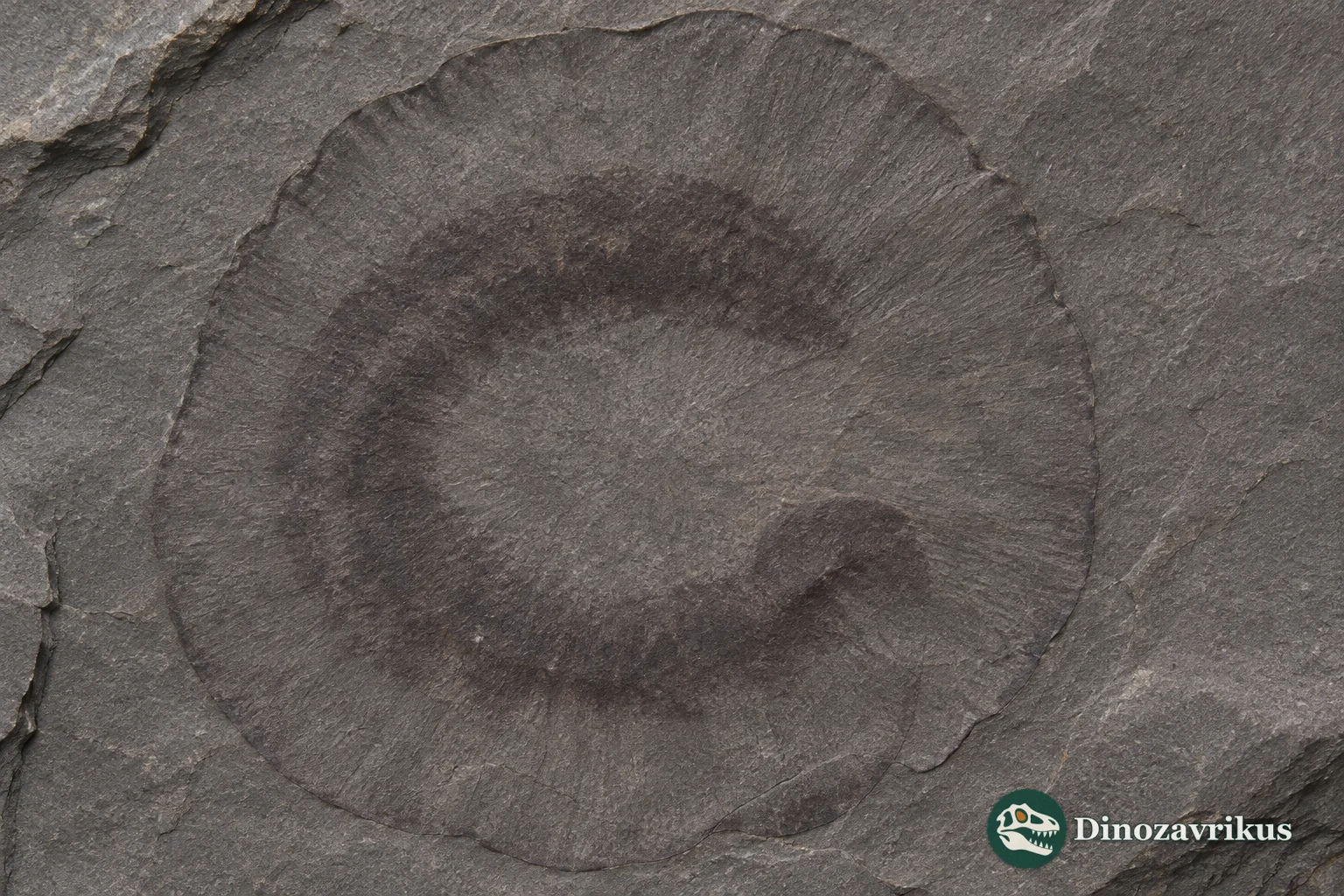
Eldonia was a soft-bodied Cambrian animal shaped like a disk. A broad curved trace inside Burgess Shale specimens records its digestive system. A pair of tentacles lay near the mouth. Those features provide clues to its affinities among early deuterostomes.
Quick facts
| Group | Cambroernids, family Eldoniidae |
|---|---|
| Age | Middle Cambrian for the type species |
| Region | North America: British Columbia and Utah |
| Diet | Unknown |
| Type species | Eldonia ludwigi |
| Disk diameter | Up to 15 cm in E. ludwigi |
| Lectotype | USNM 57540 |
What can the fossils tell us?
Some specimens preserve the outline of the disk, radiating lines, a digestive tract and paired tentacles.
The tentacles and gut resemble those of Herpetogaster and other Cambroernids.
The tentacles could have collected particles on the sediment or from nearby water. Its feeding mechanism remains uncertain.
Inside the disk
Fossil disks of E. ludwigi reach 15 cm across. Fine lines radiate from their centre. The mouth and anus opened on the underside. Viewed from above, the digestive tract curves clockwise. It includes a pharynx, a broader stomach and a narrow intestine.
A pair of tentacles lay next to the mouth, in a position consistent with a feeding role. Compression in sediment could alter the shape and proportions of the soft tissues.
The Great Eldonia Layer and a find in Utah
Charles Walcott described Eldonia ludwigi in 1911. One bed in the Walcott Quarry on Fossil Ridge yielded hundreds of specimens. Walcott named it the Great Eldonia Layer. Lectotype USNM 57540 is housed at the Smithsonian Institution.
Paul Jamison found another specimen in the Marjum Formation of Utah. A little over half of the disk survives. The preserved part measures about 8 cm across. It retains radial lines and part of the digestive tract. The area that might show the feeding apparatus is missing.

Changing views of its relatives
Walcott interpreted Eldonia as a sea cucumber. Later researchers compared its tentacles and digestive anatomy with Herpetogaster. They included both genera in the Cambroernids, an extinct group that may lie close to the common branch of echinoderms and hemichordates.
The limits of the genus have also changed. Fossils from China were described as Eldonia eumorpha by some authors and placed in a separate genus, Stellostomites, by others. Ordovician disks from Morocco once called Eldonia berbera have been reassigned to Discophyllum peltatum. These disputed assignments give a much less secure range than the records of the type species.
Feeding near the bottom or in open water
The disk shape inspired an early interpretation of Eldonia as a free-floating suspension feeder. Another hypothesis places it on or near the seafloor, where its tentacles could gather food from the sediment or the water immediately above it. The fossils preserve the shape of the tentacles and leave their movements open to interpretation.
Frequently asked questions
How large was Eldonia?
The largest known disks of the type species E. ludwigi reach about 15 cm across.
What is the dark curve on the fossil?
It records the digestive tract, which includes the pharynx, stomach and intestine.
Why was it called the Great Eldonia Layer?
One bed in the Walcott Quarry yielded hundreds of Eldonia specimens.
Is its diet known?
It may have captured suspended particles or gathered organic matter near the seafloor. The fossils do not settle the question.