

Eleutherocercus was an armoured South American mammal in the glyptodont lineage Doedicurinae. Its record includes osteoderms, shell fragments, skulls and tail armour. Researchers can compare those fossils, while coat colour, the mass of every species and the way an individual used its tail remain uncertain.
The genus belongs in the ancient mammal catalogue. The better-known Glyptodon also carried bony armour, but the two represent different glyptodont lineages; their shared silhouette is not evidence of direct ancestry.
Quick facts
| Scientific name | Eleutherocercus Koken, 1888 |
|---|---|
| Group | Glyptodontidae, Doedicurinae |
| Type species | E. setifer, described from Uruguay |
| Revised species | E. solidus and E. antiquus |
| E. solidus type | MACN 8335, four osteoderms |
| Main localities | Catamarca, Tucumán and Buenos Aires, Argentina |
| Age of principal finds | Late Miocene to early Pliocene |
What can the fossils tell us?
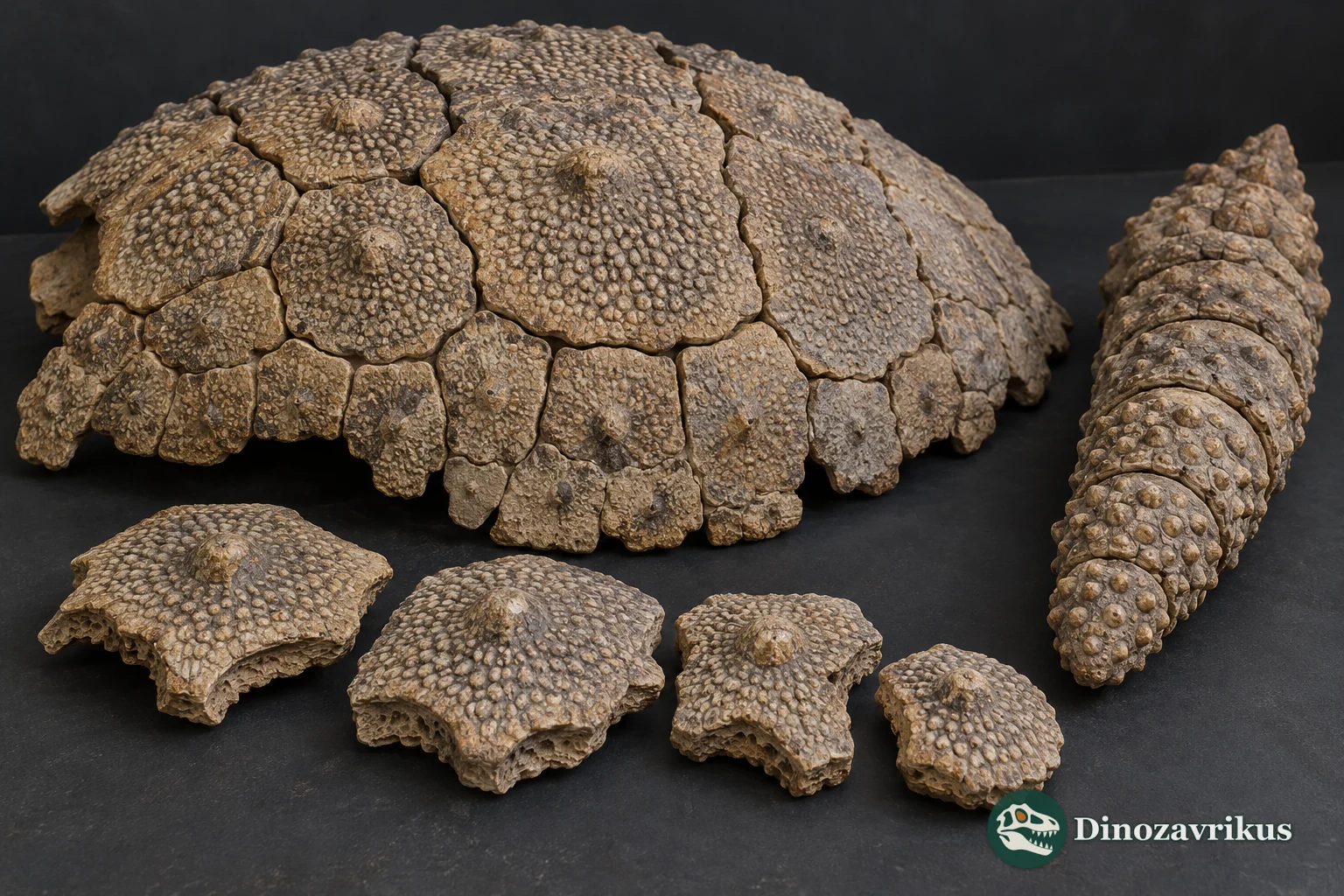
The E. solidus holotype MACN 8335 comprises three articulated and one isolated osteoderm. Additional, larger shell fragments show more of the armour, although four plates cannot establish an exact whole-body mass.
A skull from the Monte Hermoso Formation preserves cranial characters and a conspicuous parietal pathology. The altered bone records one individual, not a known condition of every animal in the genus.
Tail tubes assigned to Eleutherocercus and its relatives help track armour structure. Their form does not record a particular strike, fight or habitual behaviour.
A name and a revised set of species
Koken introduced Eleutherocercus in 1888. Its type species, E. setifer, was described from material found in Uruguay. Later Argentine fossils acquired several names. Rovereto described material now placed in E. solidus as Neuryurus solidus in 1914. This history matters when isolated armour plates are compared as though every difference represented a separate animal.
A 2023 revision examined E. solidus from Catamarca and Tucumán and E. antiquus from Buenos Aires Province. The authors did not retain E. paranaensis as a secure separate species, referring that material to Eleutherocercus sp. A later treatment also regards E. tucumanus as a junior synonym of E. solidus. These are taxonomic assessments of fossils already known, not additional skeletal discoveries.
What the armour and skull preserve
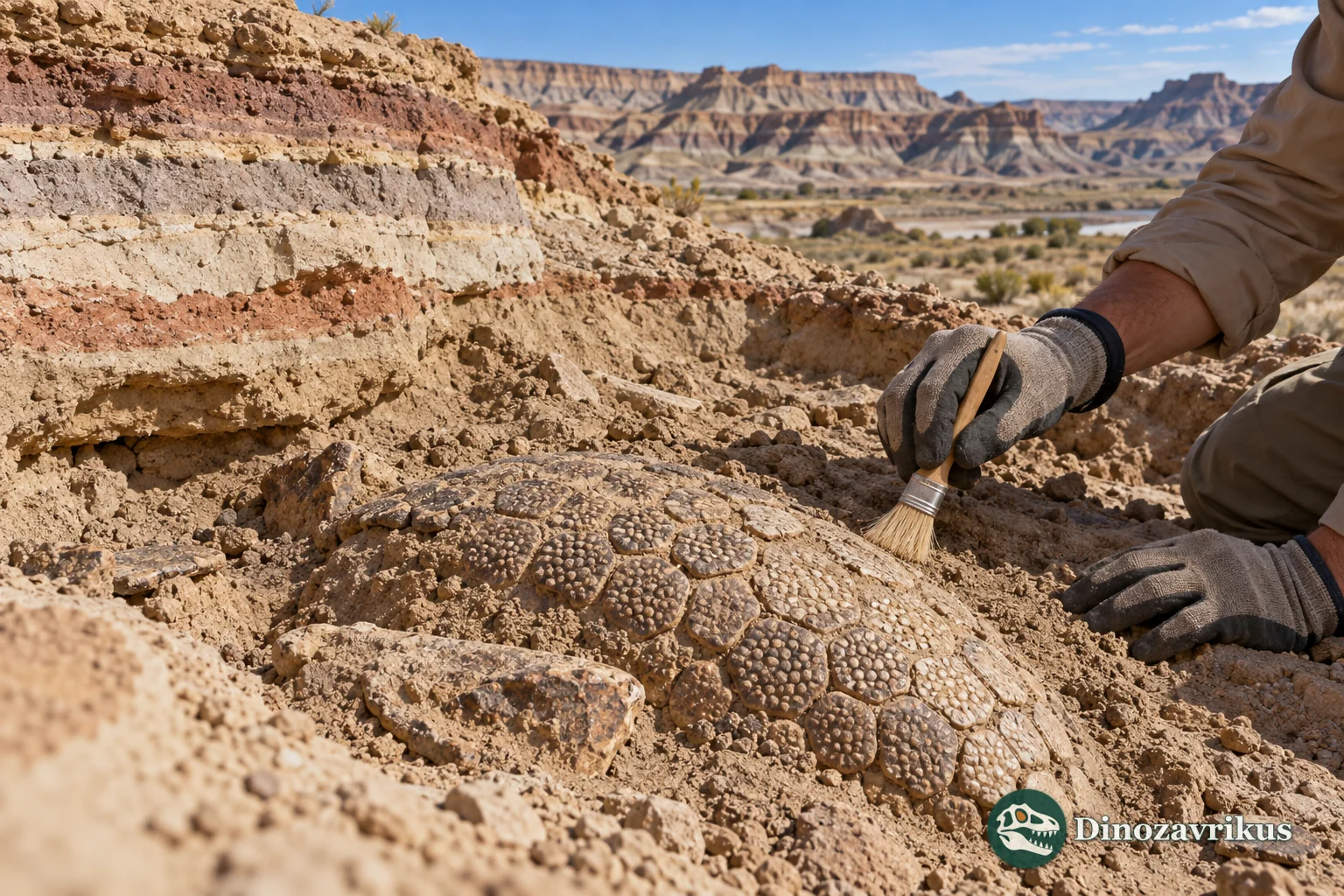
The E. solidus holotype MACN 8335 consists of three connected osteoderms and one separate plate from Andalhuala in Catamarca Province. A larger partial carapace later described from Tucumán reveals more of the armour's form. The precise horizon of that Tucumán specimen is unknown, so a single exact date for it would be misleading.
A skull attributed to E. antiquus came from the Monte Hermoso Formation. Its geological context is estimated at roughly 5–4.2 million years ago, in the early Pliocene. The skull bears a marked alteration of the parietal region. It is a direct observation of one fossil; the cause and frequency of that pathology in the population have not been established.
Armoured tail and ecological limits
Fossil tail tubes are compared through plate fusion, surface relief and shape. Some material identified only as Eleutherocercus sp. shows features between older forms and the later Doedicurus. It cannot be assigned automatically to E. solidus or E. antiquus. A robust tail is anatomically plausible in the cover, while any specific blow or fight is an artistic inference.
Glyptodonts are generally interpreted as plant eaters. No stomach contents establish the precise plants eaten by Eleutherocercus. The reconstruction's colour, skin and behaviour likewise are not preserved by the osteoderms. The fossil plates, skull and geological context support narrower claims than a complete life scene suggests.
Frequently asked questions
What is the type specimen of Eleutherocercus solidus?
MACN 8335 comprises three articulated and one isolated osteoderm. Larger shell fragments belong to other specimens.
How old is the E. antiquus skull?
Its Monte Hermoso Formation context has been estimated at about 5–4.2 million years old; that is a geological age estimate, not a direct date on the skull.
Did Eleutherocercus use its tail as a weapon?
The armoured tail is fossil evidence, but a particular strike or habitual combat has not been observed in the fossils.
Is E. paranaensis a secure species?
The 2023 revision treated the material as Eleutherocercus sp. rather than retaining a confidently distinct E. paranaensis.