

Enosuchus was an early tetrapod from the Permian of European Russia. The type species preserves part of a broad skull roof made of unusually thick bone. Other fossils reveal details of the jaw joint and shoulder girdle.
Quick facts
| Group | Early tetrapods, enosuchids (anthracosauromorphs) |
|---|---|
| Age | Middle Permian |
| Region | Europe: Tatarstan and Mari El, Russia |
| Type species | Enosuchus breviceps |
| Scientific name | Enosuchus |
| Diet | Undetermined |
What can the fossils tell us?
Holotype PIN 271/99 preserves part of the skull roof. Other Isheevo specimens include an element of the jaw joint.
In the redescription, the researchers compared the isolated bones with skulls of other early tetrapods. The family's closest relatives within the group remain unresolved.
The fragments provide too few landmarks for a reliable estimate of body length or an outline of the living animal.
The type specimen from Isheevo
Elena Konzhukova described Enosuchus breviceps in 1955. Holotype PIN 271/99 comes from the uppermost Urzhumian beds at Isheevo in Tatarstan. The fragment on which she based the species shows the upper surface of the head. Other parts of the skull are known only from separate pieces.
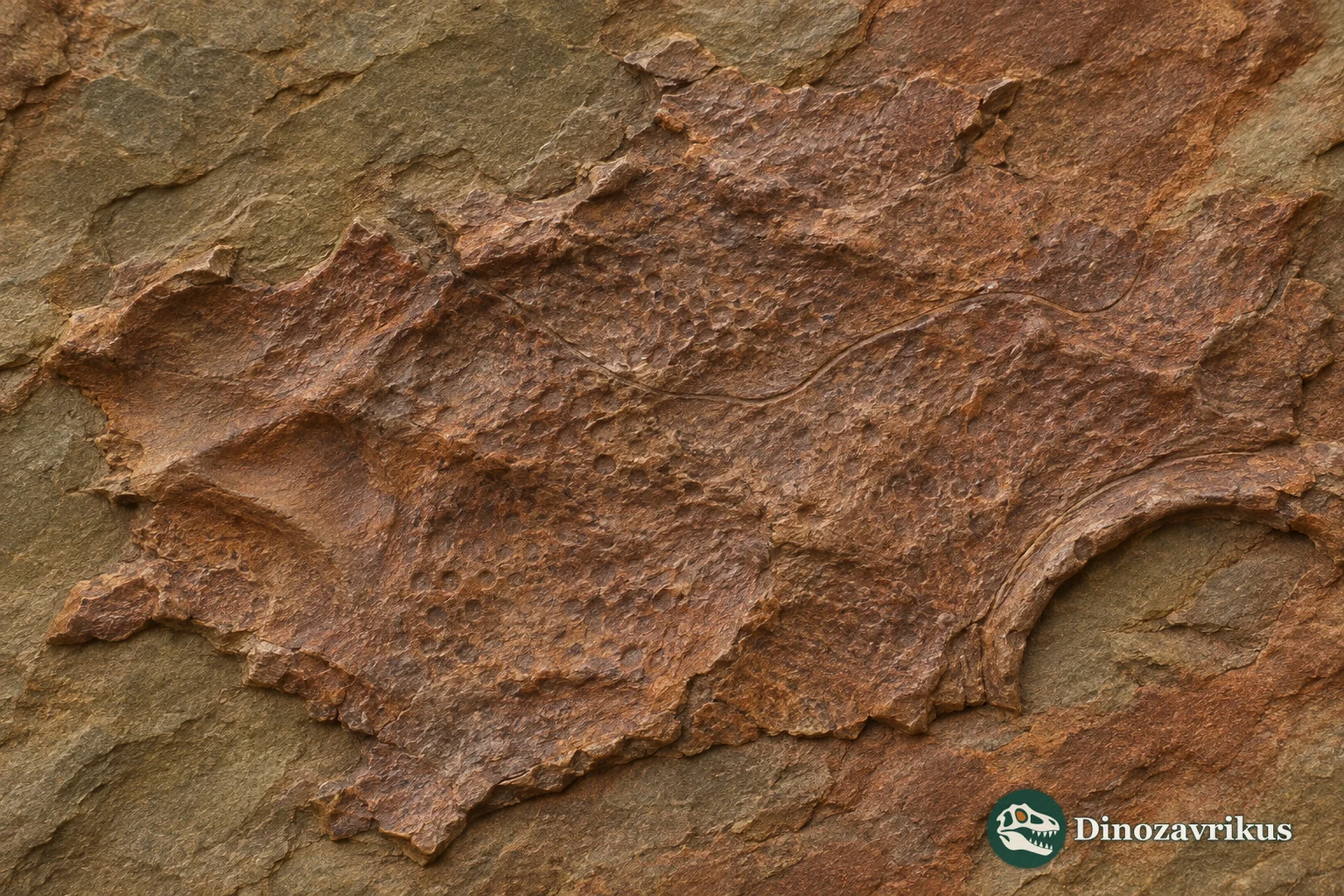
A thick skull roof with widely spaced eyes
The redescription of 2018 measured the preserved central part of the skull roof. Its length along the midline is 92 mm. The area between the eye sockets was broad, with thick, heavily ornamented bones. Other Isheevo specimens include a massive quadrate from the jaw joint and an isolated clavicle.
How the classification changed
The type species was originally assigned to the temnospondyls. In the later redescription, cranial features supported assigning the family Enosuchidae to Anthracosauromorpha. The authors left its exact position within that group open. The history of these names reflects which parts of the skull were available for comparison.
A second species from Mari El
In 2018, researchers described E. alveolatus from Sundyr-1 in Mari El. They identified differences in skull anatomy among the material assigned to Enosuchus. Both sites record part of the Permian Period, although the fossils come from different regional horizons.
Frequently asked questions
Where was Enosuchus found?
The type species comes from Isheevo in Tatarstan. A second species was described from Sundyr-1 in Mari El.
Which part of the skull does the holotype preserve?
It preserves part of the skull roof. The preserved fragment is 92 mm long along the midline.
How many species of Enosuchus have been described?
Two, Enosuchus breviceps and Enosuchus alveolatus.
What did Enosuchus eat?
The known bones do not establish what it ate. The palate of the type species is also unknown.