

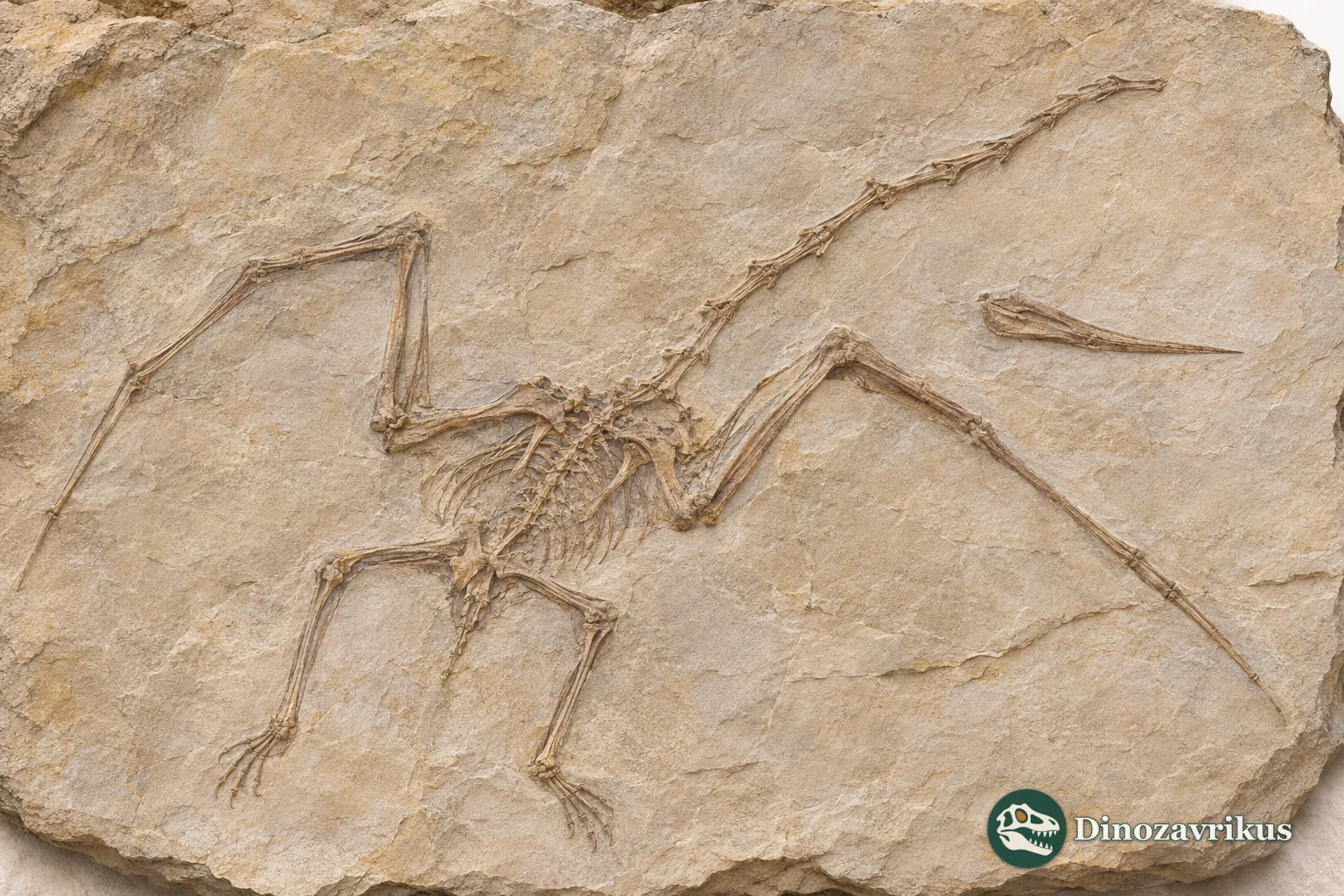
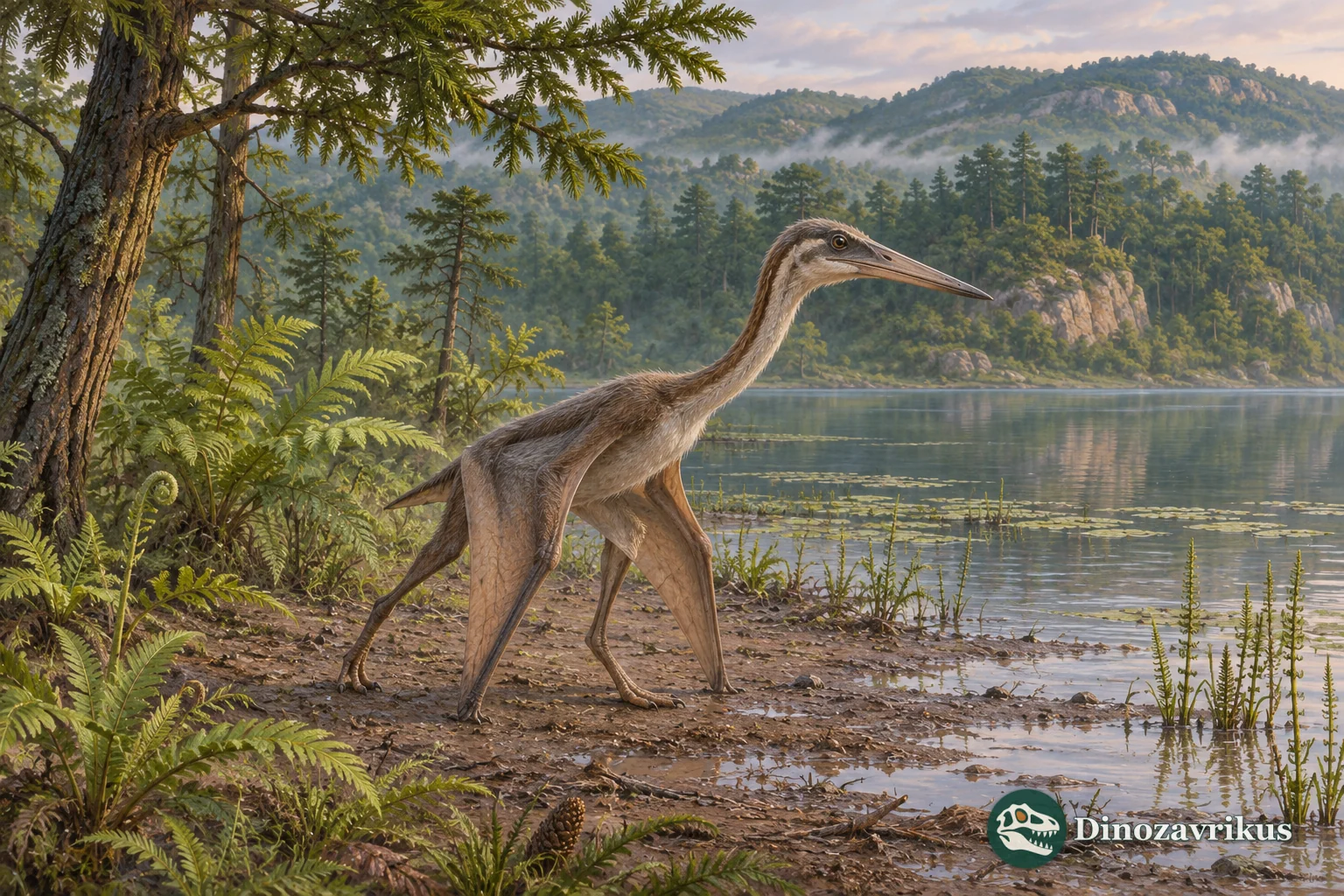
Eoazhdarcho liaoxiensis was named from a skeleton with a lower jaw found in western Liaoning. Its describing authors regarded it as an early azhdarchid, but later phylogenetic work placed it closer to the base of Azhdarchoidea. The fossil is much more than an isolated bone, yet it does not preserve a complete skull. The head in the cover artwork is an interpretation, not a recovered feature.
Quick facts
| Scientific name | Eoazhdarcho liaoxiensis, Lü and Ji, 2005 |
|---|---|
| Holotype | GMN-03-11-002, skeleton with lower jaw |
| Locality | Chaoyang area, western Liaoning, China |
| Rock unit | Jiufotang Formation, Early Cretaceous |
| Classification | Azhdarchoid; exact family placement debated |
| Middle neck | Cervical length/width ratio about 3.5 in the original description |
| Skull | Complete rostral shape not known |
What can the fossils tell us?
A large part of the body skeleton and a lower jaw are available for comparison. They do not supply a complete head or its soft tissues.
The original authors gave a length-to-width ratio of about 3.5 for mid-series cervicals. Similarity to azhdarchids is a comparison, not a secure family assignment on its own.
The mandible lies compressed on the slab. Its outline can be viewed from above, but its original curvature in side view cannot be restored with confidence.
Azhdarchidae was the original assignment. A later analysis recovered a more basal azhdarchoid, while a proposed synonymy with Chaoyangopterus has been disputed.
A fossil that changed position on the family tree
Lü Junchang and Ji Qiang described Eoazhdarcho liaoxiensis in 2005 from specimen GMN-03-11-002. The name refers to an early member of the branch then associated with azhdarchids and to western Liaoning. The type material includes the lower jaw and much of the postcranial skeleton, so the comparison draws on neck and limb anatomy rather than one isolated element.
The original paper emphasized a humerus resembling that of azhdarchids. It reported a middle-cervical length-to-width ratio near 3.5 and a humerus-to-femur length ratio near 0.96. In a 2006 phylogenetic analysis, the animal instead emerged as a more basal azhdarchoid outside the derived azhdarchid branch. One study proposed synonymizing it with Chaoyangopterus; other workers retained the genera provisionally pending fuller revision. The fossil therefore supports Azhdarchoidea more securely than a fixed placement within Azhdarchidae.
What the jaws and bones actually preserve
The preserved mandible is compressed flat on its rock slab. A later comparative study observed that its occlusal outline is visible, while its original curvature in lateral view is not. A complete skull and rostrum cannot be built directly from that lower jaw, and the head on the cover should not be read as a specimen-specific portrait.
The neck and forelimb measurements remain useful for comparisons among pterosaurs. They do not establish diet, precise body colour or an exact adult wingspan. Sinopterus shows another Liaoning pterosaur body plan, but its preserved cranial characters cannot fill gaps in the Eoazhdarcho type.
Jiufotang and the limits of a life scene
The type specimen came from the Early Cretaceous Jiufotang Formation of the Chaoyang area. Its formation places the animal in the Jehol fossil record, but the label does not provide a numerical death date for this individual. The occurrence can be compared with other Jiufotang pterosaurs without implying that two named specimens met or competed.
The accompanying lakeshore picture evokes a plausible regional setting. Shoreline position, plants, plumage-like covering and behaviour shown in the image are artistic choices. No trackway or preserved food associated with GMN-03-11-002 demonstrates how this animal walked or hunted.
Frequently asked questions
Why is Eoazhdarcho not a secure azhdarchid?
The 2005 assignment drew on its neck and humerus. A later phylogenetic analysis recovered it outside the derived azhdarchid branch, closer to the base of Azhdarchoidea.
Is its complete skull known?
No. The type includes a compressed lower jaw, but not a full skull. Its side profile and soft-tissue covering remain uncertain.
Could it be the same genus as Chaoyangopterus?
That synonymy was proposed, then contested. Other researchers retained the two names provisionally while awaiting more detailed comparison.
Where was the type specimen found?
It comes from the Early Cretaceous Jiufotang Formation in the Chaoyang area of western Liaoning, China.