

Eogavialis is an extinct long-snouted crocodilian best documented in the Fayum region of Egypt. A long joint between the halves of the lower jaw and features of the back of the skull help distinguish it from other gavialoids. A much younger Kenyan fossil was assigned to the same genus, an identification that remains open to debate.
Quick facts
| Type species | Eogavialis africanum |
|---|---|
| Group | Gavialoidea |
| Age of Egyptian species | Late Eocene to Early Oligocene |
| Locality | Fayum, Egypt |
| Key material | Jaws and skulls, including YPM 6263 |
| Original name | Tomistoma africanum |
What can the fossils tell us?
The Egyptian species is known from the Late Eocene Qasr el-Sagha Formation through the Early Oligocene Gebel Qatrani Formation.
The joined portion of the lower jaw reaches past the thirteenth tooth socket. The orbital rims rise above the skull without reaching the extreme condition seen in some other gavialoids.
Some analyses place the fossil named Eogavialis andrewsi closer to Sutekhsuchus than to the type species of Eogavialis.
An Egyptian species with several names
Charles William Andrews described the Fayum material as Tomistoma africanum in 1901. Éric Buffetaut erected Eogavialis for the species in 1982. The older name associated the fossils with false gharials. Later analyses tested relationships using many more details of the skull and jaws.
YPM 6263, a skull in the Yale Peabody Museum, has been used in comparative work. The Natural History Museum in London holds a cast of the holotype as NHMUK PV R 3329. In a 2021 study, the authors also treated several Egyptian fossils catalogued under the old name Tomistoma gavialoides as members of the type species.
A long lower jaw and a distinctive skull roof
The margins around the eyes rise above the upper surface of the skull. At the back of the skull table, a projection of the supraoccipital bone extends along the centre. Other Egyptian gavialoids had long snouts too, but their eyes and the back of the skull could differ markedly.
The two branches of the lower jaw meet along a joint that extends beyond the thirteenth tooth socket. The thin inner splenial bones participate in the joint. The slender snout could serve to catch small, mobile prey underwater. The bones do not show how much fish contributed to the diet.
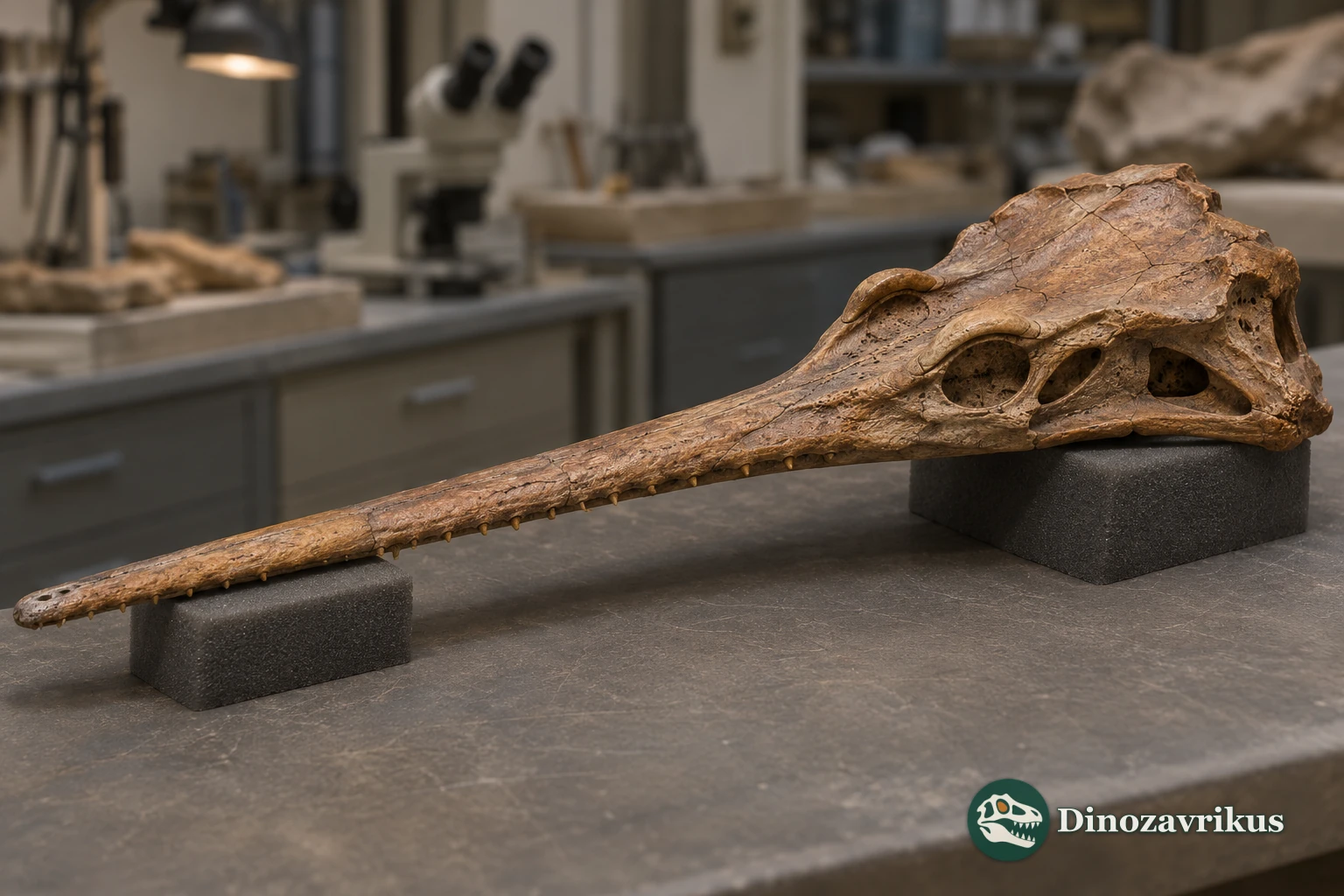
Where the Fayum fossils occur
The Egyptian species occurs in the Late Eocene Qasr el-Sagha Formation and the Early Oligocene Gebel Qatrani Formation. The deposits collectively record coastal and continental environments. They show how long the species can be traced in the region, while its tolerance of different salinities remains uncertain.

Why the Kenyan fossil is a separate question
Glenn Storrs described Eogavialis andrewsi in 2003. The holotype, KNM LT 22943, came from Late Miocene deposits at Lothagam, west of Lake Turkana. Under one analysis published online in 2024, it grouped more closely with the Early Miocene North African Sutekhsuchus than with the Egyptian type species of Eogavialis.
This placement leaves the generic assignment of the Kenyan skull unresolved. The Late Miocene age belongs to that specimen. Whether it marks the last known occurrence of Eogavialis depends on where the species ultimately belongs.
Frequently asked questions
Where was the type species found?
It is from the Fayum in Egypt. Occurrences of the type species span the Late Eocene and Early Oligocene.
What did the narrow snout do?
The shape is consistent with grabbing small prey in water. A particular prey species cannot be identified from the shape alone.
Where is skull YPM 6263 kept?
The Yale Peabody Museum holds the skull. A cast of the type specimen is in the Natural History Museum in London.
Was the animal from Kenya the same genus?
It was originally named as a species of Eogavialis. Some later results place it closer to Sutekhsuchus, so its genus remains uncertain.