

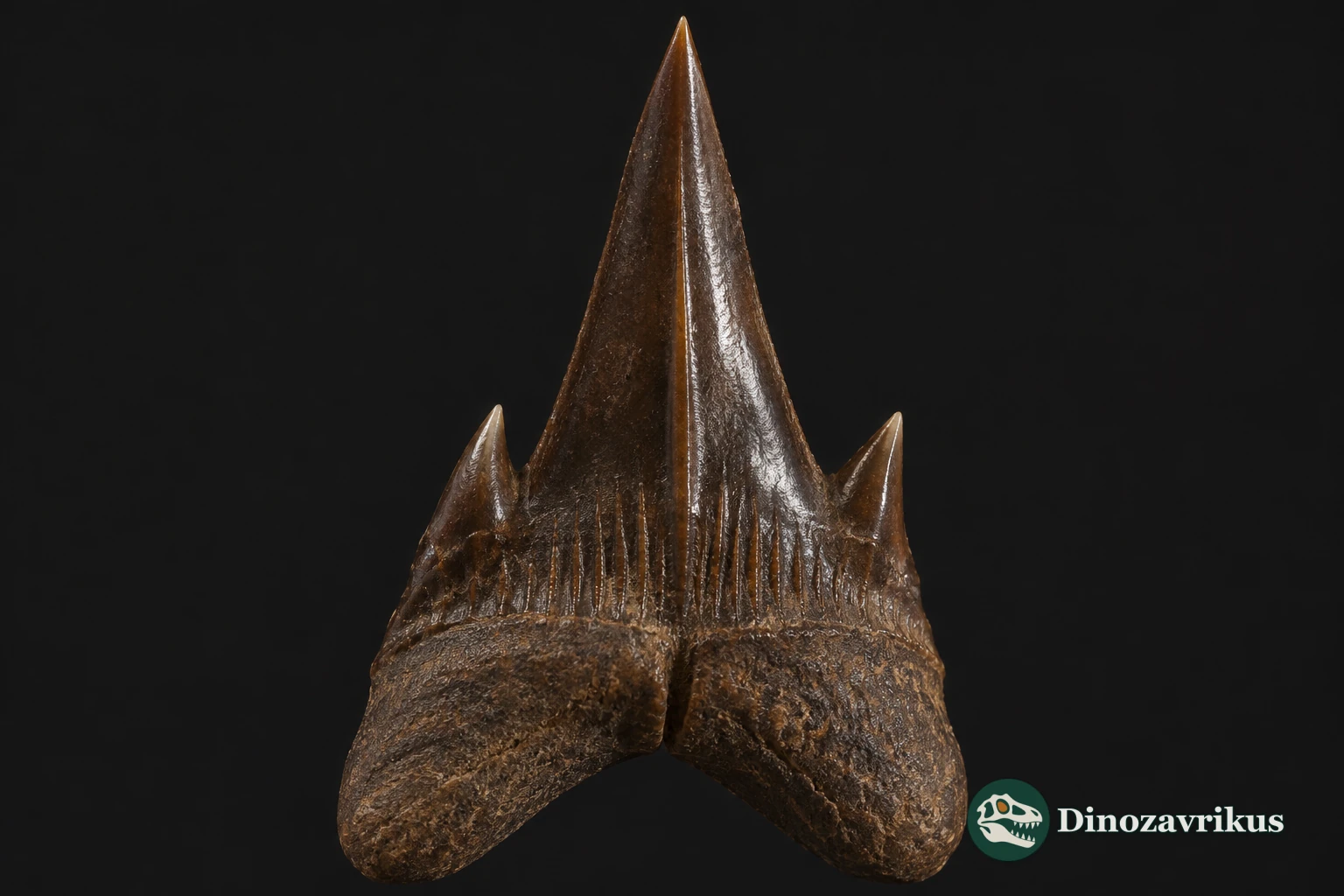
Eoptolamna was a Cretaceous lamniform shark identified by features on teeth only a few millimetres high. A vertical crest rises on the outer face of the main cusp, with smaller points on either side. Those details, together with the root shape, helped separate the Spanish fossils from teeth once assigned to Protolamna.
Quick facts
| Order | Lamniformes |
|---|---|
| Genus described | Jürgen Kriwet and colleagues, 2008 |
| Type specimen | Tooth MPZ 2005-4 |
| Type locality | Vallipón near Castellote, Spain |
| Type horizon | Late Barremian, Early Cretaceous |
| Fossils | Isolated teeth |
What can the fossils tell us?
The coastal deposit also contains land vertebrates. The mixed assemblage leaves the shark’s usual salinity range uncertain.
Front teeth have fewer folds. On side teeth the central crest often extends almost to the tip.
The original description interprets some teeth under a millimetre as possible juvenile material. Size alone does not establish age.
The coastal deposit at Vallipón
Jürgen Kriwet, Stefanie Klug, José Ignacio Canudo and Gloria Cuenca-Bescós described Eoptolamna eccentrolopha in 2008. The holotype, MPZ 2005-4, is a tooth attributed to a position near the front-to-side transition in the jaw. It came from a conglomerate at the base of the Artoles Formation and is housed at the University of Zaragoza’s palaeontological museum.
The researchers examined about 50 teeth. They treated roughly 500 kilograms of sediment with buffered acetic acid, then sieved the residue through a half-millimetre mesh and sorted the fossils. Many teeth are missing part of the crown or root. The layer contains both marine and terrestrial vertebrates. The local accumulation has been interpreted as coastal, where streams and tidal action could have brought remains together.
A ridge on the face of the tooth
The type tooth has a tall, narrow main cusp that bends slightly towards the inside of the mouth. A broad vertical crest occupies its outer face, flanked by two short wavy ridges. Farther back along the inferred tooth row, crowns become lower and the outer folds more numerous. The loose teeth establish these differences in shape while leaving the number of rows unresolved.
Some of the Spanish teeth had previously been assigned to Protolamna. The outer crest, lower projection on the inner face of the root and conspicuous nutritive groove helped distinguish Eoptolamna. The groove is especially deep in some teeth less than a millimetre high. The researchers interpreted these as possible juvenile teeth, although small teeth can also occupy particular positions in a jaw.
A later species and a classification in debate
Guillaume Guinot and colleagues described the Late Cretaceous Eoptolamna supracretacea in 2013. Its teeth are less than five millimetres high. Front teeth carry a distinct median crest, while teeth to the side bear numerous sharp outer ridges. That species extended the confirmed record of the genus into the Late Cretaceous. Other teeth from Tunisia, previously placed near Protolamna, were also reassigned to Eoptolamna.
Kriwet and colleagues originally proposed the family Eoptolamnidae. Kenshu Shimada and Michael Everhart later included the genus in Pseudoscapanorhynchidae and treated that placement as a working hypothesis. An articulated dentition would provide characters that are missing from isolated crowns and roots.
Frequently asked questions
Where is the type tooth held?
The University of Zaragoza’s palaeontological museum houses it as specimen MPZ 2005-4.
Which part of the type tooth is best preserved?
The crown. The root lobes are broken away.
How do tooth shapes vary along the jaw?
Front crowns are taller and narrower. Toward the corners of the mouth they become lower and have more folds.
Do the teeth reveal the shark’s body length?
The isolated teeth give no reliable body-length estimate.