

Eotephradactylus mcintireae was named from a small toothed lower jaw in Arizona's Petrified Forest. The sedimentary layer has an unusually precise radiometric age, while the animal itself remains anatomically incomplete. Distinct tooth shapes and strong wear invite a feeding hypothesis, but neither a meal nor a complete skull is preserved. The cover is a life reconstruction rather than a portrait of an articulated skeleton.
Quick facts
| Scientific name | Eotephradactylus mcintireae, Kligman and colleagues, 2025 |
|---|---|
| Holotype | PEFO 53384, partial left lower jaw with teeth |
| Locality | PFV 393, Petrified Forest National Park, Arizona |
| Rock unit | Lower Owl Rock Member, Chinle Formation |
| Age | 209.187 ± 0.083 million years, late Norian |
| Jaw | 41 mm preserved; differently shaped and worn teeth |
| Body size | No complete skeleton or directly measured wingspan |
What can the fossils tell us?
PEFO 53384 is part of a left dentary, 41 mm long as preserved. A full skull, body and attached wing are absent.
Many erupted teeth have broad wear facets. Hard food is one possible cause, but the marks do not identify a prey species or a meal.
Zircons in nearby volcanic ash yield 209.187 ± 0.083 million years for locality PFV 393. This dates the stratum, not the jaw by direct measurement.
Wing phalanx PEFO 52926 was referred from the same bone bed. It is not articulated with the holotype and cannot give the jaw's owner an exact wingspan.
A tiny jaw recovered from a rich fossil bed
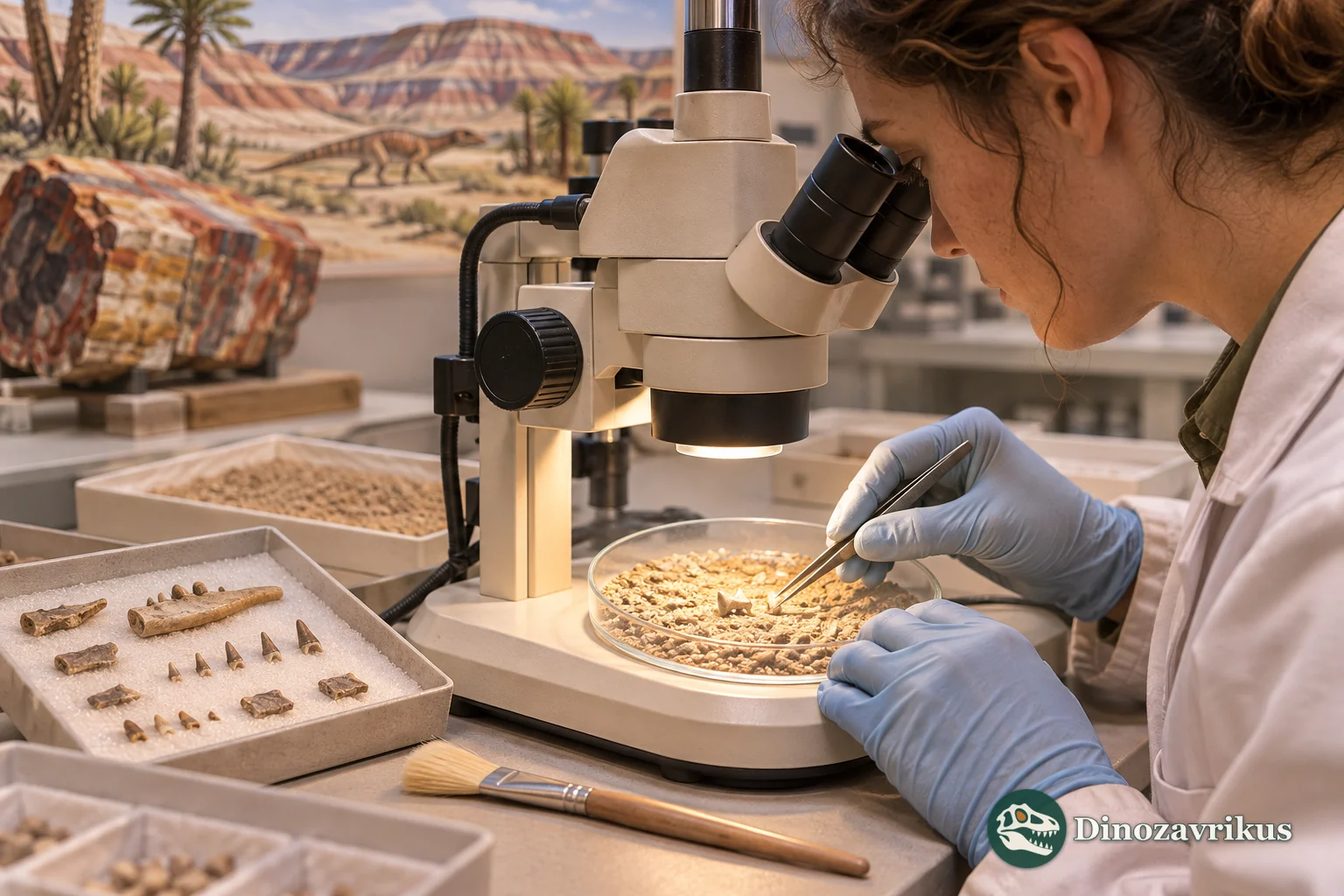
The PFV 393 bone bed lies low in the Owl Rock Member of the Chinle Formation. It contains delicate teeth and bones of several vertebrate groups in deposits left by river channels. Large sediment blocks were prepared under magnification because the fine fossils would have been difficult to recover intact by ordinary bulk washing. Suzanne McIntire found the jaw during this laboratory work, and the species name honours her contribution.
The holotype PEFO 53384 is an incomplete left dentary measuring 41 mm in its preserved state. At least 24 tooth positions were recognized, with erupted teeth in 12 of them. Damage at the front means the original total jaw length cannot be measured. Isolated teeth and a wing-finger bone from the same locality were also assigned to the species, but none is articulated with the holotype. Caelestiventus offers another North American Triassic pterosaur comparison without supplying the missing Eotephradactylus body.
Tooth wear suggests a testable diet
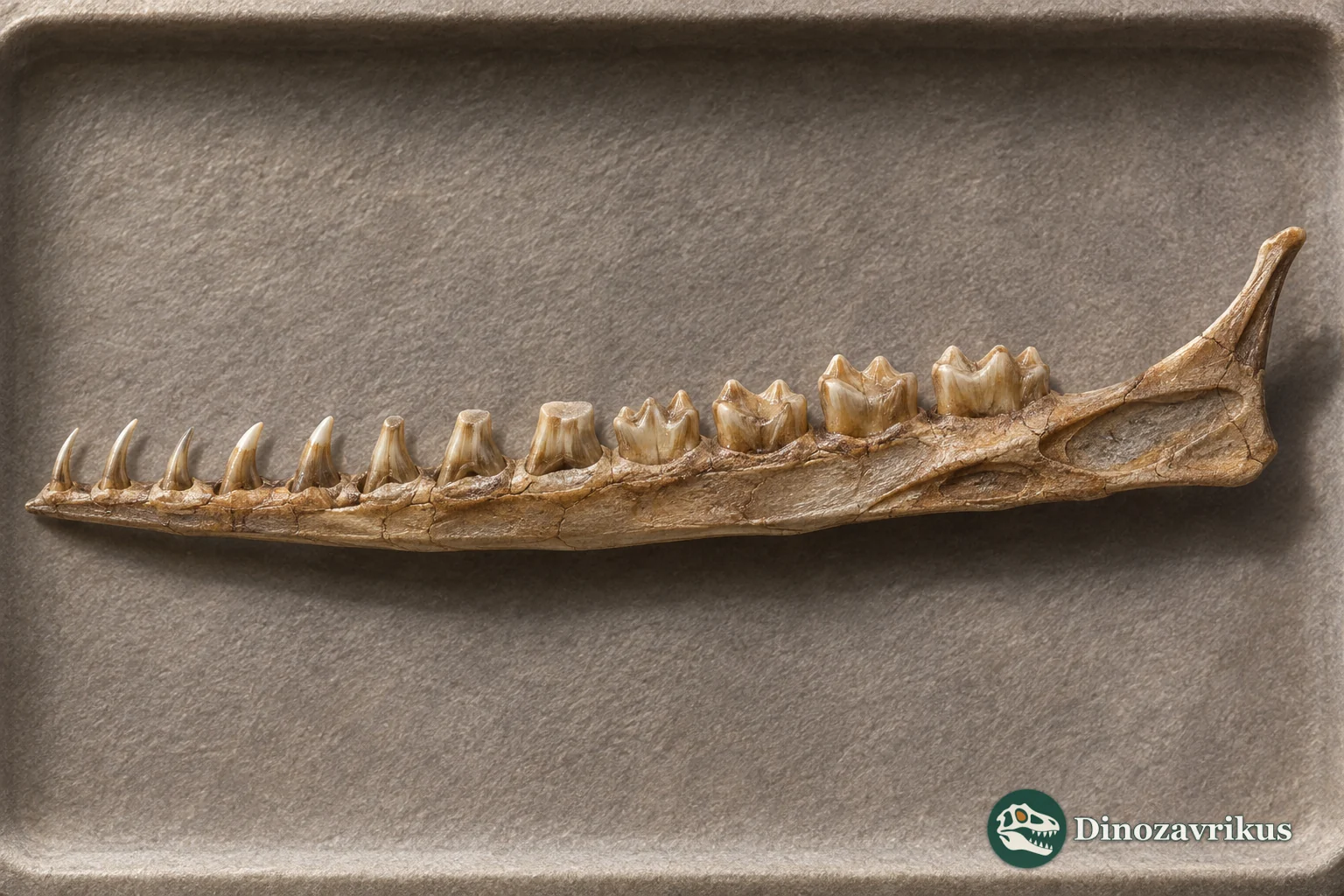
Teeth along the jaw differ in shape: some are pointed and others bear several cusps. Broad facets truncate the tips of almost every erupted tooth, sometimes exposing dentine. Micro-CT images also reveal replacement teeth and the attachment of erupted crowns inside the jaw. These are direct observations; they make the dentition particularly informative even though most of the skeleton is missing.
The describing team proposed contact with hard food such as shelled invertebrates or heavily scaled fish. Tooth-to-tooth contact may also contribute to wear. Neither prey type was found in a stomach, so the suggestions should be read as hypotheses, not a documented menu. The jaw artwork below is a conceptual study of varied teeth and is not a photograph of PEFO 53384.
An exact horizon, an uncertain outline
Uranium-lead dating of zircons from volcanic material gave an age of 209.187 ± 0.083 million years for the fossil-bearing interval, within the late Norian. The river and floodplain sediments formed in a seasonally dry tropical part of central Pangaea. They provide a much firmer time and setting than the isolated jaw provides for body proportions.
Phylogenetic analyses supported an early-diverging pterosaur, but few skull and skeletal characters can be scored from one jaw. An isolated wing phalanx does not turn that jaw into a complete individual. Arcticodactylus shows another Triassic pterosaur from a different depositional setting. Similar geological age alone does not prove close kinship. The laboratory illustration depicts a method, not the historical preparation of this named specimen.
Frequently asked questions
How old is Eotephradactylus?
Its PFV 393 fossil bed dates to about 209.187 ± 0.083 million years ago in the late Norian. The date comes from the geological horizon.
Is a complete skeleton known?
No. The holotype is a partial lower jaw. Separate teeth and a wing phalanx were referred from the same locality, but they do not form an articulated skeleton.
What did it eat?
Heavy tooth wear fits processing hard prey, possibly shelled invertebrates or strongly scaled fish. No specific meal is directly preserved.
Can its wingspan be measured?
Not directly. The jaw has no attached full wing, so any full-body size is a comparison-based reconstruction.