

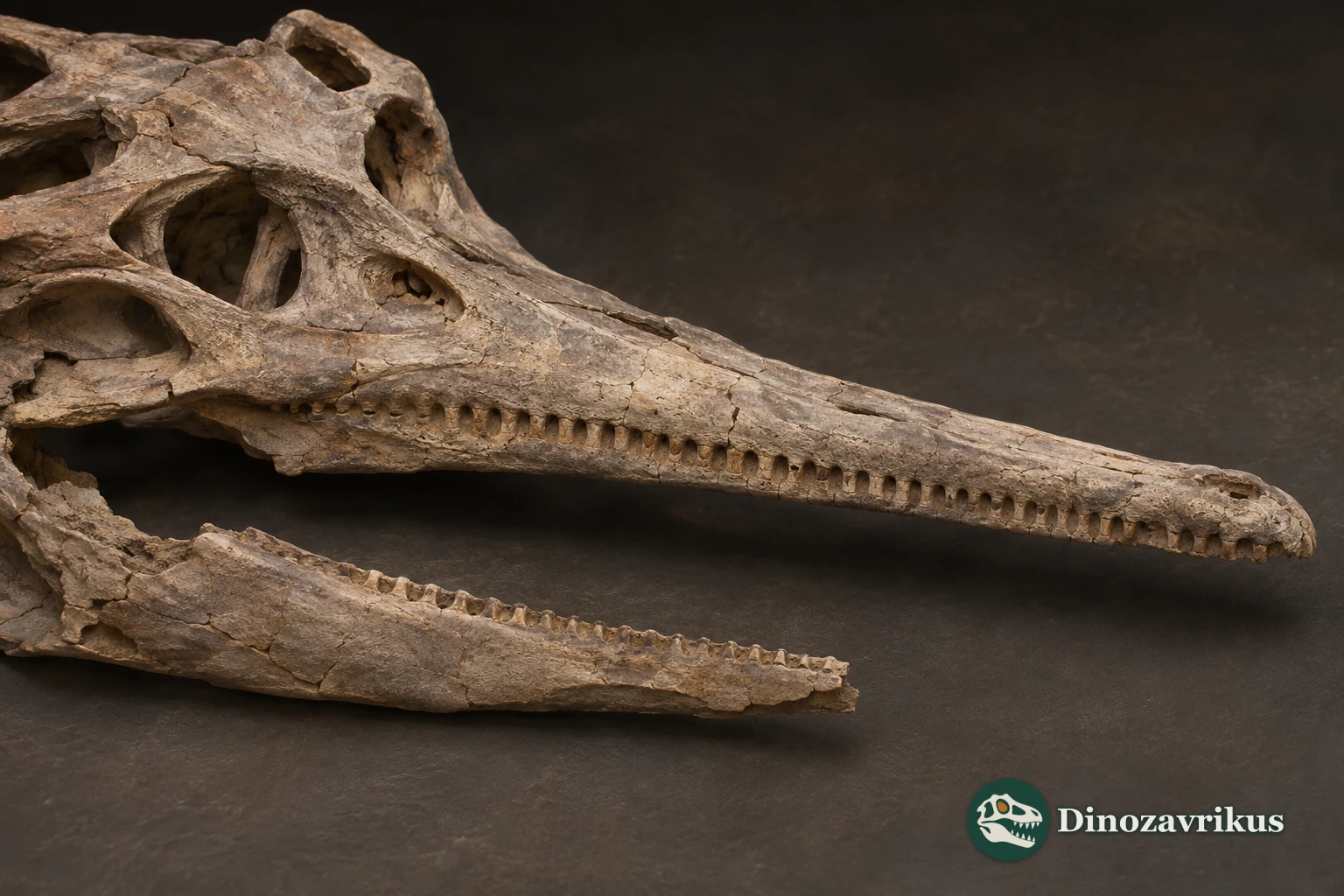
Eothoracosaurus mississippiensis lived near the coast of North America towards the end of the Cretaceous. A nearly complete Mississippi skull preserves the outline of its long, narrow jaws. CT scanning of the same specimen later provided evidence about its sensory anatomy and habitat.
Quick facts
| Species | Eothoracosaurus mississippiensis |
|---|---|
| Group | Eusuchia, exact relationships debated |
| Age of holotype | Early Maastrichtian, Late Cretaceous |
| Type locality | Oktibbeha County, Mississippi, USA |
| Holotype | MSU 3293, skull, lower jaw and associated bones |
| Formation | Ripley Formation |
What can the fossils tell us?
The third and fourth lie especially close together. Preservation makes the full count on the left uncertain.
The specimens scanned, including Eothoracosaurus, preserve expansions of the olfactory region and enlarged semicircular canals in the inner ear.
Analyses have placed it among gavialoids or outside the group formed by all living crocodilians and their last common ancestor. The internal skull anatomy has yet to settle the question.
How the Mississippi skull acquired a new name
Christopher Brochu named Eothoracosaurus in 2004. The holotype, MSU 3293, came from the early Maastrichtian Ripley Formation of Oktibbeha County. The skull, lower jaw and associated bones are held at the Dunn–Seiler Museum at Mississippi State University. The skull had previously been assigned to Thoracosaurus neocesariensis.
Less complete specimens from western Tennessee were also referred to the species. They came from the Coon Creek beds and may be late Campanian or early Maastrichtian in age. The Mississippi holotype has a more narrowly defined stratigraphic age.
Tooth sockets and the skull roof
The right dentary has 26 sockets, with the third and fourth almost touching. The bony bar between the paired openings in the skull roof is comparatively broad. These details helped separate the new genus from the North American Thoracosaurus to which the skull had been assigned.
The long, narrow jaws would have suited the capture of small, mobile prey. Comparable snout proportions occur in the Palaeogene Eosuchus. Shape alone offers limited evidence about exact diet or relationships.
What CT scans added
In 2026, researchers used scans of MSU 3293 and two Thoracosaurus skulls to reconstruct the olfactory region, parts of the airway and the inner ear. These features and the coastal sediments are consistent with a marine ecology. The researchers interpreted the expansive nasopharyngeal ducts as evidence that the animals were unlikely to dive deeply.
The original description classified Eothoracosaurus as a gavialoid. A 2025 analysis instead recovered it with other long-snouted forms outside crown Crocodylia. If that placement holds, the resemblance to gharials evolved independently. The 2026 study found that skull cavities do not clearly favour either placement.

Frequently asked questions
Where was the holotype found?
It came from the early Maastrichtian Ripley Formation of Oktibbeha County, Mississippi.
What survives of specimen MSU 3293?
A nearly complete skull and lower jaw, with associated parts of the skeleton.
What did the CT scans suggest about habitat?
Features of the inner ear and nasal regions are consistent with marine life. The researchers considered deep diving unlikely.
Was Eothoracosaurus related to living gharials?
It was originally classified as a gavialoid. Some newer analyses place it outside the group that contains all living crocodilians.