

Epachthosaurus was a titanosaur from the Late Cretaceous Bajo Barreal Formation of Argentina. One specimen preserves the trunk, tail and limbs largely in articulation. It reveals unusual joints at the base of the tail and rare details of the bones at the ends of the forelimbs.
Quick facts
| Group | Sauropods, titanosaurs (Titanosauria) |
|---|---|
| Age | Late Cretaceous (late Cenomanian to early Turonian) |
| Region | South America (Chubut Province, Argentina) |
| Diet | Herbivorous sauropod |
| Type species | Epachthosaurus sciuttoi |
| Holotype | MACN-CH 1317, incomplete dorsal vertebra |
| Articulated skeleton | UNPSJB-PV 920 |
| Formation | Lower Bajo Barreal Formation, Estancia Ocho Hermanos |
What can the fossils tell us?
José Powell named Epachthosaurus from a partial dorsal vertebra. The articulated specimen preserves comparable joint features.
The first fourteen tail vertebrae preserve extra joints where a bony projection fitted into a recess on its neighbour.
The articulated hind feet preserve the arrangement of their phalanges. A small phalanx also survives on the fourth digit of the forefoot.
From a vertebra to an articulated skeleton
José Powell named Epachthosaurus sciuttoi in 1990 from the partial dorsal vertebra MACN-CH 1317. Other vertebrae were trapped in a resistant matrix, so researchers took a cast of the exposed bones in the field. The cast made it possible to compare their anatomy without extracting the original.
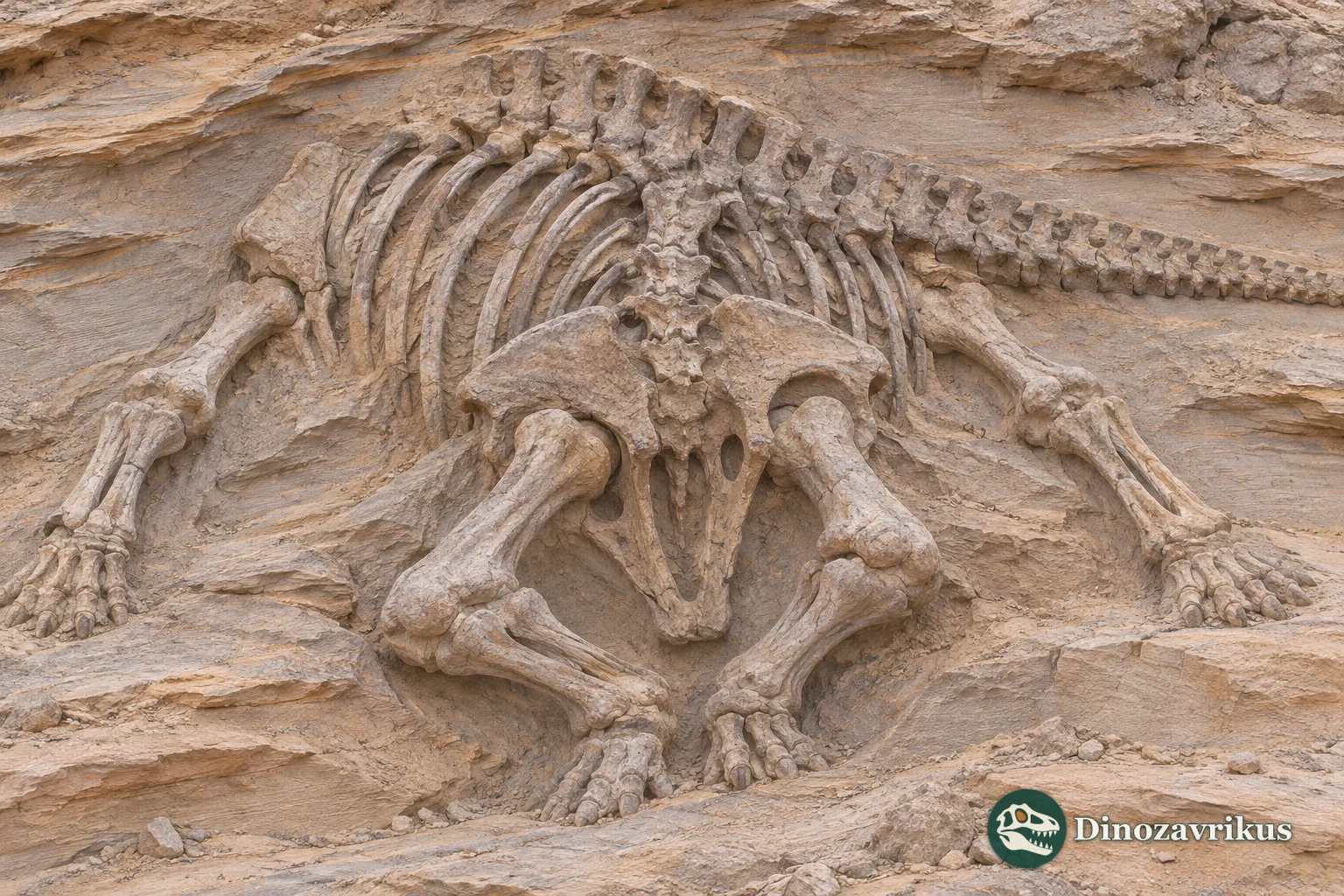
Reports of the articulated skeleton UNPSJB-PV 920 from Estancia Ocho Hermanos, Chubut, appeared as early as 1988. Rubén Martínez and colleagues published its detailed description in 2004. The skeleton lay in tuffaceous sandstone with its hindlimbs bent and its forelimbs extended to the sides. Most of the bones remained connected. This led researchers to infer rapid burial with little or no transport.
Accessory joints in the tail
Near the base of the tail, Epachthosaurus had an extra pair of interlocking surfaces between successive vertebrae. The arrangement, called a hyposphene–hypantrum joint, is present along the first fourteen tail vertebrae. It gives researchers a feature for identifying isolated bones and comparing the mechanics of titanosaur tails.
A later study identified an additional dorsal vertebra with unusual accessory joint processes from the same site. An incomplete sacrum with pieces of the hip was also examined. Its assignment to Epachthosaurus was treated more cautiously.
How many toe bones survived?
The forefoot was supported by a column of five metacarpals. The articulated skeleton also preserved a rudimentary phalanx on the fourth manual digit. The hind foot retained more phalanges, with counts of two, two, three, two and zero from digit I to digit V.
The articulated skeleton lacks its skull and neck. Another titanosaur from the Bajo Barreal Formation, Sarmientosaurus, preserves a skull. The two discoveries document different aspects of titanosaur anatomy in the same region.
Frequently asked questions
Where was Epachthosaurus found?
Its best-known fossils come from the lower part of the Bajo Barreal Formation in Chubut Province, Argentina.
Which bone established the name?
José Powell named the genus from MACN-CH 1317, an incomplete dorsal vertebra.
What is unusual about the tail?
The first fourteen tail vertebrae have extra interlocking joints between adjacent bones.
Did its forefeet have phalanges?
One small bony phalanx is documented on digit IV of the articulated forefoot.