

Epapatelo otyikokolo is an Angolan pterosaur described from two separate sets of articulated wing bones. The fossils preserve joint anatomy that can be compared across pteranodontians, yet no skull or complete wing was recovered. The often-cited 4.8 m wingspan is a calculation using missing elements, not a direct measurement. Cover artwork shows a possible coastal flight scene and intentionally does not define an unpreserved crest or beak.
Quick facts
| Scientific name | Epapatelo otyikokolo, Fernandes and colleagues, 2022 |
|---|---|
| Holotype | MGUAN-PA650, partial left humerus articulated with ulna |
| Paratype | MGUAN-PA661, articulated left ulna and radius |
| Locality | Bentiaba area, Namibe Province, Angola |
| Rock unit | Upper Mocuio Formation, early Maastrichtian |
| Wingspan | Approximately 4.8 m estimated from incomplete bones |
| Head | Skull and teeth not known |
What can the fossils tell us?
MGUAN-PA650 links the distal left humerus to an ulna in one individual. It does not contain a complete wing or head.
MGUAN-PA661 links a left ulna and radius. Combining its characters with the holotype informs diagnosis, not a single composite skeleton.
The type ulna measures 290.1 mm. Other wing elements were extrapolated from comparison, producing a 4.8 m span estimate rather than a whole-wing measurement.
Distinctive humerus and ulna surfaces support Pteranodontia. A phylogenetic analysis linked Epapatelo with Alcione and Simurghia, but no skull characters are available.
Two fossils from the Bentiaba coast
Fernandes and colleagues named Epapatelo otyikokolo in 2022. Both words draw on the local Nhaneca language: the genus means wing and the species means lizard. The type locality lies north of the Bentiaba River in Angola's Namibe Province, within the upper Mocuio Formation. This was among the first documented pterosaur assemblages from the country.
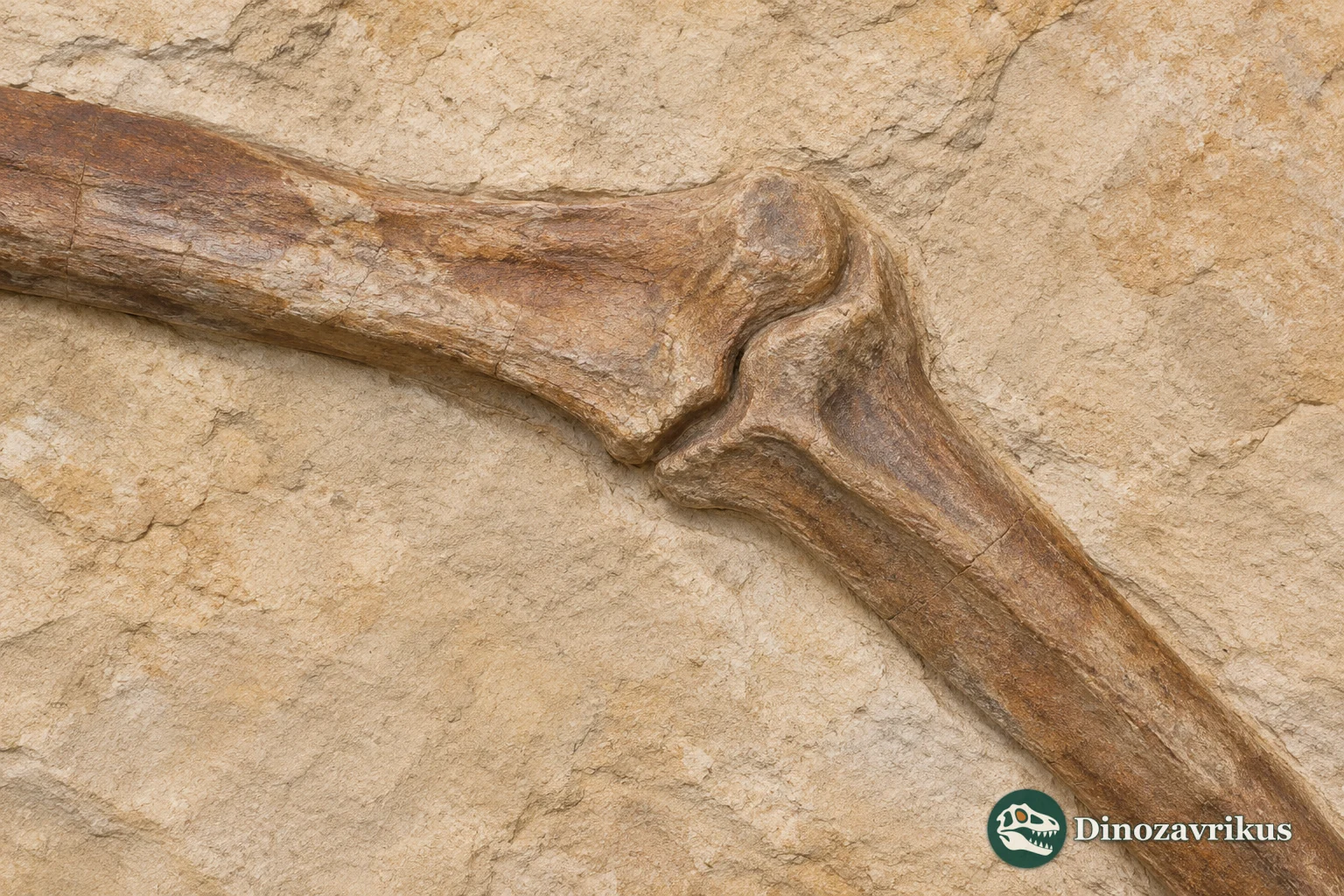
The holotype MGUAN-PA650 includes the distal half of a left humerus found attached to an ulna. The paratype MGUAN-PA661 has an associated left ulna and radius from a different individual. Other isolated bones from Bentiaba document more pterosaurs, but they cannot all be assigned to Epapatelo. The anatomical image below represents the kind of material, not the actual fossil pair.
What the wing joints and proportions say
The preserved distal humerus has a broad expansion and distinctive projections. Joint surfaces on the ulna add further diagnostic characters. A phylogenetic analysis using both named specimens placed Epapatelo within Pteranodontia and close to Alcione and Simurghia in the proposed Aponyctosauria group. These relationships are hypotheses from a character matrix, while the bone shapes themselves can be observed directly.
The type ulna was measured at 290.1 mm. The authors estimated missing humerus, metacarpal and finger-bone lengths by comparison, arriving at just over 2.4 m for one wing and roughly 4.8 m across both. Those values carry model uncertainty. Preliminary bone histology suggested that one studied specimen was probably not fully mature. Pteranodon is a useful broader comparison, but its skull and crest cannot be copied onto Epapatelo.
Marine burial and its limits
The upper Mocuio beds near Bentiaba are early Maastrichtian, approximately 71.64–71.40 million years old. The bones accumulated on a shallow marine shelf near a coastline. Other fossils at the locality show signs of damage and possible scavenging, but those observations do not establish how the two named Epapatelo individuals died.
A marine fossil site shows where the bones were buried. It does not prove the animal always flew offshore or identify its food. No skull, teeth or stomach contents of Epapatelo are known. The second illustration evokes the ancient coast while keeping its exact shoreline, colours and flight behaviour within artistic interpretation.

Frequently asked questions
Is an Epapatelo skull known?
No. The type and paratype preserve wing bones only. Beak shape, a possible crest and teeth are not documented for the species.
Was its 4.8 m wingspan measured directly?
No. The measured 290.1 mm ulna anchors an estimate that extrapolates several missing wing elements.
Are the type and paratype one skeleton?
No. MGUAN-PA650 and MGUAN-PA661 represent separate individuals with different articulated wing elements.
Why is a coastal environment proposed?
The named fossils were buried in shallow-marine deposits of the Mocuio Formation near Bentiaba. That context does not directly reveal feeding behaviour.