

Eremopezus was a large ground-dwelling bird from Egypt’s Fayum region. Its leg bones belong to an ancient landscape of river channels and swampy vegetation, very different from the dry country seen there today. Its relationships remain unresolved: a large terrestrial bird is not necessarily an ostrich relative.
Quick facts
| Locality | Fayum, Egypt |
|---|---|
| Formation | Jebel Qatrani |
| Age | Late Eocene or Early Oligocene |
| Known remains | Hindlimb bones |
| Species named | Charles Andrews, 1904 |
What can the fossils tell us?
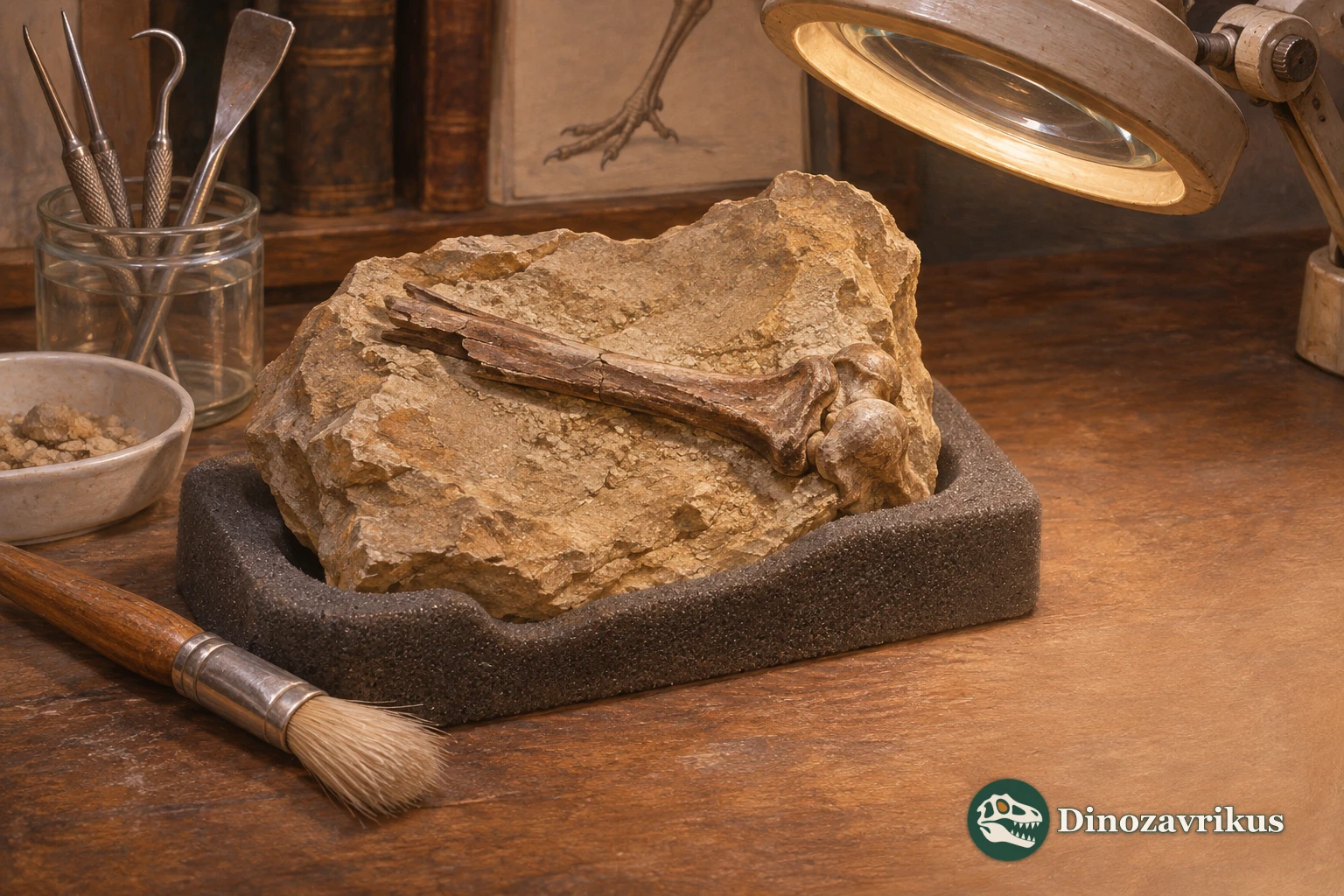
The holotype is the lower end of a left tibiotarsus. It preserves neither the head nor feathers.
More complete material allowed the foot joints to be compared and suggested an ability to grasp or manipulate with the toes.
The Late Eocene attribution used in 2001 should be read alongside the Early Oligocene interpretation adopted in a 2020 stratigraphic synthesis.
From a fragment to a more informative foot
Charles William Andrews named Eremopezus eocaenus in 1904. The holotype, BM(NH) A843, is the distal, or lower, end of a left tibiotarsus, the main bone of a bird’s lower leg. It came from the lower Jebel Qatrani Formation north of Birket Qarun and is held by the Natural History Museum in London.
In 2001, D. Tab Rasmussen and colleagues described material from locality L-41: two distal tarsometatarsi, together with an associated complete tarsometatarsus and distal tibiotarsus. The tarsometatarsus links the lower leg to the toes, making its joint surfaces particularly informative about the foot. These finds do not constitute a complete skeleton.
Why it cannot simply be called an ancient ostrich
The leg was relatively long and slender. Its lateral toes were not strongly reduced, and the joints differed from those of specialised running birds. The researchers inferred a greater capacity to grasp or manipulate with the toes. Exactly what the bird might have held remains unknown.
Earlier comparisons with large ratites were not supported by compelling evidence from the new bones. Neither ostriches, elephant birds nor Gastornis provide a secure close relative. Large size and flightlessness may have developed independently in this African lineage. Flightlessness is itself an inference from the hindlimb material and size; a reduced wing has not been discovered.
Another Fayum leg fragment received the name Stromeria fajumensis in 1929. It was subsequently treated as a junior synonym of Eremopezus, illustrating how isolated parts of a similar bird can initially be assigned separate names.
Why the geological age needs qualification
The 2001 account described L-41 as Upper Eocene. Its position relative to the Eocene–Oligocene boundary, however, depends on how the local rock sequence is correlated with other records. In a 2020 synthesis of African land mammal ages, John Van Couvering and Eric Delson favoured an Early Oligocene interpretation while acknowledging that further investigation was needed.
An interval around the transition between these epochs is therefore more defensible than a precise date presented as settled. River deposits and the associated fauna support a freshwater setting with abundant vegetation. The desert association in the name Eremopezus should not be mistaken for a description of its living habitat.
Frequently asked questions
How large was Eremopezus?
It has been compared in size with a rhea. That is an approximate comparison of bones, not a securely measured height or body mass for a complete bird.
Can its bill be reconstructed?
No securely identified skull is available. Giving the bird a particular bill would be conjectural, so the illustrations show an environment and an imagined research scene instead.
What did it eat?
There is no direct dietary evidence. The unusual foot allows hypotheses about toe use, but does not identify particular food items.
Why do sources give different geological epochs?
Researchers have correlated the Fayum rock sequence with the geological timescale in different ways. Both Late Eocene and Early Oligocene interpretations have been discussed for L-41.