

Eudinoceras was a genus of extinct pantodont mammals known from Eocene deposits in Asia. Its history was built largely from teeth: in 1924 Henry Fairfield Osborn named the genus from two isolated upper premolars collected in Mongolia. Later collections and revised stratigraphy in the Erlian Basin changed both the number of recognised species and the age assigned to some material.
The genus belongs in the ancient mammal catalogue. It is compared with Coryphodon and other coryphodontids: these are related pantodonts, not successive stages of one species.
Quick facts
| Scientific name | Eudinoceras Osborn, 1924 |
|---|---|
| Group | Pantodonta, family Coryphodontidae |
| Time | Eocene Asia; the exact interval depends on species and horizon |
| Region | Mongolia and China, including the Erlian Basin |
| Type species | Eudinoceras mongoliensis Osborn, 1924 |
| Type material | Two isolated upper fourth premolars from the Irdin Manha Formation |
| Recognised species | Six in Mao and Wang’s 2012 revision |
| Size | No dependable body-length or mass estimate is established from the original type material |
How did teeth change the picture of Eudinoceras?
Osborn named Eudinoceras mongoliensis from two isolated upper fourth premolars from the Irdin Manha Formation. These teeth established a distinctive form but did not show a complete skull or skeleton.
Mao and Wang compared new Erlian Basin material and treated several previously named forms as synonyms of E. mongoliensis, while transferring E. xintaiensis into the genus. Their revision recognises six species, although older literature contains more names.
Upper premolar form and the lophodont pattern of molars help diagnose coryphodontids. They allow comparison among fossil layers but do not provide a calendar age without independent stratigraphic control.
Osborn’s 1924 paper called Eudinoceras Upper Eocene. For E. mongoliensis in the revised Erlian Basin framework, Mao and Wang placed the material in the middle part of the Early Eocene, about 53–49 million years ago. Species and horizons cannot all be assigned one interval.
Two teeth and a changing classification
Osborn described Eudinoceras mongoliensis in 1924 under the title “Upper Eocene Amblypod of Mongolia”. The name was based on two separate upper fourth premolars found by Roy Chapman Andrews’s expedition in the Irdin Manha Formation. At the time, the animal’s broader affinities were uncertain, and Osborn compared it with large North American dinocerates.
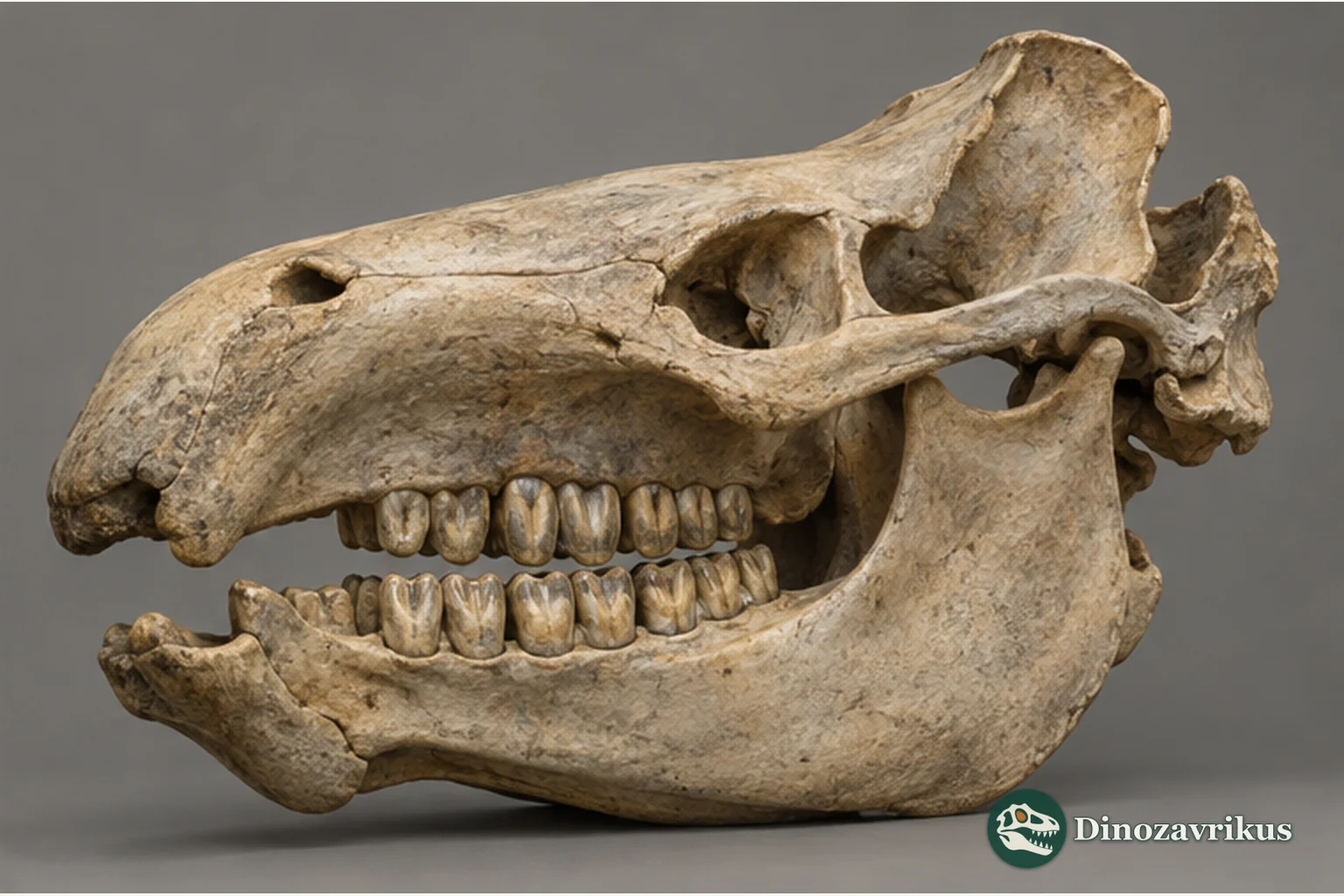
Later American Museum of Natural History expeditions recovered additional skull and jaw material. In 1931 Osborn and Walter Granger described, among other material, E. kholobolchiensis. The more complete fossils showed that Eudinoceras belonged to Coryphodontidae and was related to Coryphodon, while differing in its teeth. The “Upper Eocene” age associated with Irdin Manha in early publications is a historical interpretation, not a date to apply automatically to every Asian specimen.
Species and synonymy
In 2012 Fang-Yuan Mao and Yuan-Qing Wang examined better-preserved coryphodontid fossils from the Erlian Basin. Comparing size and dental characters, they concluded that E. kholobolchiensis, E. obailiensis, Metacoryphodon luminis and M.? minor did not differ enough from E. mongoliensis to remain separate species. They treated these names as junior subjective synonyms of E. mongoliensis.
The same revision transferred Metacoryphodon xintaiensis to Eudinoceras as E. xintaiensis and rejected Metacoryphodon as an invalid genus name. Its resulting list contains six species: E. zhichengensis, E. youngi, E. xintaiensis, E. mongoliensis, E. crassum and E. sishuiensis. This is the conclusion of a particular systematic revision; older publications may retain combinations that have since changed.
Teeth and feeding
Coryphodontids are diagnosed in part by the structure of their upper premolars and molars. The Eudinoceras revision compared ridge angles, development of the front and rear parts of the crowns, degree of lophodonty and tooth proportions. Mao and Wang noted that individual variation and sexual dimorphism among coryphodontids can make one species look like several. A tooth should therefore not be classified by size alone, without considering its shape and position in the tooth row.
Pantodonts were herbivorous mammals, and broad ridged teeth are consistent with processing plant material. No stomach contents or other unambiguous direct food evidence is known for Eudinoceras. Plants from the same deposits help describe the surroundings but do not show which leaves, shoots or aquatic plants an individual ate.
Age and geological context
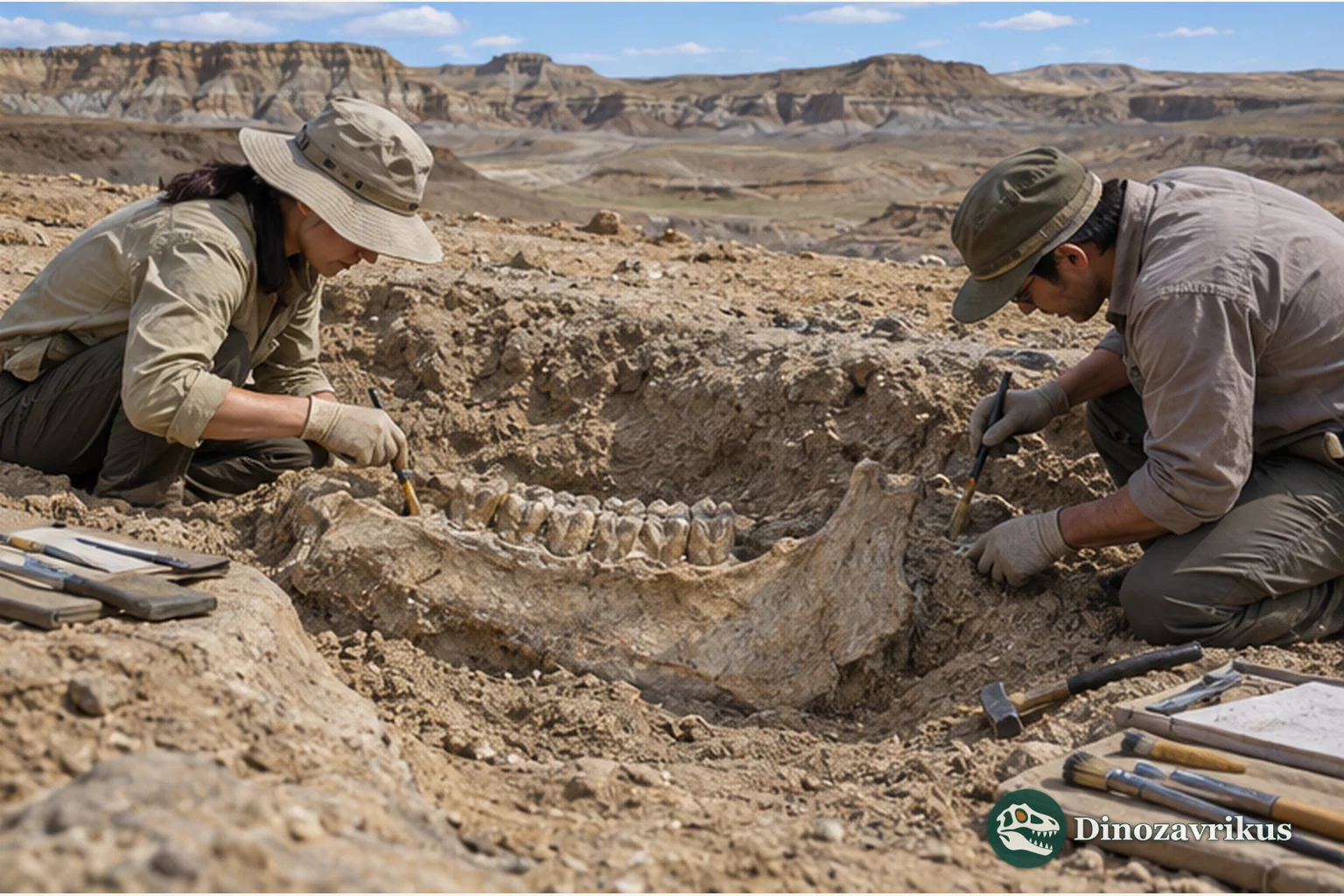
Osborn’s 1924 title established an Upper Eocene interpretation. Geological correlations of Asian deposits have since changed. For E. mongoliensis from the Erlian Basin, Mao and Wang placed occurrences within the Arshanto Formation and reported a middle Early Eocene age of about 53–49 million years. This does not date every record of the genus, including fossils from other formations and regions, to that same interval.
The revision demonstrates why stratigraphy matters alongside dental taxonomy. If separate beds are correlated incorrectly, fossils can appear contemporaneous when they are not, or more widely separated than they really are. Eudinoceras is useful for biostratigraphic comparison only where the specimens are tied to a reliable sequence of rocks.
What is known about the animal’s body
The genus is most thoroughly documented by teeth, jaws and skulls, and the amount of material differs among localities. Coryphodontids include robust-bodied mammals, but the average size of another genus cannot simply be assigned to Eudinoceras. Two isolated premolars cannot yield a reliable total length or body mass, and the revisions considered here do not establish a species-level estimate that can be extended to the whole genus.
Direct evidence for injuries, reproduction, social groups and precise gait is limited. Strong teeth indicate chewing, but do not by themselves reveal a detailed behaviour. Any reconstruction beyond the preserved bones is a comparative inference or an artistic choice.
Frequently asked questions
When did Eudinoceras live?
The genus is known from Eocene deposits in Asia. Mao and Wang reported about 53–49 million years for E. mongoliensis in the Arshanto Formation; that interval should not automatically be extended to every species and locality.
Why did an old paper call Eudinoceras Upper Eocene?
That was Osborn’s 1924 geological interpretation. Stratigraphic frameworks and correlations of some Asian formations were later revised, so the old title is not the modern age for every specimen.
How many species are recognised?
The 2012 revision recognises six species. Several earlier names were treated as synonyms of E. mongoliensis, and one species was transferred from Metacoryphodon to Eudinoceras.
What does the name Eudinoceras mean for its classification?
The genus was named when its affinities were still uncertain and it was compared with dinocerates. Later skull and tooth fossils placed it among coryphodontid pantodonts rather than North American dinocerates.